Native Intelligence
 
Archive by Month

« June 2009 | Home | August 2009 »

July 31, 2009

LA Times cowboys up but loses rodeo in bizarre horse editorial

Will this era see the end of our great partner and icon, the mustang (not to mention the great road trip car named in its honor)? Given the misleading media coverage, the real thing may soon be heading off a cliff, spurred one step closer in the July 27th Los Angeles Times editorial called "Wild Horse Sense." A long and well-placed piece fueled by gov, beef biz, and hunting lobby talking points, the editorial seeks to take down an important new bill which cleared the House by a wide margin but hasn't even been introduced in the Senate.

When it comes to the wild things, the Times generally gets it. As I see it, our disconnect to wilderness is at the core of our problems, and it matters that a major newspaper understands that we are losing pieces of the natural world every day. But in this case, something is deeply amiss. For the Times to go after legislation that has not reached critical mass with so much ferocity is puzzling - and makes me wonder exactly why and how the decision to run this piece was made. As we shall see in a moment, it certainly was not by following its own editorial mission.

Quick backstory: wild horses are indigenous to this country, linked by mitochondrial DNA to the horses of the Ice Age. They died out during the Pleistocene era, were reintroduced by conquistadors, and flourished on the American range. They were pressed into service to blaze our trails, fight our wars, carry our mail, serve as transportation. By the end of the 19th Century, there were two million mustangs. Many of them were again sent off to war, culled for chicken feed or pet food, moved off by cattlemen, or massacred. By the middle of the 20th Century, they were on their way out, reduced to perhaps 60 or 70,000. To this day, many ranchers see them as pests that steal food from livestock, and often refer to them as "feral" or "weeds," not unlike the Times editorial, which ignores the very language of the law that protects them - and also fails to understand the frailty of its own argument: if everything that's feral were removed from the land, all of us except Native Americans should leave.

But the fact is this: wild horses are called wild by the law, which is the Free Roaming Wild Horse and Burro Act, signed by Richard Nixon in 1971, primarily assigning wild horse protection to the Bureau of Land Management, which is tasked with carrying out annual round-ups in designated "Herd Management Areas" provided that proper population and range impact studies were conducted regularly. For a variety of reasons, they aren't - a fact that the Times editorial does not mention.

For decades, various constituencies have tried to take down the law. In recent years, they nearly have and wild horse populations are under siege across the West. In fact, contrary to the editorial's assertion that there is an "overpopulation" on the land, their numbers are dwindling. Where there is an overpopulation however is in government corrals, now crowded with at least 30,000 wild horses - more than are on the range. Many of these horses are awaiting adoption through the BLM's adopt-a-horse program, but there are far too many horses for too few adopters, and to alleviate a problem which the government itself created, the BLM recently raised the idea of euthanasia.

As if the corrals weren't crowded enough, the government periodically wages "emergency gathers" during a time of drought, stating that it would be "cruel" to let horses die of thirst - a response that the Times agrees with in its attempt to take down the ROAM Act, which seeks to broaden protections for wild horses. Curiously, no other wild animals are ever removed from the range during a time of drought, and when given a drink of water, the "rescued" mustangs are not returned. The real problem is the fencing off of water sources inside herd areas - a situation which needs serious investigation, again something not mentioned in the Times editorial.

But perhaps the most misleading aspect of the Times piece is its reduction of the debate over mustangs to one between "horse advocates" and various other groups. A wide range of citizens are in favor of the ROAM Act. They come to my book talks around the country and they are Republicans, Democrats, mustangers who regret their role in the decimation of our herds, Native Americans, rodeo heroes, you name the persuasion - they're at my gigs. They understand what's at stake if we lose our great partner and they do not have a problem with using their tax dollars in this regard - contrary to the expense canard rolled out in the Times editorial.

As the 1971 law states, "wild free-roaming horses and burros are living symbols of the historic and pioneer spirit of the West; ...they are to be considered in the area where presently found, as an integral part of the natural system of the public lands." It's a statement not unlike the Times own editorial mission: "Freedom is our core value...an abiding commitment to preserve the nation's natural treasures is also in keeping with our western roots." In both cases, the word "natural" is key.

So as we hit the road this summer, perhaps in our Mustangs, let's remember that the real thing is out there being wild and free for the rest of us. But not for much longer if the media keeps repeating what the guy in the cowboy hat tells them.** You all know that guy, the one who keeps leading us into war. This time, it's against the wild horse - now making its last stand in remote pockets of the vanishing West, as civilization closes in, intent on wiping out the animal that has carried us through our shame and our glory.

*Full disclosure: In response to the Times editorial, I wrote a shorter version of this piece for the Times Blowback section, after contacting editors there. A piece from the Humane Society was also in the works, and it decided to publish that one instead.

**Don't get me wrong; I love cowboys - like Shane, and I've met some who are like that in real life. Alas, they are not in charge of things.

July 30, 2009

Odom returns to the Lakers

It's a really busy day in the LA sports world, and it only got busier today with Lamar Odom re-signing with the Lakers. I have no idea what took so long, but I'm glad that it all worked out in the end.

Some Laker fans have been saying that the team doesn't need Lamar Odom, but I disagree. While Odom's inconsistency can be maddening on some nights, he creates mismatches on the floor, and he's another big body to rebound. If Andrew Bynum is 100% healthy, doesn't get injured again, and plays his absolute best every night of the season, then the Lakers are fine without Odom. But we still don't know what Bynum will wind up becoming, so Odom's presence on the floor is almost required if the Lakers are to remain a championship team.

I have a firm belief that the Lakers need 3 superstar-level performances on a given night to beat elite NBA teams. They will get one from Kobe Bryant and Pau Gasol almost every game. During the playoffs, Trevor Ariza or Lamar Odom would provide that necessary third performance with Derek Fisher of course saving the day in Game 4 of the Finals.

Ron Artest is a considerable upgrade over Ariza, and he can provide that third offensive superstar performance that the Lakers need. But his impact will mostly be felt on the defensive end of the floor, so it will help to have Odom out there as well.

I'm sure Odom is disappointed that he's making less than $10 million a year. I can also understand his disappointment in not starting, even though he'll be on the floor late in games. But I think Odom recognized that LA provided the best situation for him, both from a financial standpoint (because of the salary cap) and a basketball standpoint (the opportunity to win more titles).

I know Laker fans were worried throughout the process, but overall I think this was well-played by the Lakers organization. Fans like to say that Jerry Buss "should just spend the money", but it's more complicated than that. Last year the Lakers had a payroll in the high-$70 million range and had to pay some luxury tax. This year, with Odom now signed, I believe the Lakers payroll will check in around the low-$90 million range.

With a dollar-for-dollar tax on payroll above the estimated $70 million threshold, the Lakers will actually be spending over $110 million on player personnel in 2009-10. That's an increase of roughly $25 million in costs from last year to this year. It's hard for any team to add $25 million in costs in this economy, and the Lakers are no exception. One has to wonder how the Lakers will afford those increased costs. The team already sells out every game, and they did not raise ticket prices this past year. It remains to be seen if the team will raise prices this year. This is a particularly difficult time for sponsors in all of sports, and I would be surprised if the Lakers sponsorship revenue went up dramatically. The Lakers still receive some revenue sharing money from merchandising and the league-wide TV deal, but that won't change much. The team has a new radio deal with 710 ESPN, so that will provide some extra revenue, but radio contracts are not usually huge. The team also gets extra revenue from hosting postseason games, but going deep into the playoffs is almost an annual expectation in Lakerland.

So while I've never seen the Lakers balance sheet, my guess is that the organization and Jerry Buss will take something of a financial hit this season in order to give the team it's best possible chance of winning a title. When fans say that Jerry Buss is one of the best owners in all of sports, it's decisions like this that explain why. The Lakers had to play some hardball in their negotiations with Odom, but ultimately knew they had leverage, and now will be the odds-on favorite to repeat.

While the Celtics added Rasheed Wallace, the Spurs traded for Richard Jefferson, the Cavs acquired Shaq, and the Magic got Vince Carter, I think the Lakers are still the best team in the NBA having improved by effectively swapping Ariza for Artest and returning everyone else. I see the Lakers and Portland being the two best teams in the Western Conference next season, and my money would be on the Celtics outlasting the Cavs in the East. So my early prediction is Lakers over Celtics in the 2010 NBA Finals.

Dodgers reportedly trade for Sherrill

According to MLB.com, the Dodgers have traded for Baltimore Orioles closer George Sherrill. The team reportedly gave up minor leaguers Josh Bell and Steve Johnson, and they will use Sherrill in a setup role.

I have lukewarm feelings about this deal, and I like the analysis from Jon Weisman's LA Times blog, which is linked above. George Sherrill undoubtedly makes the Dodger bullpen better. He gives the team a needed left-handed arm, and he's a considerable upgrade over someone like Brent Leach. I'll go as far to say that I feel slightly more comfortable with him in the 8th inning than Ramon Troncoso. So I do feel like the Dodgers are a better today than yesterday.

That being said, Sherrill is a pitcher with a mixed track record.

He has had weight problems throughout his career and has historically worn down in the second half. His career ERA is 2 runs higher after the All-Star Break than before it.

He really collapsed in the second half of last season for Baltimore and got off to a terrible start this year. Sherrill lost his closer job early in the year, only to get it back and pitch extremely well. His ERA went from 5.87 all the way down to 1.99, before creeping up to 2.45 recently, and he has an impressive 39 strikeouts in 41.1 innings with a 1.14 WHIP. He has a rather unique delivery that makes it difficult for batters to hit his slider.

I really cannot say too much about the prospects the Dodgers gave up in Bell and Johnson. I've never seen either play, but both are having good seasons. Bell has sometimes been at the bottom of top-10 Dodger prospect listings I've never seen Johnson on the list. Usually teams know their own system best, but you never know if an Orioles scout saw something he really liked in either player.

I do wonder though if the Dodgers could have given up slightly less to acquire John Grabow from Pittsburgh, who I think could have been just as effective down the stretch. Grabow may not have the "closer" designation, and his name might not be as sexy as Sherrill's, but he's a lefty setup man who can get guys out. I'd also like to see Scott Elbert get more of an opportunity (maybe even get to start). Ronald Belisario, who has been very good this year, will return from the DL soon too.

I know a lot of Dodger fans want Roy Halladay (and heck, I do too), but it appears that the Blue Jays asking price is too high to get a deal done with any team, let alone the Dodgers.

Overall, I think the Sherrill deal marginally helps the Dodgers, and the price seems appropriate. I do question though if acquiring him was the best option they had available.

Manny tested positive in 2003

The New York Times reports today that Manny Ramirez and David Ortiz tested positive for performance enhancing substances in 2003. Their names were on the now famous list of positive tests from 2003; a list that was supposed to be destroyed.

What does this mean for the Dodgers? Well, honestly, not much. I think that most fans have developed steroid fatigue and have long accepted that most of the accomplishments of the past 10-15 years were tainted in some way. Fans have also shown they still love the game, and baseball attendance and TV ratings remain strong. Manny Ramirez has shown remarkable resilience after his first positive test, and he continues to be a popular figure here. This is not a surprise to people, and I don't think LA fans views on Manny will change.

That being said, this news does do two things.

First, there were some who tried to frame Ramirez's first positive test as a "one-time mistake." Now that assertion looks silly and some may have the impression that Manny is a habitual steroid user. Secondly, if Ramirez's Hall of Fame hopes were on ice before, then, well that ice has melted.

I've long said that MLB should establish a commission to review the "steroid era" and provide clear recommendations to the Hall of Fame. But short of that, it appears the current crop of baseball writers are determined to vote "no" on anyone who has even the slightest steroid suspicion. This will further dampen the Hall hopes for guys who have not been publicly linked, such as Jeff Bagwell or Jim Thome, because the entire era is tainted. My guess is that the vast majority of players who earned their great success in the past 15 years will not make it. Greg Maddux could be one of the only exceptions.

This news will also lead to continued banter between Yankee and Red Sox fans about the legitimacy of the 2004 and 2007 World Series titles, but we live in LA, and I don't really care for either team.

July 29, 2009

Cirque Berzerk and the simplicity of spectacle

IMG_2395_small.jpg

There is something gaspingly lovely about seeing a girl in a striped panty being swung through the air at the end of a piece of fluttering silk. That lust for loveliness is what animates Cirque Berzerk, currently doing an extended run at the Los Angeles Historical State Park (aka 'The Cornfield") downtown. It is a show rich in symbolism, humor, and also pays noisy heed to a Weimar/Goth/Cabaret ethos. That stylization makes it both visually arresting, and also, at times, a tad predictable. It's Big-Top-Cabaret-meets-Crazy-Girls-via-Burning Man. But you know what? I'm just a sucker for that stuff.

I got my tickets for the show over a month ago, but after reading Reed Johnson's wonderful piece in the Times, I realized why I had to see it: I am hopelessly addicted to non-traditional theater, to spectacle, to the sweet, high note of visual affect and the romance and wide-open possibility of the stage.

In his piece Johnson traces the blossoming of alternative theater in Los Angeles, citing Highways Performance Space as its birthplace in 1988. I moved to Los Angeles in the fall of 1988, flush with the excitement of having worked with the nascent Blue Man Group in New York. I had met two of the three Blue Men at a catering gig. They tossed goat cheese across the length of the service area, catching it in their mouths, and thus an act was born. That night on the bus ride back into the city, Chris Wink dabbed blue paint on my face and explained the concept to me. I can't say I understood it completely at the time, but what I did understand was his excitement. I watched them develop "bits" over time for their show "Tubes," lending my voice for a bit about fractals, helping them mount their early show at La Mama. Johnson points out that Blue Man now headlines a flashy show in Vegas. With success came added production extravagance. But they didn't need it. What made Blue Man Group magical was the cheese-tossing, the hilarity of a Twinkie being opened with a circulating saw, the innocence and wonder of these strange fellows experiencing our even more strange, everyday world for the first time. Often, while developing bits I would hear Chris say, "I'm not sure what this means, but let's do it just because it looks so cool." It was that sense of play that made their shows such fun for so many.

I came to Los Angeles in 1988 an out-of-work actress looking for art and community.

I read something about Highways in the LA Weekly and headed over there one day. I knocked on a random door at the 18th Street Arts complex in Santa Monica and was welcomed into that newly-hatched community by Jill Burnham, daughter of Linda Burnham, co-founder of Highways. I immersed myself in their world, writing and performing my own pieces, and offering myself up for roles in other artists' works.

In 1989 a young, female, investment banker jogging in Central Park was "Wilded" and left for dead. Keith Antar Mason recruited me to play the victim in his piece "Prometheus Against a Black Landscape: The Core." It was a rigorous, exhausting piece that explored that terrible moment of violence, and I allowed myself to be theatrically savaged by a group of men before a horrified audience. What I remember most vividly about that piece however, was not the violence, but a moment when a beautiful young man came out on stage in full Billie Holliday drag and sang "Strange Fruit" acapella. It was simple, haunting and heartbreaking -- communicating the entire essence of Antar-Mason's feeling about the Central Park tragedy: that racial violence is reciprocated across eras, its half-life incalculable.

There were other acts of beauty and daring I witnessed at Highways: the giddy, brilliant John Fleck, nude but for an open, flowing robe, his penis tucked between his legs, singing a mad, fevered operetta. Less lovely, but even more daring was Karen Finley notoriously smearing her body with chocolate and bean sprouts. I peered through a speculum at Annie Sprinkle's cervix and watched Tim Miller lay claim to his queer identity in a half dozen pieces that used only his body and his words to convey the full tumult of being gay in AIDS-ravaged, homophobic America. This was not voyeurism; these were people identifying themselves at a time when non-traditional voices had little outlet in the mainstream theater world. All of it was done with minimal overhead. I myself performed a piece with nothing but two chairs I had painted red, another with a cardboard box.

Los Angeles has offered many other moments of artful transcendence. It was through UCLA Live at the Freud Theater that I saw Robert Le Page's masterful piece "The Dark Side of the Moon," a piece so simple and magical that it made me convulse with tears. I will never forget the final image of the show: An astronaut floating in space. The effect was rendered by the actor gyrating on a black floor, reflected in a wall of mirrors behind him, making it look as though he were truly in orbit. More recently, "Aurelia's Oratorio," also at the Freud, delighted with its magical, childish charm, using dresser drawers and pieces of fabric to create extraordinary illusion and illustrate bold notions about imagination and innocence and the limitless power of those two qualities working in conjunction.

The hallmark of all these shows is their almost homespun simplicity. Today's LA Times reports an LA City Council has issued a 30-million loan to the owner of the Kodak Theater so it can be retrofitted to accommodate an extravagant Cirque du Soleil production. I am a hardcore, trapeze-studying circus freak, and will no doubt make my way to that show when it opens in 2011, but you know what? We don't really need it.

Cirque Berzerk does everything Cirque du Soleil does, but on a shoestring. There are many reasons to go see Cirque Berzerk: the party atmosphere that surrounds the tent, complete with beer and vintage pinball machines rigged for free play, the giddy spectacle of "Burners" in their glad rags, dancing to a techno-beat at the show's halftime, the enormous flame-thrower that spews hot, explosive light into the night air, signaling the end of intermission.

But in the end it is the satisfaction of pure spectacle as made by human hands and unfettered imagination that makes Cirque Berzerk so brilliant. In one act a group of brothers fall off the top of a high wall and only to bounce and somersault off trampolines and return to the precipice unharmed. Or two men, so taken by their forbidden love for each other that they are literally yanked off their feet and high into the air to do a suspended dance of love. For me, the high point was an acrobatic duet between a drowned sailor and his ladylove. It was the ageless drama of a man and a woman in love, played out with nothing but their bodies. He was huge and muscle-bound; she was a tiny sylph, clothed in a seaweed-like leotard. He brought all his strength to bear on her supple body and she climbed his dizzy heights with passionate abandon. At one point they lay down on the floor together, chest-to-chest, and he lifted her up and horizontally forward. She hung for a moment, stretching her arm in front of her, embracing the air, becoming the figurehead of his downed ship. No rigging, no special effects. Just the artful answering of the soul's call for sheer, heart-stopping, tangible beauty.

IMG_2816_small.jpg
Cirque Berzerk closes August 9th. Tickets: (866)55-TICKETS

July 28, 2009

LACMA abandons film

The moving image is THE art form of the 20th century. If there is one person you would expect to appreciate that fact it is the head of the Los Angeles County Museum of Art - after all Los Angeles has been creating that art for over 100 years and has called itself the international center of filmmaking since at least 1920, the year that city fathers announced that movie making and the ancillary jobs that resulted from it was the city's largest employer. The people who come from throughout the world to put their feet in the cement outside Grauman's Chinese and tour the studios recognize that, and yet as I write this Michael Govan is announcing that he is closing the LACMA film department.

There are those who will say other venues will "pick up the slack," but they are wrong. While we are blessed in Los Angeles with having the Academy, the Cinematheque and now the Billy Wilder theater at the Hammer, LACMA is unique - where else could you see "The Manchurian Candidate" with Angela Landsbury and John Frankenheimer, the 6 hour Russian version of "War and Peace" or "Good Night and Good Luck" introduced by George Clooney? Then there are the career retrospectives, bringing to fore talents such as Gregory LaCava, Fritz Lang and Joel McCrea, showing their films on the glorious big screen, often for the first time in fifty or more years.

There have been fabulous, emotional in-person tributes to Robert Altman, Olivia De Havilland, Jules Dassin and Blake Edwards. And then there are the ripple effects that no one would necessarily even know about. I helped work on a tribute to the Kanin family - Michael, Fay and Garson - and it was discovered that there was no loaning copy available of Fay Kanin's Oscar-nominated "Teacher's Pet." Calling that to Paramount's attention, they - at Sherry Lansing's urging - put time and money into preserving it and making a copy to be screened. One more film saved.

Ian Birnie has, over the past thirteen years, proven to be a master curator of films. Just this summer, his tribute to Norman Jewison was sold out weeks in advance - and that was before it was known that Cher would be there in person to introduce the filmmaker and the screening of "Moonstruck." Tonight, the screening of "Julie and Julia" is expecting overflow crowds. But more importantly, quietly and methodically, Birnie has given us a chance see the films, foreign and home grown, current and historic, that we couldn't see anywhere else. He could be faulted for failing to schmooze funders, but he has earned the respect of film lovers, archivists and studios on an international scale. What he has pulled off on such a small budget should be celebrated, not punished. I don't know him that well, but I have worked with him on several retrospectives and he has always been incredibly professional while revealing himself to be a veritable fountain of information and knowledge on films past and present.

Rumors have been flying for the past week or so about Govan's plans. He didn't mention the film department per se in the article in last week's Times about the financial drain they were facing, but he did say they have a new "associate director of Korean art" and that he was still searching for a curator of Chinese Art. Room and money for those and others - and of course building more buildings - but not for film? Yet when it comes to fund raising, they are more than willing to reach out to the film-making community.

While I am confident that if each curator's department budget was scrutinized for profit, most would find it difficult to justify their existence for that purpose alone. The Film Department - which is much easier to quantify because it has a separate box office - lost a little over $50,000 last year, yet Govan has apparently reached back and rounded off numbers to claim that they have lost a million dollars over the last decade.

He can say audiences have "dwindled" but attendance hasn't been helped by the fact that the museum has been treating the film department as a second class citizen for some time. I became a LACMA member because of the films there, yet you arrive a little after 7 for a 7:30 screening and find the members' window closing and the number of windows reduced from four to one. The stand alone calendar which promoted the films to be shown was killed off some time ago. Good luck finding the film listings inside the convoluted general "Content" brochure they now send out. And there are few if any film books in their store.

Although Birnie has done an amazing job finding appropriate films, I cannot believe attendance has been helped when weekends on end are booked with films that promote exhibits at the museum. And surely we don't want them to screen "Sunset Boulevard" or "Casablanca" every Saturday night. Part of the joy of LACMA films is the gems that you would see nowhere else. Yet the message from on high is loud and clear: Films are not considered "art" at LACMA.

Behind the scenes Govan seems to have different explanations for different people. He told the press it was financial, but then alluded to others that closing the department was only a ruse to get people to pay attention - that by shutting it down maybe something better can bloom. Is he being too clever by half or does he actually believe it? Does he not realize how fortunate he is to have Ian Birnie at the helm? Govan wanted to embargo the story until he was out of town, but apparently, to the Times credit, they wouldn't bite. He supposedly prides himself on being willing to take any heat, but would he change his mind if a certain director or producer wrote a $500,000 check to guarantee the film department's existence for the next five years? At that amount, the film department might even get a budget increase out of it.

Back in the early 1930's Iris Barry of MOMA was just putting together their film collection and she was a voice in the wilderness. She came to California and personally convinced Mary Pickford not to destroy her films as she had been telling friends she wanted to do - they were works of art to be preserved for generations to come. Barry convinced Pickford, yet we know today that around 80 percent of all silent films are "lost" - a euphemism for scrapping them for a penny a foot at the time, dumping them off piers into the ocean to make room in vaults or simply ignoring them to the point that the film destroyed itself. Since Barry's seminal efforts, appreciation of film and film preservation has been on a growing curve of being recognized as the true art that it is. Govan, with his actions today, has announced his belief that film isn't worthy of having one of its own curators out of the dozen or more that are currently employed at LACMA. To me, as a film historian and more importantly as a film going LACMA member, that is blasphemy.

July 27, 2009

More on Halladay

It seems as if everything I'm reading and hearing indicates that Roy Halladay won't be a Dodger. For now, it appears the Blue Jays asking price is so high that even the group of prospects I discussed in yesterday's post won't be enough to get a deal done.

Trading Billingsley or Kershaw would probably get a deal done, but as I wrote yesterday, both are too young, too good, too important to the future of the Dodgers, and losing either of them for a rental would not help the team's rotation depth. Trading them would also seemingly violate "The Dodger Way" of building from within, which should be important to some people.

It's not the end of the world if the Dodgers can't get Roy Halladay though, considering they enter today with the best ERA in Major League Baseball. They have a good enough team to compete in October.

Still, it's out of character for Ned Colletti to stand pat at the trade deadline, and I know he's going to be motivated to do something. I wouldn't be surprised to see him go after Cliff Lee. Colletti and Indians GM Mark Shapiro have a good working relationship, and I know that the Indians are thrilled to have Carlos Santana in their system after the Casey Blake trade last year.

Lee is not nearly as good as Halladay, but he's on par with Billingsley this year, and he would certainly help the Dodgers rotation. I'm not sure if the Indians are chomping at the bit to give up Lee though, so it might be tough to pry him away.

Another name that keeps coming up is George Sherrill. I should caution the Dodgers that just because a guy like Sherrill is a serviceable Major League closer, doesn't mean he's better than some middle relievers that could be acquired at a cheaper price.

Additionally, while some note the Dodger bullpen has been worked hard this year, they need to take a close look at the workload of relievers they could potentially trade for. I'm not as concerned about the Dodger bullpen as some others in the media. Their bullpen has been pretty darn good this year, and while they've worked a lot of innings, they've also had a lot of different guys pitch for them. The Dodgers have carried 13 pitchers most of the season, knowing that some starters don't go deep into games.

July 26, 2009

Dodger delusions

I am convinced that the Dodgers are the most misunderstood team in Major League Baseball. As it stands now, the Dodgers have the best record in baseball and an 8-game division lead, yet no one in the media can seem to tell you why.

This has become obvious as we approach the trade deadline, when all the local writers have stopped covering the Lakers, and they begin to notice the team up the 110 is really good. I like to call this baseball's silly season... a time when most members of the sports media prove they have little understanding of baseball's finances or economic structure.

These days, I read and hear media types say the Dodgers should trade their "prospects" to get Roy Halladay, because they just can't survive without him. The "prospects" I've heard suggested include Chad Billingsley, Matt Kemp, Andre Ethier, Russell Martin, Jonathan Broxton, James Loney, Clayton Kershaw, and several other good young Dodgers.

When is the media going to wake up and realize that these guys aren't prospects anymore? These guys are legitimate Major Leaguers, and they are a big reason why the Dodgers have the best record in baseball and are on course to make the playoffs for the third time in four years. Billingsley, Broxton, and Martin have all made All-Star teams, and Matt Kemp came very close this year. And I'm not talking about the Pacific Coast League All-Star Game... I'm talking about the Major League All-Star Game.

Most of these guys aren't "kids" anymore. They're mostly in their mid-20s, and just entering the prime of their careers. Ethier is already 27, Martin is 26, Broxton and Loney are 25, and Billingsley and Kemp are 24. Most teams would kill to have major leaguers at this age who have already proven themselves.

In today's Los Angeles Times, Bill Shaikin writes: "We say (the Dodgers) ought to swallow hard and consider trading Billingsley to the Toronto Blue Jays if needed to get the Halladay deal done."

First off, I'm not sure who "we" is? But secondly... trade Billinglsey? Are you nuts? Again, Chad Billingsley is already an All-Star. And in his 4th year of playing in the majors, he has never finished a season with an ERA over 4. Chad Billingsley is a big reason why the Dodgers have been successful this year, and his talent and proven track record indicate he'll have a successful future with the team as well.

Is Roy Halladay a better pitcher than Chad Billingsley? Yes. But the Dodgers need Billingsley (and his $435,000 salary this year) to grow as an organization, and giving him up for a one-and-a-half year rental of Roy Halladay is not smart management. To his credit, I don't think Dodgers GM Ned Colletti has even considered doing this deal.

Jon Weisman (who was a guest on my KSCR radio show yesterday) has an excellent blog post on the LA Times site, discussing some of the unwarranted bias against Billingsley.

It seems like every time I listen to local sports radio honks (and there aren't too many local guys left), I have to listen to an absurd discussion about how the Dodgers should consider trading Clayton Kershaw for Roy Halladay. I'm sure the Blue Jays would do that in a second. But Kershaw is only 21 years old and he already has a 2.95 ERA with an 8-5 record and one of the sickest curveballs I've ever seen. He has 110 strikeouts in 112.2 innings, and it seems very realistic that he'll become an ace pitcher sooner rather than later.

Yet, a few nights ago I was in my car listening to JT the Brick and Tomm Looney on 570 AM, and one of them said that "the Dodgers better trade Clayton Kershaw for Roy Halladay," effectively saying that the team needs to "show it wants to win." I think the Dodgers have already made their commitment to winning quite clear by investing heavily in scouting and a player development system that has produced numerous great young major leaguers who have helped lead the team to the best record in baseball.

Clayton Kershaw is exactly the type of player that championship organizations develop, because they can keep him for a long time, have considerable control over his salary, and have him grow with the franchise. In this economy, at a time when mutli-million dollar free agent pitcher acquisitions fail more often than they succeed, Clayton Kershaw is as valuable to the Dodgers as anyone in the organization. Again, to his credit, I don't think Colletti will give up Kershaw either.

I usually listen to JT and Looney for about 15 minutes before I change the channel in frustration. That silly comment wasn't quite enough to get my hand touch the dial. Then I heard one of them bash the Red Sox for not trying hard enough and say "The Red Sox should give up all of Pawtucket to get Roy Halladay."

The idea of challenging the Red Sox to get Roy Halladay is so idiotic that it barely merits a rebuttal. Yes, I'm sure the Red Sox would love to trade for Halladay. But why would the Blue Jays give Halladay to a team in the division, and effectively strengthen a squad that has helped keep Toronto out of the playoffs for the better part of this decade? It might very well take "all of Pawtucket" to get Halladay to Boston. But it's young players who came from Pawtucket that played a major role in the Red Sox winning the World Series in 2007... guys like Dustin Pedroia, Kevin Youkilis, Jacoby Ellsbury, Jon Lester, Jonathan Papelbon, etc.

The JT and Looney program is a pretty poor excuse for a radio show. Both guys seem consumed with anger, and they spout off of comments that are laced with factual errors and logical fallacies. Yet both pretend like they know everything. Saying a point really loudly does not make it true. And if you're someone who is paid a salary to follow and comment on sports, then passionately advocating the Dodgers to trade Clayton Kershaw means you're doing a bad job. 570 AM would be better off syndicating Tony Bruno's show at night. While he doesn't know everything, at least he admits what he does not know, and unlike JT and Looney, he's actually funny.

So the other day I'm listening to 710 AM, and I hear Andrew Siciliano ask several times: "If Clayton Kershaw is untouchable, then who is touchable?" Siciliano genuinely didn't know, and his partner Mychal Thompson couldn't answer the question, probably because the only thoughts in head were "Kobe, Kobe, Kobe, Kobe, Kobe..."

Now, I normally like Andrew Siciliano. He does a terrific job hosting the Red Zone Channel on Sundays for DirecTV. And when he fills in for Jim Rome or when he did his old show for Fox Sports Radio, he usually constructs well-thought arguments that I respect, even if I disagree with them. I was pleased to learn recently that he would have a regular local show on KSPN 710 (even though it is with Thompson).

But I think Siciliano asked the question because he doesn't really know who is good in the Dodgers farm system. In fact, I don't think anyone in the LA media really knows which Dodger prospects are good, and who the team could legitimately give up for Roy Halladay.

Again, this baffles me. It would seem to me that if your profession is to cover the Los Angeles sports world on a daily basis, then you should have at least a passing knowledge of the Dodgers top prospects. I don't expect local media types to be watching games in Albuquerque and Chattanooga. But I do expect smarter suggestions than Clayton Kershaw for Roy Halladay.

From a baseball standpoint, I do think that some package involving 2 or 3 of a group that includes James McDonald, Ethan Martin, Andrew Lambo, Ivan Dejesus, and Devaris Gordon would make some sense. My guess is that the Blue Jays would want at least one pitcher in any deal for Halladay. While Martin has a high ceiling, McDonald is a Major Leaguer already, and I think he can be a good rotation starter as soon as next season.

According to reports I've read, the Dodgers do not want to trade Gordon, and some baseball people I've spoken with say the Dodgers should be very hesitant about dealing Lambo. But Gordon and Lambo are the names that sports media types should be arguing about, not Clayton Kershaw.

Personally, I would be open to giving up as many as three of the guys I mentioned above, even Gordon and Lambo for Halladay. I understand that the Dodgers farm system isn't as strong as it was a few years ago, and further depleting it is risky, but this is a good year to double down on their playoff prospects. I actually do agree that the Dodger rotation could use a boost, although I also feel their current rotation is good enough to give them a legitimate chance.

There isn't a team in baseball right now, Yankees and Red Sox included, that feels comfortable with their playoff rotation. Last year, the Phillies won the World Series with Brett Myers, Joe Blanton, and Jamie Moyer starting in games that Cole Hamels didn't, and Hamels has really struggled this year. ESPN's Jayson Stark does a great job of debunking commonly held myths about acquiring a pitcher before the trade deadline.

Still, it would be foolish to think that acquiring Halladay wouldn't make the Dodgers a much better team come October, so beyond the right prospects, the question comes down to finances. As someone who has worked in sports, I'm more than sensitive about a team's financial situation. On the radio I've heard people say things like: "Frank McCourt should just spend the money."

Imagine if you were running a business, and you had people calling into radio shows and writing columns in the newspaper, angrily saying that you should just spend $15 million more, and not care about any losses. Well, that's roughly what running a baseball team is like. Bill Shaikin's column notes that the Dodgers will see a drop in revenue this year, largely due to the economy. Trading for Roy Halladay probably won't "pay for itself" in terms of attendance or concessions revenue. If the Dodgers make a deep playoff run, then they would see a stream of postseason revenue from home games played. But I don't know the team's exact financial situation, so it would be inappropriate for me to say whether or not paying Roy Halladay $20.5 million over two years would make fiscal sense. I can sympathize that it's infuriating for a fan to hear that a team might not be able to afford a good player, but in this economy, when credit is tight, it's hard for anyone to say that a team "should just lose money."

I can, however, discuss some of the comments mentioned in Shaikin's column, about how acquiring Halladay would be a wash because Jason Schmidt comes off the books next year. While it's true that losing Schmidt will result in some savings, the Dodgers will also have to pay more money to Manny Ramirez (who is expected to exercise his player option), Rafael Furcal, Hiroki Kuroda and Casey Blake simply because their salaries escalate per their contracts. Also, the aforementioned young players will see a rise in their salaries as they advance into the arbitration stage of their contracts. They won't be too expensive, but it could be a few extra million for each of them. Additionally, the Dodgers will be pressured to re-sign Orlando Hudson, who is actually getting a large chunk of the money saved on Manny's suspension through incentives he seems likely to meet. There could be additional pressure to re-sign Randy Wolf, or at least another starting pitcher. And don't forget that Andruw Jones (yes, him) will get $6 million from the Dodgers next year in deferred compensation. So, my point is that it's not fair to say that losing Schmidt and acquiring Halladay works out to a wash on the balance sheet because of other factors involved.

When the Dodgers started the season with the best record in baseball, it was easy for the media to say that were only winning because of Manny Ramirez. When they emerged from Ramirez's suspension maintaining a hefty lead on baseball's best record, the local media seemed confused. Some claimed it was because of the heroic play of Juan Pierre, ignoring the fact that after a well-timed hot start, he hit a pedestrian .264 in June.

But I've heard few people say the Dodgers were playing well because they have a large number of talented and exciting baseball players. Kemp, Ethier, Loney, Billingsley, Martin, Broxton, Kershaw, and others are all fun to watch, and it's been a treat to see them develop into great professionals over the years.

In an era in which sports writers bemoan free agency and business trumping the romantic traditional aspects of the game, I am baffled as to why the local sports media hasn't been more interested in a large group of homegrown stars that have helped lead the Dodgers to the best record in baseball. Why does the media want to break up the duo of Billingsley and Kershaw, which is the best 1-2 punch the Dodgers have developed from within their own system in a long time? Isn't the idea of having these two pitchers lead the Dodger pitching staff for years ahead appealing?

Something about this group simply hasn't won over the local media, but they're the envy of most teams in baseball. Trading them would be a mistake.

Unthinkable

I received an email this morning alerting me to the murder of Lily Burk, 17. I thought, Lily, Greg's daughter? No, no...

Yes. I am not going to detail it. I am going to say that I got in the shower and wept. I was not very close with Greg, but he was on staff at the LA Weekly, where I was writing, and we interacted. I also saw him or his wife, who I never saw not smiling, nearly every weekday morning for five years, because our daughters were schoolmates in Hollywood. Lily was two years younger than my daughter, petite, a smiler like her mother, with waist-length hair and a bouncy step.

I wrote an email this morning to a dear friend, a mutual friend of Greg's and mine, and said, it's as though we -- LA journos with kids the same age -- are part of the same fishnet, and this has come along and ripped out part of it, irrevocably. It's wrecked people's lives, and the rest of us look at what's happened in horror, but there's nothing we can do to fix it, we can only say how sorry we are and also, that Lily is remembered.

Part II: The Monstrousness of Empathy

July 19, 2009

Outside the box thinking

To: Los Angeles media outlets

From: Eddy Hartenstein, publisher, Los Angeles Times

Re: I call your attention to another innovative marketing campaign by The Times. This will be announced on Monday. Text of the announcement follows.

Dear Readers and Staff Members,

It is with great excitement and pride that The Los Angeles Times introduces its newest building-readership feature: The Page Three Girl.

In a rapidly deteriorating economic phase, unthinkable thoughts must be given their due. "The Page Three Girl" is my boldest answer to the troublesome question: "What is the future of print journalism?"

In my future, beautiful women clad from the waist down are the answer. Sex saves the British tabloids, and sex will, I believe, save the Los Angeles Times. I think this will produce the same kind of reader enthusiasm as has my order that one story with an animal appear on each day's Front Page.

L.A. Times "talent scouts," many of them among the involuntarily dismissed Editorial Department staff members, have been retained to find the most ravishing women in Los Angeles. We will begin publishing the Page Three Girl feature on Friday, July 24.

To those readers who believe nudity is an inappropriate technique for recruiting readers, and to the three senor editors who resigned in protest this week, I offer the following pearl of wisdom from Barney Kilgore, a fabled editor of the Wall Street Journal: "The easiest thing in the world a reader can do is to stop reading."

The Page 3 Girls will hold our audience and grow it further, something print journalism has forgotten how to do. And don't forget our Web presence, with special rates for subscribers in the mood for something more risqurisqué than a mere topless pose.

Please prepare your families for the future of print: Page 3 girls, 7 days a week, coming your way on July 24.

Your Friend and Publisher,
Eddy

Contributor Bob Baker sticks to non-fiction at his website about writing and journalism.

July 16, 2009

Farmers Market turns 75

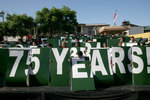
clocktower.jpgIn keeping with its tradition of "salesmanship and silliness," L.A.'s beloved Farmers Market celebrated its 75th birthday this week with a hokey card trick, homemade cupcakes, City Council proclamations and the horns of the USC Marching Band.

About 200 regulars, invited guests, and merchants past and present gathered under the clocktower at 8 a.m. (it didn't chime) to mark the official birthday of the market. Farmers Markets was an idea brought to wealthy landowner Earl Bell Gilmore in 1934 by two entrepreneurs, Roger Dahlhjelm and Fred Beck. According to Gilmore Co. executive Hank Hilty, farmers came because "their farms had failed, their businesses gone bust and their investments had vanished. It shouldn't have worked, but it did...because it was a plain good idea and a good place to be."

According to thousands who visit the market every year, it still is.
uscband.jpg

cardtrick.jpg

July 5, 2009

Lawyers, safaris, and Malibu

Summer is in full swing, and that means two things in Malibu:

1. Lawyers!! They're battling against the opening of a new accessway on Carbon Beach, a new one on Malibu Rd., and the Santa Monica Mountains Conservancy's newly-approved plan to create public campsites. (Just my top three litigation highlights.)

Print out the news coverage for a terrific beach read--with all the pettiness of a Gossip Girl novel and the procedural detail of a Bob Woodward exposé. Here's a sample nugget: the Carbon accessway can't be opened to the public just yet, since the homeowner who dedicated the easement 25 years ago has since built a fence, a generator, a 9-ft. wall, and a lighting system inside its boundaries.

2. The return of the Los Angeles Urban Rangers' Malibu Public Beaches Safaris!!--if you'd like to know how to find and use a public beach in Malibu legally and safely. Skills-enhancing activities include sign watching, trailblazing the public-private boundary, a no-kill hunt for accessways, and a public easement potluck. (Full disclosure: I have a doppelganger called Ranger Jenny).

2009 summer safari dates:

SUN Aug 2, 11:00am-2:30pm (east Malibu)
SUN Aug 16, 9:00am-12:30pm (east)
SAT Aug 22, 3:00pm-6:30pm (east)
SUN Aug 23, 4:00pm-7:30pm (west)

To sign up, e-mail info@laurbanrangers.org w/name, # of people, and preferred date.

Or for the do-it-yourselfers among you, download the "Malibu Public Beaches" guide here. And click here for the CA Coastal Commission maps of the dry-sand easements on Carbon and Broad Beaches. (Beware of Broad, however, where four years of erosion has all but erased the public tidelands and has thrown the dry-sand easements into the adjacent gardens and yards.)

Recently posted at LA Observed
Media
 
Politics
LA Biz
 
Arts, Books & Food
LA Living
 
Sports
 
© 2003-2011   •  About LA Observed  •  Email the editor
Follow LAO
Kevin Roderick blog
9:47 AM Fri | Morning mess on the 405 in Westwood. Labor's losing bet on Wendy Greuel. How City Hall powers will test Garcetti. Are independent PAC's now toxic to LA candidates? Ex-LAT publisher now in at SF Chronicle. Orange County of 'Arrested Development.' Plus KPCC looks atLAPD's helicopters. And more inside.
Mark Lacter, LA Biz Observed
1:38 PM Fri | Congressional lawmakers who are clearly incapable of carrying out their own jobs morphed into schoolyard bullies during the testimony of the IRS official.

Enter your email address:

Delivered by FeedBurner


Get RSS Feeds
of LA Observed
LA Observed publishes several Real Simple Syndication feeds for easy scanning of headlines. If you wish to subscribe to a feed, most popular RSS readers will do it for you. You can also enter the web address from the XML button below or click on a specific feed. For more help with RSS, try here or here.


Add to Google