Three weeks ago, on September 11, UCLA played its second game of the 2010 football season. They faced Stanford, considered to be one of the better teams in the Pac-10. It was not a pretty sight. The Bruins were outplayed in every way imaginable, losing 35-0 to the Cardinal. UCLA was 0-2 and seemingly headed for a 1-11 or 2-10 season.
A friend (or to be precise, a guy who follows me on Twitter, but I imagine we would actually be friends if we ever actually met in person or knew what each other looked like) wrote me, "I await your epic rant."
Then, one week later, UCLA beat 23rd ranked Houston, 31-13, at the Rose Bowl. But, I chalked that up to Houston being overrated and also losing its first and second string quarterbacks to injury during the game.
It would be September 25 when UCLA would face its day of reckoning, venturing out to Austin to take on No. 7 Texas. I was braced for the worst, so much so that I did not even make plans to watch as I had to work. And, following the game through the excitement of text message updates on my phone, I saw that UCLA had upset Texas 34-12.
Texas was supposed to have one of the top defenses in the nation, but the Bruins ran over the Longhorns all day, picking up 264 yards on the ground, including 119 from Johnathon Franklin, using its new "Pistol" offense. UCLA attempted just nine passes, completing just five of them for a meager 27 yards (one went for a touchdown for one yard.) Five turnovers by Texas aided matters greatly. The game brought back memories of 1997, when an 0-2 UCLA team traveled to Austin and won 66-3, starting a 20-game winning streak for UCLA. (The 27 passing yards were the fewest for a UCLA team in a winning effort since 1978, when UCLA ran a veer offense.)
UCLA coach Rick Neuheisel along with Offensive Coordinator Norm Chow decided to change UCLA's offense to the Pistol (so named by its inventor, Nevada coach Chris Ault, because the quarterback lines up behind the center a shorter distance than a quarterback in shotgun formation does) in order to improve the Bruins ability to run the ball. And so far, the Bruins have shown themselves to have a capable rushing attack. But the passing game has been mostly dormant.
Bruins quarterback Kevin Prince has missed numerous practices with various injuries, and has even had to sit out practice this week. He's completed just 29 of 63 passes with four interceptions for 285 yards and two touchdowns. Prince has not been helped by an inexperienced group of receivers, none of whom have made people forget J.J. Stokes or Freddie Mitchell.
However, despite the 2-2 record, the Bruins are going to be hard-pressed to finish the season with even a 6-6 record unless a lot of breaks go their way. UCLA should be able to handle Pac-10 doormat Washington State Saturday at the Rose Bowl, but then the schedule is extremely unkind. And that's because, with the exception of Washington State, there are no easy weeks on the Pac-10 schedule.
Next week, UCLA travels up to Berkeley to play Cal (which did give up 52 points to Nevada, the other Pistol offense in the country) and then gets a week off for before having to go up to Eugene to face Oregon, which has been putting points on the board as if they were playing basketball. Home games follow against Arizona and Oregon State, before heading on the road for two weeks to play Washington and Arizona State. UCLA finishes the season on December 4 at home against USC. The best chances for wins would be at Berkeley and at Seattle, and then the Bruins would need to win two of three home games against the Wildcats, Beavers, and Trojans. It's a very tall order.
The Bruins will likely not be favored to win any game after playing Washington State, barring a major injury by an opponent. Prior to the win over Texas, the last team ranked in the Top 10 that UCLA beat was No. 7 Oregon in 2007. And Oregon started that game with its second string quarterback starting, and ended it with its fourth string quarterback playing.
UCLA's lack of a passing attack is going to hurt it against teams like Oregon, Arizona, and USC which can put points on the board quickly. If UCLA falls behind, the team would have to rely on Prince's arm to get it back in the game, which is a very risky proposition. The defense features pro prospect Akeem Ayers as a defensive back, but the rest of that unit is not as strong as in the past two seasons.
Neuheisel received a fair amount of criticism early for the Bruins poor play. He maintained his optimism and he and Chow stuck to their offensive plan, even though the Bruins looked hopeless just two weeks ago. Neuheisel* needed a signature win over a ranked team to give his team some credibility.
*Before each game, Neuheisel has a videotaped message in which he tries to explain his pet phrase "passion bucket." I have listened to it twice. It manages to make less sense the more I hear it.
With USC on probation the next two years, it would seem that this is the time for UCLA to try to win back some of its reputation as a local football power. UCLA did beat USC eight straight years from 1991-98, but that seems like a long time ago. Especially since USC has won 10 of the last 11 games, shutting out UCLA once and holding the Bruins to a single touchdown four other times.
However, USC has started out 4-0, albeit against a much easier schedule than what UCLA faced. The Trojans, ineligible for the the conference title, have beaten Hawai'i, Virginia, Minnesota, and Washington State. The Trojans, under new coach Lane Kiffin, take on underachieving Washington at the Coliseum on Saturday.
If UCLA can somehow pull off a 6-6 season (which I think is the best they can hope for), yet another minor bowl game is in their future. Last year, UCLA got to play in the Eagle Bank Bowl in Washington, DC, a place where many people like to visit in the dead of winter. The Kraft Fight Hunger Bowl in San Francisco may be the best that UCLA can hope for. (It's played in San Francisco. It used to be the Emerald Bowl, and before that, the Diamond Walnut Bowl, and before that, the San Francisco Bowl.)
2011 is the year that Neuheisel is hoping will be the one where the Bruins finally compete for the conference title. By then, the conference should be the Pac-12 as Colorado and Utah are scheduled to join the club. The UCLA Athletics Department announced Neuheisel's hire with full page newspaper ads announcing that "the football monopoly in Los Angeles is officially over!" It will be up to Neuheisel to make that true soon. Or else there will be epic rants written by just about every UCLA fan.
![]()
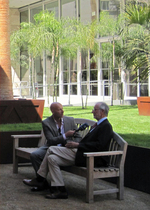
LACMA's unveiling of the new Lynda and Stewart Resnick Exhibition Pavilion continued today with a preview for the media. The Resnicks were there, along with architect Renzo Piano (pictured being interviewed, below) and museum director Michael Govan. The pavilion is, according to the press kit, "the largest purpose-built, naturally lit, open-plan museum space in the world." The building opens to the public with a free weekend on October 2-3.
Photos: Judy Graeme / LA Observed
When I got a media invite to the Operation Smile benefit swag lounge for the Emmys a couple weeks ago... Well, saying yes was a no-brainer. Swag! I'd read about it, sneered at it, drooled over it. Celebrities! Free stuff! Celebrities with free stuff! As a cultural critic, I of course wanted to learn more about this outgrowth of popular culture. Also, I wanted a wide-screen TV.
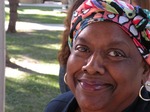
Herein, a report back:
**Class Acts: The swag lounges operate by a caste system--the two castes being the Talent (the actors) and the media. While my media buddy Lynn and I tried to explain that we are very talented--in fact, maybe more talented than some of the Talent--the caste barriers remained impermeable. What this means: the Talent gets cooler swag, and a lot more bags of it.
**What I didn't get, therefore (among other things): the Hawaiian vacation, the Caribbean vacation, designer heels, Bullets 4 Peace jewelry, pirate-themed vibrators, a digital guitar, free spa treatments. Or the wide-screen TV.
**Best pitch: "The diamonds are cut and polished in a retrofitted Heritage Bank building in the heart of the Canadian prairie."
**Runner-up: "It's an eyelash growth serum. It's all natural."
**Tip for the Talented: It's OK to laugh when someone says that. They don't pick up on why you're laughing. It turns out that people giving free stuff to celebrities are extremely serious and single-minded.
**Meanest to the Talented: Digital Playground, giving free pirate-themed phalluses to the Talent
**Nicest to the Talented: California Exotic Novelties, which had truly nice and fun sex toys, anyway, versus the creepy pirate ones
**Star sightings: Kevin Sorbo... and at least a couple dozen beautiful teens I couldn't identify. And I do watch a lot of TV.
**What I got (aka The Haul): 4 Giving Band bracelets, high-heel gel cushions, Caribbean Living magazine (minus the vacation for the Talent), Las Vegas Cut Diamonds playing cards, 5-pack disposable breast petals, some "perfect solution" bra accessories that I don't really understand, CalExotic "masseur" vibrator, "amorous" vibrator that looks more complicated, vibrating thong, soy massage oil candle, CalExotic keychains, CalExotic calculator (use your imagination), massage oil with pheromones, universal lube, Vermont maple mini-donuts, french fries with garlic mayo, cupcake with Butterfinger on top, acai drink, New Beauty magazine, total B complex super liquid vitamin supplement, face blotting paper, mini nail files, hair styling elixir, herbal mask, lash gel, sweet apple foaming botanical cleanser, pore reducer, cuticle conditioner, sateen-velvet moisturizing lotion, white oak facial cleanser, face masque, vitamin E oil, exfoliating solution, creme d'orange lotion, travel kit for the last half-dozen items, advanced night skin repair, collagen booster, hydrating skin mist, antioxidant moisturizer, oil-free moisturizer, teeth whitening system, skin recovery complex, age-defying Arctic cloudberry day creme, 3-pack of lip shine oils (Devotion, Reflection, and Fantasy), firming toner, anti-frizz shampoo, eye gloss, Moroccan hair conditioning oil, travel puff face makeup, peel off mask (these last dozen items from a kit for the actually cool New Beauty TestTube program--Get 4 kits a year!), $20 SpaLook coupon, and the book Stop Worrying If You'll Ever Meet Him.

The influential artist Varnette P. Honeywood passed away in Los Angeles on Sunday after a long illness. A native of Los Angeles, she was an accomplished painter, illustrator and teacher. She graduated from Spelman College in 1972 after attending Los Angeles-era schools and obtained her Masters in Education and a teaching credential from U.S.C. As a graduate student she taught art at juvenile hall and launched a career as an art teacher and curriculum designer for multi-cultural arts-and-crafts programs.
In the 80s, her vibrant, quilt-like style received worldwide recognition after Bill Cosby personally selected her 1974 painting "Birthday" to decorate the Huxtable living room on the Cosby Show. Subsequently, television series such as Amen and 227 also made use of her paintings. Indeed, Little Bill, the animated television series was based on Honeywood's illustrations and she designed the characters and contributed to the program.
News of Ms. Honeywood's passing circulated via email and Facebook amongst many of her friends and admirers. Most of the online tributes have emphasized her kind and generous nature.
She was always upbeat and gracious during the relatively short time that I knew her. I met her in 2008 while volunteering at the Mayme A. Clayton Library and Museum in Culver City. Ms. Honeywood had donated some books to the library and I had the honor of going to her house in the West Adams district to sort and retrieve them. She was so welcoming and open as we sat in her bright living room, filled with paintings and furniture. We chattered about books, Los Angeles history, growing up as the offspring of elementary school teachers and our common experiences in the art licensing business. Ms. Honeywood and her sister created one of the first greeting card businesses focused on the African American lifestyle.
The last time I saw her was at the Huntington Library reception for the opening of the Central Avenue and Beyond exhibit in October 2009. That was such a happy day and it pains me to realize that both Avery Clayton, co-curator of the exhibit and President of the Clayton Library, and Ms. Honeywood are no longer with us. Avery Clayton died suddenly last November. After running into one another in the exhibit hall, Ms Honeywood remembered me and was just as friendly as could be. She pulled me over to look at a handwritten letter by pioneering black aviatrix Bessie Coleman and exclaimed at the quality of some of the items on display.
She was always eager to share new discoveries and teach what she knew. It's no surprise that a catalogue of her work is entitled Traditions: She Who Learns Teaches. She had a profound influence on so many people in Los Angeles as an artist, educator and mentor and will be missed.
Photograph of Varnette Honeywood by Mark Steven Greenfield used with the permission of the artist
Update:
Celebration of Life for Varnette P. Honeywood (viewing)
Where: Inglewood Cemetery Mortuary
When: Thursday, September 23 from 3:00 pm to 8:00 pm
Funeral Services for Varnette P. Honeywood
Where: Messiah Baptist Church
When: Friday, September 24 from 11:00 am to 2:00 pm
Messiah Baptist Church
4500 West Adams Blvd
Los Angeles, CA 90016
Ever since the days of the old American Football League, when my skinny 9-year-old butt would be plastered to the cold, hard seats of Bears Stadium as I watched the Denver Broncos lose another game, I have been a sports fan. I like to play, watch and read about sports.
Less so in recent years. I still participate, but I read and watch less. Corporate greed, celebrity sense of entitlement and media more concerned with heat than light conspire to render what can be entertaining and accomplished, offensive and remote. Sport's increasingly huge presence stands in stark contrast to its ever smaller minds, and I'm unwilling to excuse it from the human race.
Now come Rohan Bopanna and Aisam-Ul-Haq Qureshi. Losers of the men's doubles championship Friday at the 2010 U.S. Open, they turn out to be the kind of winners who remind you that, sometimes, sport still transcends its insular jock culture and reflects the best of humanity.
In the same week the Los Angeles Dodgers sent a cease-and-desist letter claiming trademark infringement to a guy who sells the "Los Doyers" T-shirts that denote a long-standing Latino fan base, in the same week that Reggie Bush disavows any responsibility for his tainted Heisman trophy, a guy from India and a guy from Pakistan playing the also-ran sport of doubles tennis lose the match, win the world and set the standard for perspective and class.
Representing two nations that have been hostile neighbors for 63 years, Bopanna and Qureshi forged their partnership several years ago. They weren't making a statement; they were trying to win games. But through a simple love of sport and the commitment required to play it professionally, the two, nicknamed the Indo-Pak Express, make a mockery of those whose good fortune as owners, athletes, organizers and enablers render them clueless, craven and bereft of a sense of community.
Some athletes are handsomely rewarded to display product logos; the Indo-Pak partners wear jackets that read "Stop War, Start Tennis." They won their first ATP tournament in February, made the quarterfinals at Wimbledon and beat the U.S. Open Champion Bryan brothers at a tournament in August. But because their sport is contested in the shadow of the more glamorous singles game, it wasn't until the U.S. Open, on the eve of the anniversary of the 9/11 attacks, that their hands-across-the-border story was widely told. It wasn't until last week that India's U.N. Ambassador Hardeep Singh Puri and Pakistani Ambassador Abdullah Hussain Haroon sat together in the stands to watch the semifinal and final matches.
Like Armando Galarraga, the Detroit Tigers pitcher who lost a perfect game in June because of a bad call at first base, and graciously accepted the ump's apology after the game, this doubles match showed the bad-tempered, elitist sports world how to behave. It was the incarnation of what every kid hears from the time she can wrap her fingers around a ball: It's not whether you win or lose, it's how you play the game.
After this well-played game -- each of its two sets was decided by a tie-breaker -- at the center court award ceremony, Qureshi dedicated the match to victims of the Pakistani flood, and acknowledged the 9/11 attacks. "I feel there's a very wrong perception of Pakistan as a terrorist country," he said, standing in the brightest spotlight of his career. "We are a very peace-loving country and we want peace as much as you. ...There are extremists I think in every religion but ... you can't judge the whole country as a terrorist nation."
The response was a standing ovation, and two Bryan twins daubing the tears from their eyes. They had lots of company.
Professional tennis players are required to attend a post-match news conference; in doubles, it's rare to see more than a couple of journalists in the room. At this one, however, maybe 65 members of the media were there, and so were Puri and Haroon, who presented the Bryans with ceremonial shawls in appreciation of their sizable donation to Pakistan's flood victims.
Before the award ceremony, Qureshi had spoken to the Bryans to let them know that while he didn't intend to detract from their victory, he did want to go off-topic in his runner-up remarks. Not only did they understand, they encouraged his world-view comments in the wake of their afterthought sporting event. "What they are doing," Bob Bryan said later, "is a lot more important than winning the U.S. Open."
Yes, it is. When you're good enough and lucky enough to have a global platform, you can shrink the world. It's what sport does best.
![]()
"Los Angeles Plays Itself," a three hour film that is a virtual tutorial on how Los Angeles is portrayed in the movies, screened this weekend at the Aero Theater in Santa Monica. It played to packed houses and will soon be available for the first time on DVD. It is part love letter to the city and part rant against the way Hollywood has misrepresented it.
The film was put together in 2003 by CalArts film professor Thom Anderson and is rarely seen in theaters, mainly because Anderson never got permission to use the 200+ film clips that are at its heart. But what gives the movie its soul is the narration Anderson wrote, adding up to an idiosyncratically personal view of Los Angeles and filmmaking.
Anderson skewers Hollywood mercilessly for offenses large and small, the least of which begins with calling Los Angeles 'L.A.,' something he feels is disrespectful and verges on the criminal. The greater sins committed on film are political, not so much for what is depicted, but rather for what is left out. Huge swaths of the Los Angeles population seem to be missing in action — African Americans, Latinos, even women are underrepresented in the Los Angeles Anderson sees — and there is lots of what he called "silly geography," where a car chase will start in the Venice canals and end up in the South Bay, to illustrate how out of touch Hollywood was.
Despite all the humor, the film stays with you after it's over. Footage of Angels Flight, when its short ride really mattered, and Broadway's movie palaces lit up like the fourth of July provide fleeting glimpses of old Los Angeles. At three hours, it is long enough to have an intermission but well worth the journey.
In opening remarks at the Aero, the only place in Los Angeles that the film has ever screened, Anderson called the movie "kind of incomplete. It was meant to create a dialogue. It doesn't have a lot of suspense, other than waiting to see when your favorite movie will come along." He says he pored over the entire AFI catalog of films from the 20's through the 60's but called it a waste of time, finding most of the films he included through suggestions of friends and colleagues.
Anderson, whose humor and humility downplay his depth of knowledge of film and the city, said that the movie was reviewed in the Nation when it was completed in 2003. "He said it was kind of like listening to a drunk ramble on in a bar. And that was a positive review." Judging from the crowds this weekend, though, it definitely has legs.
![]()
Anderson has made a quirky ode to the city he loves. The film shows how Los Angeles figures as a character in films early on, even before Billy Wilder featured it in "Double Indemnity," and reached its pinnacle in "Chinatown" and "LA Confidential."
But the use--and misuse--of many of its architectural icons really tick him off. Why, for instance, did every high-rolling outlaw, thug and thief, or record mogul on his way down, live in a postmodern palace? Since when did evil and greed become associated with postmodernism? He concludes that Hollywood was against modern architecture and accuses Hollywood of making these homes the equivalent of the black hat. He lists the names and shows the scenes of the postmodern architects whose work was used and abused, saving the worst indignity for John Lautner. the architect he says Hollywood loved to hate. It was Lautner's Garcia house on Mulholland that was easily pulled off its footing by Mel Gibson's pickup--thereby adding incompetence to Lautner's other shortcomings.
Anderson said that the first half of his movie is more trivial and full of humor, but in the second part, when he features the powerful and poignant films of Billy Woodberry and Charles Burnett, along with "The Exiles," Kent MacKenzie's black and white movie that depicts the native American community living in the shadows in downtown Los Angeles, the film's tone becomes more serious. Films like "Killer of Sheep" and "Bless Their Little Hearts" focus on the city's struggling African American community, a part of Los Angeles rarely depicted honestly in film.
"There is nothing as radical as reality," Anderson said. He touches on bigger issues as well, like the city government's killing of public housing and destruction of public transportation, and how that shaped the city.
"Hollywood made movies about what they knew," he explained. And until Woodberry and Burnett made their films in the 80's, that meant that people of color were rarely seen. The Zoot Suit conflict is represented glancingly by Edward Olmos' film "American Me."
Anderson called Los Angeles "the most cosmopolitan city there is" but admitted that sometimes we don't appreciate what we have. He cited Agnes Vardas' film "Murs, Murs" about the murals of the city: "It took an outsider to see them as something remarkable."
Anderson ended his remarks by talking with a passion tinged with outrage and sadness, about a recent newspaper article detailing futile efforts to find private buyers for Wright's Ennis House and La Miniatura in Los Angeles, both of which have been on the market for months. "The Ennis and Miniatura houses should be purchased by a museum and made accessible to the public, rather than building another museum to house art already seen in museums all over the country," he said.
He questions spending "33 million to mount a Wagner fest, or 44 million for one painting, as the Getty is currently hoping to do. The Watts Towers has spent 4-5 million dollars on restoration and now they've given up because they can't raise the 5 million more to finish to job. That suggests skewed cultural priorities," he said. It sounded sadly like a plea from someone who feels like the lone wolf crying into the wind.
Anderson says approval to issue "Los Angeles Plays Itself" on DVD has finally been granted and it should be available soon. His newest film, "Get Out Of The Car," will be screened at the Redcat Theater in November.
Photos by Iris Schneider
![]()
Bruce Lisker and Kara at their Marina del Rey apartment.
Part 6 of an occasional series
A week ago, the biggest problem Bruce Lisker had was finding a couch. I had accompanied him and his girlfriend Kara to Abell's Auctions, a vast warehouse in Commerce that holds a weekly auction of everything from child's rockers ("$5. Do I hear $5?") to huge woven rugs ($15), breakfronts ("No interest? Trash it!") and elegant porcelain pieces from Nancy, France. When Bruce and Kara returned from Maui, where he marked the one year anniversary of his release from Mule Creek Prison, the couple who had loaned them several rooms of furniture decided they needed it all back immediately
.
That left Bruce and Kara sleeping and eating on the floor of their sunny Marina Del Rey apartment. They got a new bed from IKEA and then Kara, familiar with Abells from years of furnishing homes and appreciating a good deal, headed to the auction house for one of their weekly auctions. On their second visit, it worked. After purchasing a red suede couch for $40 and some other smaller items to sit on and hang on the walls, Kara was excited. "Baby, we have a home! We have a proper home!" she exclaimed gleefully when the gavel fell and the couch was theirs.
They next day they had what they hoped would be their last meal on the floor as they waited for the couch and dining room table to be delivered. Bruce started back at Santa Monica Community College, taking one class on campus--Speech and Argumentation--and a couple of classes online. He meets regularly with a therapist now, helping him with depression and to make sense of his life's journey. She is seeing him pro bono, a huge help since he still has not been able to find a job, despite filling out 50 job applications all over the city. But, all in all, for Bruce life was good.
Then he got a surprise phone call from his lawyers. And they had bad news. On Wednesday, the Attorney General's office filed a motion asking U.S. District Court Judge Virginia Philips to reverse her decision that overturned Lisker's murder conviction. The judge was asked to send Lisker back to prison to continue serving a 16-year-to-life sentence for the murder of his mother, a crime he maintains he did not commit.
Before the phone call, Lisker's next court date was not until March, 2011 when his civil case against the city of Los Angeles is due to begin.
Lisker's lawyer, Bill Genego, explained the situation. Several years after Bruce was incarcerated, a new law was passed. It stated that you could not file a writ of habeas corpus more than one year after your conviction had become final. Because the law did not even exist until several years after he was convicted, Bruce missed that deadline. Now the attorney general has filed a motion seeking to overturn the ruling that freed him and send him back to prison, not because he is guilty, but rather because he missed the deadline by which he was supposed to file his appeal.
Genego, who is representing Lisker in his civil suit against the city, and who has been working on winning Bruce's freedom since 2005, had to make the phone call to tell his client the news. "It was devastating." Genego said. "This is a perversion of the law. They are saying that someone who is innocent should sit in jail because they missed the filing deadline. That is not law as justice. It is law as a game," he said.
![]()
Bruce and Kara at Abell's Auctions.
The Attorney General could have appealed the decision to release Bruce last year when he was released, but decided not to pursue the case. The Los Angeles County DA decided not to re-prosecute, citing lack of evidence, and eventually Lisker was exonerated. "Now they are saying, 'We decided not to appeal, but we wish we had,'" Genego said.
But he is optimistic. They will appear before Judge Philips, who ultimately overturned Lisker's conviction, finding that he had been convicted on false evidence and that his original attorney did not adequately represent him. She ruled that innocence overcomes untimeliness and you can overcome an untimely petition and have your case heard nonetheless to prove your innocence.
In a note to his supporters after he heard the news from his lawyers, Lisker wrote: "I just need to stay focused on the tasks ahead: school, love, life and staying in a spiritually and emotionally healthy place."
In talking with Bruce this week about his year anniversary, he said that on a trip up to Northern California, he fulfilled something he had dreamed about doing for many years. "I got to drive by Mule Creek Prison," he said, the prison he walked out of last year, after fighting tirelessly for his exoneration.
Despite this latest setback, Lisker's letter attested that he still has faith: "Justice will win the day," he said.
Photographer Iris Schneider is following Bruce Lisker as he returns to society. He was released from prison in August 2009 after 26 years.
While reading today's LA Times, I ran across Tim Rutten's review of former British Prime Minister Tony Blair's new book, "A Journey: My Political Life." He called it a book of "unusual interest" for these reasons (among others):
1. Blair wrote it himself, which "makes this volume unique among the English-speaking world's recent political autobiographies." This is true.
2. (Blair having written it himself), gives the book "a disarming frankness that a professional collaborator almost certainly would have manicured away, along with anecdotes that are unintentionally self-revealing."
This is not true.
Professional collaborators, like Rodney Dangerfield, can't get no respect.
This is the business I'm (sometimes) in -- and proud of it.
My name is David Rensin.
I'm a collaborator.
I like Rutten, so this isn't about him. It's about what was probably a throw-away generalization -- and hardly even the point of his otherwise fine column.
I've written 13 books, 11 of them collaborations. (I won't go into them here, but you can check my amateurishly-designed web page; to see for yourself.) I'm currently collaborating on two more books and making plans for another solo book. Not a bad way to make a buck without going to the office, and satisfy a wanderlust for exploring different lives through my writing.
I appreciate that Rutten used the word "collaborator" because too many people call it ghost-writing. I suppose if you're relegated to a "thanks to ... for helping me make sense of my thoughts" in the acknowledgments, and no name on the cover, you might feel like a ghost. But I don't think the job-descriptions are interchangeable. Ghosting always makes me picture a project a writer is hired to do, alone and with minimal input, in the name of another. It may be the next installment of a never-ending YA series, or a novel for an entitled celebrity mogul's spouse who tells the writer, "I want to do a romantic mystery about an Upper East Side or Hollywood wife whose billionaire husband cheats, so she kicks him out, and then he dies."
"Uh huh..."
"So she hangs with her girlfriends, goes shopping, and the sisterhood solves the murder. Then she meets the one-in-a-million hunk -- a stockbroker who gave it all up to serve vegan food to the homeless -- who won't ask her to give up her identity, shows her the meaning of life and fantastic sex -- and even wants to go shopping with her! Can you do that?
"Sure? By next Thursday?"
"Great. Let me see it when it's done."
Of course, that's a generalization. But you know what I mean.
In my experience, and the same goes for a number of excellent writers/collaborators I know, the partnership plays out over many meetings during which the "author" and "collaborator" discuss the project, make outlines, tape endless sessions of biography or comedy or adventure story, and put in a lot more work than the collaborator ever lets the unsuspecting "author" know is necessary. The late super-manager and super-mensch Bernie Brillstein used to love telling people that I'd lied to him about how much work his memoirs required. We spent a year figuring out what it wasn't about before we settled on what it was about. Then we spent a year writing, reading, editing, rewriting*.
Typically, we start from scratch, writing an extensive proposal designed to sell the book to a publisher. My most recent proposal runs 60+ pages. Sometimes the "author" is a big enough name, or has a "platform" that guarantees pre-recognition, and gets a deal without a collaborator. Then, after the "author" gets over wanting to go it alone, one is suggested by the publisher/agent/manager/friend. Sometimes the "author" already knows the collaborator because he/she once interviewed the "name-above-the-title," who remembers it fondly. That's partly how I lucked into my first book.
The book collaborator is also a psychologist, confidant, interlocutor, and supportive friend. We have to honest and kind. And politic. Otherwise we're worthless. We defuse fears, hang out, massage egos, play Devil's Advocate, call our "authors" on the bullshit - gently -- and pry them loose from years of being habitually cautious with the press. Although a collaborator might write for a magazine or newspaper or do their own books, WE ARE NOT THE PRESS. At the moment. (Or later because there's usually a confidentiality clause. Oh the secrets I'll never tell!)
Call us Geishas with a pen.
Then the collaborator goes home and does the typing, bringing to bear his/her inherent ability to structure a story, embody the "author's" voice in the author's own words, make it funny and dramatic and nuanced, and do all the stuff that we've learned to do well because, after all, this is our talent. It's not the "author's" occupation, otherwise he/she would write their own books instead of make movies/write songs/live on the edge/save lives/make jokes/tell an inspirational tale/do big science, etc. That's not to say that every "author" needs a collaborator; I've worked with "authors" who do a lot of writing, which I then massage. Still, it's nice to have a professional sounding board.
Regarding Rutten's suggestion that a collaborator would likely have trimmed away the "disarming frankness," I say, "No way." If anything, it's the "author" or manager or wife or agent or sibling or personal trainer who wants to excise passages that are intentionally or unintentionally too revealing. Yes, some stuff shouldn't go into a book, and some doesn't fit no matter how hard you try. And we want to protect the people we work with because every "author" wants to look good. Collaborators, however, want the goods. We cherish what makes a story consistently readable instead of a safe, predictable monotone. We want to channel hard won authenticity to the page in a way that lets everyone still respect themselves in the morning. We want to keep the "author" from making a fool of himself -- unless that's their claim to fame -- but we don't trim off the highs and lows like fat on a fine steak.
Our goal is to have guys like Tim Rutten review the book and call it "disarmingly frank."
Collaborating, for those who started out in newspaper and magazine journalism, is that wonderful opportunity to really go deep with a truly interesting subject who's probably bored to death of doling out their life tidbits over noisy hour-long lunches, in the service of promoting their latest project.
A collaborator's job includes checking his/her ego at the door, being careful not to think it's our book, and to do the best job possible. But we're not ghosts. We're in it together. Sometimes we even get our names on the cover, with certain exceptions. And since we're in it together the collaborator wants to guide the name-above-the-title author down an honest, self-effacing path. Readers can tell if you slip over the line into too much glad-handing, white-washing, self-aggrandizement, or trash-talking. You can't please everyone but you can at least see the book as a tightrope walk; the idea is to keep moving ahead and not fall off.
The result is better for it. And most "authors" would agree. On my books they've always seemed grateful for the help -- especially when they finally realize what's involved in making a book -- because I'm really interested in learning about their lives. I stay away from books I'm not passionate about; nothing's worse than waking up during a project you suspected you might hate. And I treat my collaborator as a human being, not a paycheck. You can't do this job and do otherwise. It's not a one-night-stand.
A couple of years ago in these electronic pages I wrote in an elegy to Bernie Brillstein that part of what made his books so universally admired was (in addition to his life being his life), his willingness to let it all hang out. He boldly told me everything. He started his book with an anecdote about going to a proctologist, after all. I did make many editorial and creative choices, but he had the final say. And big courage. Word of advice to prospective "authors" who hire collaborators: "Disarming frankness" in a book happens when the "author" is disarmingly frank. That stuff is gold.
Of course, I'm sure there are times when Rutten's presumption is dead on. There are hacks among us. Some of these books are more flash than substance. I'm not arguing that co-written autobiographies writers are all Pulitzer-worthy, but I am saying that they're not less worthy because the "author" had help.
And, by the way, even people who do write their own books have researchers, draft readers, and assistants who might pen a passage or two. It's always a collaboration even if the person whose name is on the cover is the one who ultimately faces the blank page.
Collaboration should come out of the closet. I'm glad that Rutten wrote what he did because it gives me the opportunity to comment on some common misconceptions I've privately grumbled about for a long time -- especially at parties when acquaintances ask if I'm still writing. (Nope. I finally threw over that losing job. Now I'm a stock girl at the GAP.)
I could go on. But I have a better idea. After serving on some fun panels at the Los Angeles Times Festival of Books - including one in 2008 dedicated to surfing, when my oral biography of rebel surfer Miki Dora was published - I have wanted to interest the Festival powers-that-be in doing a panel about the art and craft of collaboration.
So many books are written this way, and the topic has never been explored at length at the Festival. So I'm volunteering to collaborate with my behind-the-scenes writer peers on this project for the 2011 edition. I'm sure we'd fill a hall twice because the readers want to know what really goes on, and how its done.
I think we'd change some minds about the worth of collaborative books, for the better.
If not, we always have juicy backstage gossip -- that is, if you promise not to tell anyone we told you.
|
Media
|
Politics
|
|
|
LA Biz
|
Arts, Books & Food
|
LA Living
|
Sports
|