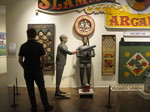
Baseball: The All-American Game, an exhibition of pieces owned by Los Angeles memorabilia collector Gary Cypres, opens Sunday at the Craft and Folk Art Museum on Wilshire Boulevard in the Miracle Mile district. The exhibit "explores the influence of baseball on American folk art made between the late-1800s to present day. For the first time in Los Angeles, the public will have access to the largest exhibition of baseball-related traditional folk art since the American Folk Art Museum's historic "Perfect Game: America Looks at Baseball: in 2003, says CAFAM.
There's a public opening reception at the museum tonight from 6 p.m. to 9 p.m.
The photo above shows an arcade display of a batter and catcher with moving arms, produced by Strike-em out Baseball Co. in Boston about 1929.
LA Observed photo: Judy Graeme
Although the term paparazzi was first coined in Italy, it has reached its zenith — or its nadir — on this side of the Atlantic, aided by the internet, the money to be made and the ease of picture-taking technology and dissemination. It's debatable which came first, the insatiable desire to document the famous or the need for the masses to see endless images of celebrities caught acting like normal people. Added to the mix is another layer, as celebrities themselves post their whereabouts and thoughts on their Twitter accounts, courting the popularity that we always knew they craved despite their protests.
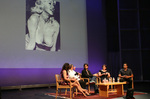
Some of these issues of celebrity were addressed at the Getty Wednesday night at "Are We All Paparazzi Now?," a discussion in conjunction with an exhibit called "Portraits of Renown," celebrity portraits dating back to the 1800s and including Abraham Lincoln, Mark Twain, Georgia O'Keefe, Edgar Allan Poe, Josephine Baker, Andy Warhol and Anderson Cooper as an infant, photographed by Diane Arbus. The show hangs, not accidentally, adjacent to an expansive show of the work of Herb Ritts, whose sun-drenched and beautifully composed images of people like Madonna and Richard Gere had almost as much to do with their ascension in the public eye as did their talent.
Since directing "Teenage Paparazzo," a thought-provoking 2010 documentary about a 13-year-old Los Angeles boy who threw himself into the pursuit of the celebrity image, Adrian Grenier has taken on the role of educator. The star of "Entourage," usually the object of the camera's lens himself, screens his film and speaks to teens and adults about the perils and paradoxes of celebrity in American culture. He often uses the term "hall of mirrors" to describe the state of society today. It seems apt, as I often wonder if people have forsaken actually living their lives for the shared experience of documenting their lives, pausing to photograph the meal that's just arrived at their table, the painting they are looking at in the museum or the shoes they are trying on. Now that we know celebrities are just like us, proven by the endless flow of images of them shopping, pushing strollers, sipping lattes in their sweats or heading to or from the airport, we've come to the point where we've deemed our own lives just as worthy of exposure.
The discussion, taking place at a major museum, begs the question: the portraits that grace the walls of the Getty seem several cuts above the images that we are bombarded with daily. Yes, the paparazzi quench the desire for our society's need to know everything about those we have put on the public pedestal. But is there anything about these images that can be called art? Squiers noted the difference between making pictures and taking pictures. "Great photographers make pictures," she said.
Today's paparazzi certainly give us images that provide a glimpse into our society and what it values at this moment in time. One quizzical audience member referred to them as "bullshit." Galo Ramirez, the lone paparazzo on the panel, responded, "If it's bullshit they want, it's bullshit I will give them." At the same time, he acknowledged the lucrative market for his work, refusing to put an amount on what an image could bring him but saying that whatever he is paid makes it well worth his while to wait at someone's home for hours. He is hoping to snag the hottest shot on the market in the next "news" cycle: Angelina Jolie in her wedding gown.
The panelists at the event, which was co-sponsored by Zocalo Public Square, included Grenier, Carol Squiers of the International Center for Photography, Carolyn Davis (a photo editor at Us Weekly) and Ramirez, who famously crashed his car into one driven by Lindsay Lohan as they both made U-turns several months ago. He recently got pictures of the coroner's van taking Whitney Houston's body from the Beverly Wilshire Hotel. Carla Hall, an editorial writer at the Los Angeles Times, moderated the panel.
Grenier has taken the issue of celebrity and run with it, having the self-awareness and smarts to see its many layers. He acknowledges that pictures tell a story and there is nothing inherently wrong with storytelling. "But we have to leave the celebrity experience and have human experiences with each other," he said. "I don't want to tell anyone how to live. I just want people to see as many perpectives as possible."
![]()
Carla Hall, Carol Squiers, Adrian Grenier, Carolyn Davis and Galo Ramirez.
Both photos: Iris Schneider
Now we call him Sir Simon. But back in the day — before his curly top turned white — Simon Rattle was an enormously gifted principal guest conductor of the LA Philharmonic.
He'd joined forces with Carlo Maria Giulini. Remember him? The old-world maestro who led our resident band on excursions of poetic transport? Who looked every part the willowy patrician and got the orchestra to play like heaven's tribunes?
Of course you do.
Okay, that was an earlier golden era — well before this one headed by the spirited, infectious Gustavo Dudamel, who belies its administration's corporate style.
We cannot forget any of those from the '80s -- not Rattle, the young Liverpudlian, nor native Angeleno Michael Tilson Thomas, co-principal guest conductor. Together they stood next to Giulini, breathing in his aura, forever to be held to the Italian podium meister's standards.
So here's what happened in the wake of the Sainted One's 1984 departure from this country.
LA Phil director Ernest Fleischmann passed over MTT for the chief post, allegedly because the candidate had a same-sex partner and in those pre-historic times of full-bloom homophobia, such preferences were a no-no.
And Sir Simon — now ennobled by the Brits — reportedly turned down the offer, preferring to be back across the pond with his orchestra in Birmingham. Finally, he was tapped by the Berlin Philharmonic to head that Rolls Royce of orchestras, where perfection does not go wanting.
In 2003 he and the Berliners joined Disney Hall's glitzy inaugural revelries — with an unforgettable sonic blast that still reverberates. And now, at last, the beloved Brit returned to his old chums here who still remain in the LA Phil and the newer hires.
In a word their concert together was fabulous. Rattle gave us modernist Ligeti's long-lined floating essences, "Atmosphères," devolving into Wagner's similarly long-lined "Lohengrin" (first act prelude) - both works cosmic to the core. An inspired stroke to present them as a unit.
The solo spot fell to his wife, the dazzling Czech mezzo and European star Magdalena Kozená, for Mahler's "Rückert Lieder." And while we could hear her voice in the drifts of velvet gorgeousness that wended their way to our side seats at Disney (hardly an ideal location), her sense of the poems — wistful, innocent, profound — was always evident, as was Rattle's and the players' collaboration in same.
Next came Bruckner's massive 9th Symphony, which he conducted from memory. There were extraordinary stop-on-a-dime moments that dropped from big striding basses to sudden, suspended quiet and delicate playing. What treachery lurks in this work, as performance goes, and what a physical workout for any ensemble.
What's more, we could see/hear in his ministrations where much of Dudamel's influences came from. For instance, Rattle sometimes stands stock still, in a groove with the players as they go at it, conducting with his eyebrows! And there's the trick of passing his baton from hand to hand as needed, as though a it's a mere extension. He even joins his musicians at curtain calls, shoulder to shoulder with them on the stage floor, not on the podium.
Another hero in our midst, Mona Golabek, has taken her talents to the Geffen stage in "The Pianist of Willesden Lane" (through June 24) as actor/musician (have you heard her reading Chopin's letters to George Sand on air, courtesy of K-Mozart, 1260 AM?) So powerfully moving is Golabek's chronicle of her mother, Holocaust orphan Lisa Jura — an aspiring pianist who boarded Vienna's Kindertransport to London at age 12, never to see her parents again — that the one-woman bio-show is an epic not to miss. Hershey Felder, the creator of this genre, helped bring the memoir to script form.
So much for performing artists. And now a little something about a woman who presents them, Dale Franzen. The former opera singer surely qualifies as LA's leading impresaria — she even undertook the project of building a concert hall, Santa Monica's Broad Stage, bankrolled by, of course...
Franzen's last event of the season there was the recital of big-time tenor Piotr Beczala. The Polish singer, seen recently in a Met simulcast of "Manon," with Anna Netrebko, drew a sellout crowd of voice fanciers to the Broad. But although he boasts a stellar, ringing voice, Beczala hasn't adjusted down to the scale of an intimate 500-seat theater that is already resonant to the nth degree. Nor did he bother much with the recital mode: nuanced singing, subtlety of characterization, word pointing. And because he used the same big projection technique needed for a 4,000-seat house, some of us — and I'm not exaggerating — required ear-stuffers.
Rattle photo courtesy of LA Phil; Mona Golabek by Michael Lamont.
The recent success of the Kings, Lakers, and Clippers will create an challenging weekend for the people who operate Staples Center, Dodger Stadium, as well as traffic and transit planners.
Right now, here is what is scheduled on Saturday, May 19.
Then on Sunday, May 20.
From Thursday through Sunday, Staples Center will host six playoff games in four days.
According to this post from CBS Sports hockey blogger Brian Stubits, a changeover from hockey to basketball can be done in 2 1/2 hours. However, playoff hockey games can go for a very long time and it's possible that the Kings and Coyotes may not finish until close to 5 pm on Sunday.
Did you know also that there will be a major bicycle race going from Beverly Hills to Downtown on Sunday morning? The finish line will be at Staples Center.
For me, this brings back memories of a similar jam up back on April 13, 1996. The L.A. Galaxy were playing their first ever match at the Rose Bowl against the New York/New Jersey MetroStars. They won 2-1 before a crowd of over 92,000 that greatly exceeded expectations, swamping traffic on the 110.
This caused a problem for people going to the Dodgers game that night. It was a Hideo Nomo start back when Nomomania was still in vogue. Over 40,000 (including me) came to Dodger Stadium to see Nomo, who struck out 17 Marlins, in a 3-1 Dodgers win.
And even the Clippers gone into the act that night, drawing over 16,000 for a game at the Sports Arena against Utah. The Clippers won that night (there were a lot of prizes given out at the game) for their final victory in a 29-53 season.
When I left the Dodgers game that night back in 1996, I could see that traffic was moving in neither direction. Fortunately, I had a book in my car. I just sat in the parking lot for about 30 minutes reading before the traffic cleared up. Overall, there were about 150,000 people attending sporting events near the 110 Freeway in an area stretching from Exposition Park up to the Arroyo Seco.
As for this Sunday, with all the sporting activities going on in Downtown, I will be headed to the Walt Disney Concert Hall for an LA Phil performance. It starts at 2 pm. Judging by the schedule of events going on in Downtown, I think I will be able to make it there with minimal trouble, although it sometimes feels like I will be pulling off a feat similar to Luke Skywalker blowing up the Death Star.
Greg Critser 's next book, "City of Genius," is about Silicon Valley.
If we had a prize for Most Celebrated Business Hero in America, it would have to be Steve Jobs, the late founder of Apple.
The agile doge of Silicon Valley had a "death stare" you couldn't escape.
He had a up-from-orphan back story you couldn't resist.
And he had the vision of ten of his fellow technology executives
That's why — we're told — Apple was so good at making the things we love. All things "I", that is — from iPads and iPhones, to iPods and iTunes.
Lately, it also seems that Jobs and the company he left behind were also awfully good at all things Me.
Nothing illustrates that as well at Job's 2011 remarks to a Cupertino city council member, recounted recently in the New York Times. Jobs was asked if he would consider giving the cash-strapped Apple hometown free wireless service. (He was asking for permission to build a new infrastructure-needy headquarters.) "See, I'm a simpleton," he told the council. "I've always had this view that we pay taxes, and the city should do those things. That's why we pay taxes. Now, if we can get out of paying taxes, I'll be glad to put up Wi-Fi."
The notion that the company should pay more taxes to pay for more of the things the city needs was death-stared down. Apple, he said, paid its fair share of taxes.
In fact, Apple, like almost all other technology companies, pays about one-third less than all other companies on the Standard and Poors 500. That's because its tax department has used every dodge in the books to avoid paying them, dodges with such Tony Soprano-sounding names as "The Double Irish" (using that country's low tax rates to wash US revenue), "The Dutch Sandwich" (ditto above, except the Netherlands), and, "The Reno" (moving its revenue collecting area to zero-tax Nevado, apparently to avoid all those nasty city councils at home.)
The true Apple ethos — far from the progressive stereotype rendered by its ranks of official hagiographers — is one of exploit, avoid, and hide.
That shortfall affects everybody from Joe Sixpack to Jane iPad, especially in California.
A new study released by CALPIRG found that the average California taxpayer in 2011 "would have to shoulder an extra $423 tax burden to make up for corporations and wealthy individuals shifting income to offshore tax havens."
Small businesses in California have to foot an extra bill of over $2,010 on average.
State, local and state tax revenues are so diminished that college students are fasting to protest huge fee and tuition hikes.
Roads and bridges are all on "deferred maintenance schedules."
And the children of the folks that clean Apple executives' comfortable homes can't get health care.
How...cool.
There is a natural reluctance, especially by local governments in need of property tax dollars, to make taxes an issue. It is a reluctance fortified by an implicit threat: treat us in anything other than a deferential way, and we'll move. ( Jobs threatened to move Apple if the City Council was so unhappy.)
But not everybody is cowed. As the ballsy Brian Murphy, head of De Anza College located in Cupertino, put it to a Times reporter recently, "When it comes time ...to pay their fair share, there's a knee jerk resistance. They're philosophically anti-tax, and it's decimating the state."
To almost all of today's tech tycoons, taxes are antithetical to capitalism. But that hasn't always been the case. Andrew Carnegie, the Gilded Age tycoon who later turned his fortune to building public libraries — his day's Wiki — lauded the British system of high taxes on inherited wealth. And he required that any city that got one of his grants also pass an ordinance establishing a tax to support the library's operating expenses.
It's time for the technology barons of our own age to start thinking a bigger.
They compete in the world. They live in America.
Steve Harvey is on Twitter: check him out. To email Steve a tip, click here.
So something smelled about the astounding $2.15 billion purchase price of the Dodgers, not to mention the never-ending involvement of Frank McCourt? Well, the team is apparently trying to clear the air by offering an appropriate gift at your local 76 gas station_a Dodger car freshener. It supposedly emits the smell of newly "cut grass," though I thought I detected a faint whiff of gasoline, too. Anyway, I'm more excited about the newly cut parking prices (reduced from $15 to $10.)
Thanks a lot
Can it get any tougher to find parking places around here? Stuart Melvin noticed a lot in the Larchmont area where even those "authorized" to park will be towed.
L.A.: Land of Extremes
I think I read that line in the National Geographic once. Anyway, on the one hand, you can find what is touted as the nation's largest chair, a 40-foot-tall wooden perch, at the downtown L.A. Mart furniture center. It takes up six parking spaces.
Venice, on the other hand, is the home of a 1½-square foot patch of lawn that bears the inscription "world's smallest front yard." A previous lawn there was ripped out by thieves, believe or not, so if you come upon a rival claimant for world's smallest front yard, be suspicious.
Well, Goodbye Dolly
I recently saw the funny stage production, "Forbidden Broadway," which parodies famous musicals, including one that Carol Channing made famous. I was reminded of a photograph George Bentley of La Puente took near the Music Center. Bentley noticed that a prankster had added some words to a piece of graffiti, turning it into a commentary on "Hello Dolly Revivals."
Such a deal
Lewis Van Gelder submits the accompanying coupon for your "Bargain Hunting in Beverly Hills" file. The $1,000 discount is no joke; handbag purses run as high as $29,000 at Francesco Santoro, a store employee told me.
Reconfiguring!
The "Saturday Night Live" TV show recently performed a skit about L.A.'s car culture in which an ailing Westside resident is advised to go to a treatment center in Marina del Rey. ``All the way the other side of the 10?" he exclaims. "It's almost Long Beach, man!"
here reading Start
Dave Voda, an escapee from L.A. who lives in Boulder, Colo., emails to say that he was struck by the AHEDA STOP photo that appeared in this column. Voda suspects that it's an L.A. custom — and a confusing one — to lay out the words in a pavement sign message "as if you are reading them one at a time as you approach. This presents a problem to me because the nuns taught us to read by taking in entire phrases at a clip."
And, of course, it further complicates things when the message appears to be partly in Italian. I guess this photo by Jim Stott would sum up Voda's attitude:

A lifejacket-and-tie function
The Capitol Steps troupe, which specializes in political satire, played recently in Beckman Auditorium at Caltech. Spectators were advised beforehand that in the event of an emergency they should await exiting instructions from "your Italian cruise-ship captain."
miscelLAny
Apparently some Long Beach residents don't get along with their furry neighbors. The newsletter of the Belmont Heights Community Association points out that the Internet offers recipes for such delicacies as "Grilled Squirrel," "Squirrel Alfredo," "Cajun Squirrel," and, of course, "Bushytail with Autumn Apples."
That's it
You've reached the end of the column. Contributor Phil Proctor asks that you to close the door on your way out.
* Name of show fixed
As an agency within the Department of Homeland Security, U.S. Customs and Border Protection is charged with, among other things, keeping terrorists out of the country. This week, its officers are hard at work in a warehouse under the LAX flight path scrutinizing new U.S. arrivals for their danger potential.
The tools of their trade aren't guns and walkie-talkies, they're jeweler's loupes, tweezers, bottles of ethyl acetate, eye droppers and things that look like dental scalers. The bad guys these good guys are looking for are agricultural pests that, according to the CBP, cost the U.S. about $136 billion in lost agriculture revenue every year.
With the approach of Mother's Day, inspectors this week are probing bundles of flowers. By week's end, most of these botanical beauties will be somebody's way of thanking mom for going to all that trouble. The CBP has some 2,360 agriculture specialists sticking their noses into product queuing at 167 ports of entry across the country. The agency will not divulge the number of agents in L.A., but one one them is Jessie Frias. Wearing black rubber gloves, the senior agriculture specialist extracts a dozen long-stemmed red roses from an elongated cardboard box, and liberates them from their cellophane wrapper. He examines the underside of the leaves as carefully as if they secreted the winning lottery numbers. Then he holds the bunch upside-down, shakes it and spanks it as you would a newborn. Vegetal debris falls onto the white table, and he looks that over, too, sometimes through the loupe that renders the utterly unseeable barely visible.
A shipment of flowers might include 2,000 boxes from 130 to 150 growers, there might be 10 or 25 dozen stems or flowers in a box and they might come from Colombia, Ecuador, New Zealand or Asia. On this day most are roses or orchids. A minimum of 2 percent of each shipment is sent to inspection. If the specialist detects something fishy--a yellow cast along the leaf vein, rusty spots, bumps, ridges or an actual critter, the whole box is deemed "actionable," and sent for further inspection to an entomologist at a USDA lab nearby. When that happens, every box of that kind of flower from that particular grower is held until a threat determination can be made. Sometimes a threat can be neutralized with fumigation.
L.A. is the No. 2 port of entry for flowers imported during the Mother's Day season. On an average day, CBP specialists here seize 665 prohibited plants, meat and animal byproducts, and intercept more than 70 agricultural pests that could threaten U.S. resources.
The warehouse, a 45,000-square-foot refrigerated facility belonging to Gourmet Logistics, is the Ellis Island of horticultural immigrants. In addition to the inspectors checking for disease or entomological turpitude, it's equipped to handle a range of perishables and all the paperwork and transportation required to get a commodity off a plane and into consumers' hands under the government seal of approval. There are four forced-air pre-cooling tunnels, a hydrocooler and the meteorologically confusing "dry fog system." Pallets are stacked higher than a basketball rim; randomly selected specimens are given to the specialists to pass judgment on their migrant status.
Justice is served quickly because these travelers are already jet-lagged, and sending mom a rose on life support is sending the wrong message. Agriculture specialists conduct examinations within 24 hours of when a plane lands, or sooner, and the USDA can examine an actionable specimen within an hour. Once the shipment has passed muster, the whole colorful crowd can be at the downtown flower market within a day, maybe two if treatment is required.
The ag specialists are trained to look for certain things, but they all come equipped with expertise. Robin Marten, who is getting extremely personal with a box of sweet little wedding-white dendrobium orchids from Malaysia, has a degree in animal science. Hugo Rodriguez, who is peering into the soul of a pink cymbidium orchid from New Zealand, is a biologist. Orchids present a relatively high risk for pests; roses relatively low, and most of the ones found on them are not actionable--that is, they might compromise a flower's loveliness, but they're not going to give another crop the cooties.
The most interesting thing about the dendrobiums is their packing material--a Malaysian newspaper. Marten deems them fit. Rodriguez has a more puzzling customer--a strange red line runs up the top of one stem, and there are weird black spots along the bottom of another. Rodriguez doesn't know the cause, but these potential perps of pestilence are pronounced guilty until proved innocent. Their box is wrapped in yellow warning tape, like a crime scene, and shipped to the USDA. If found to be diseased, all the boxes of orchids from this grower will be destroyed. A single cymbidium stem sells retail for $30-$35, and a single box contains 10 stems, so this precious cargo might end up being dead weight Down Under.
Plenty of bad border-crossers are also homegrown threats--thrips, moths, acari (mites) and aphids proliferate here, and we don't want anybody else's surplus villainy. But the most unwelcome hitchhikers are exotic species the U.S. is trying desperately to exclude from the melting pot. Growers in countries harboring such critters must file a "Phytosanitory certificate," which promises that none of their product in the shipment was grown in areas where the culprit is known to live.
Having sent the suspect cymbidiums to further review, Rodriguez dons a thick leather glove and unsheaths a particularly thorny rose stem. How often does he get stabbed? "Every day."
Not this time, but after the shakedown he draws a blue ink circle around a spot on the table the size of the dot in this i. He's not sure what it is, but suspects something from the order diptera. Most people would call it a fly. He deftly collects it on a little, tiny brush with bristles smaller than an eyelash, drops the larval life form into a specimen bottle and kicks it to the USDA. Its box of origin is crime-taped and sent to the holding cell.
Marten is busy with a shell-pink bunch of roses any mother would love to receive. A reporter from a local radio station leans in, squints and points to the closed buds. "And what is that?" he asks, leaving the eavesdroppers to wonder if the centerpiece on his mother's dinner table this Sunday will be featuring a winsome clutch of dandelions.
Photos: U.S. Customs and Border Protection
Joel Bellman, a former radio and newspaper journalist, is communications deputy for Supervisor Zev Yaroslavsky.
Chances are, the recent passing of author and biographer Charles Higham escaped your notice. He left no survivors. His longtime partner had died two years earlier. And Higham - who'd reportedly broken his hip earlier in a fall - had passed away more than a week before the story of his death finally broke in the Hollywood Reporter.
To the extent that Higham was known at all by the general public, it was for a series of sensational tell-all celebrity biographies notorious for their scandalous, sometimes thinly sourced and often hotly denied allegations of personal peccadilloes, weird sex (lots of it) and general depraved portrayals of his subjects. Critics dismissed them; the entertainment industry reviled them; and ultimately, many readers simply tired of them.
Still, I felt a twinge of sadness when I read about his lonely death. And I thought back to a long-ago interview I conducted with him, and how, though it was our only contact, it taught me one of the most valuable lessons of both my professional career, and my life.
Higham's literary career was controversial, to put it mildly. Born into privilege in England, his family fell on hard times following a divorce. He published poetry from a young age and wrote several plays. Later, as a successful journalist and film critic, he took a writer-in-residence position at UC Santa Cruz, which led to his first book, one of the few serious critical overviews of the films of Orson Welles. Though generally admiring, it was also unsparing - and committed, for Welles acolytes like Peter Bogdanovich and author Barbara Leaming, the unpardonable sin of blaming Welles for many unnecessary self-inflicted career wounds. Higham attributed them to Welles's "fear of completion" that repeatedly led him to abandon projects that remained unfinished, or were subsequently maimed and mishandled by others attempting to salvage what was left.
Higham went on to become the New York Times Hollywood correspondent, and the successful author of numerous formulaic and increasingly sordid biographies largely trashing some of the biggest movie stars of the 1940s and 1950s.
I don't know whether Errol Flynn really was a Nazi spy or Cary Grant a "wife-beating, miserly closeted homosexual," as one obit short-handed two of his more sensational claims. But when I had the opportunity to interview Higham for a radio documentary I was producing on Orson Welles, I didn't care. Tawdry tales of Tinseltown - true, exaggerated, invented, unverifiable - didn't interest me.
What did interest me, intensely, was what he'd written about Welles, an early hero of mine both for his prolific and wildly successful radio career in the 1930s and 1940s, and for a small handful of some of the most memorable American films ever made, from the acknowledged masterpieces "Citizen Kane" and "The Magnificent Ambersons" to the noir classics "Lady From Shanghai" and "Touch of Evil."
In 1985, Welles turned 70, and Higham had written "Orson Welles: The Rise and Fall of An American Genius," the more critical of two biographies published that year. The other, by Hunter College film professor Barbara Leaming, boasted Welles's complete cooperation and Leaming's uncritical adoration, offering a gracefully written and colorful portrait of an uncompromising genius who'd suffered more than his share of indignities and tough breaks in a world of artistic philistines. Higham's book, by contrast, had enjoyed no cooperation from Welles at all - that earlier book had ensured lifelong enmity from the sensitive and easily wounded Welles. Its writing was mechanical, the tone generally unsympathetic, the narrative a tragic arc of vanity, indulgence, and artistic dissipation. Small wonder that critics dismissed it as merely the latest uninspired product in a literary assembly line of celebrity takedowns.
Still, much as I love and admire so much of Welles's work, I could not brush aside Higham's "fear of completion" thesis. And when I interviewed Higham - after having earlier interviewed Leaming - I found myself increasingly skeptical of her sunny, uncritical embrace of the Orsonian world-view. I really wanted to embrace her simplistic account of the unjust victimization of a misunderstood and underappreciated genius. But Higham, a more graceless writer, nevertheless made a compelling case for something more than just bad luck dogging Welles's career. As an acting prodigy whose lifelong infatuation with Shakespeare began when he was a young boy, Orson himself in a candid moment might have agreed with Cassius: "The fault, dear Brutus, is not in our stars, but in ourselves..."
As I was wrapping up my interview with Higham, he offhandedly asked me if I'd interviewed Welles himself for the piece. "Oh, God, no," I said, dismissing the possibility. "I can't imagine he'd agree to do something like this. He doesn't know who I am, and I don't know anyone who knows him." Higham replied, "You should do it. At least try. He's staying here in town at a house in the (Hollywood) Hills close by."
As I pondered our conversation later, I began to think, "Yeah - what the hell? What have I got to lose? Why don't I?" I made a mental note to follow up.
The following week, as it turned out, based on some previous investigative reporting I had done, I was subpoenaed to testify as an expert witness in a civil lawsuit brought against the Lyndon LaRouche political cult. After almost two full days on the stand, getting pounded in cross-examination by the LaRouche attorney - an aggressive former prosecutor - I was exhausted and anxious to get back to my documentary.
As I was about to pull out of the parking lot, I snapped on KNX for a quick news update, only to hear: "Actor-director Orson Welles was found dead today in the Hollywood Hills home where he had recently been staying. Officials said he had suffered an apparent heart attack, and died alone. Welles, 70, was best known..."
I don't remember the rest of the report; I don't think I heard it. I may have been in shock. Not only would I have to reconfigure the documentary from a birthday tribute to a eulogy, I could not believe how my timidity and procrastination had cost me a priceless opportunity to snare what might have been one of the very last interviews Orson Welles would ever grant. At the very least, I had missed forever a chance to tell the great man how much his work had inspired me. And he'd been living less than a mile from my office.
I went on to finish what became a two-part documentary, a sad and difficult job quite different than the project I had eagerly embarked upon. It got some attention and won a few awards, and today it's part of the archived holdings in the Paley Center for the Media. But I will always regret the failure of nerve that carried such an incalculable price.
Late in his career, in a reflective moment, Welles famously observed that "We're born alone, we live alone, we die alone." Last month, Higham - like Orson - apparently suffered a fatal heart attack, at home, alone. He, too, was past his prime, his early artistic promise not eclipsed by a string of hammy bit parts, chat-show appearances and Paul Masson commercials, but buried under a pile of lurid yet lucrative celebrity exposes that similarly earned him wealth and fame, while costing him dearly in credibility and respect.
But it's the second half of Welles's quote that I want to remember: "Only through our love and friendship," he added, "can we create the illusion for the moment that we're not alone." And that's the lesson I learned not just from Orson, but from Higham: in work, and in life, never hesitate to reach out to someone, no matter how prominent or inaccessible they may seem.
They can only say no. But over the decades, I've been surprised by how often they say yes.
Washington Post file photo from 1981 of Charles Higham; young Welles photo from Bellman
Greg Critser is the author of several books, including "Fat Land: How Americans Became the Fattest People in the World." He lives in Pasadena.
Over the past decade, the American obesity epidemic has provoked a wide range of possible solutions, from soda-pop bans in elementary schools to salad bars in high school cafeterias. Some cities have begun retooling their recreation infrastructure, making playgrounds and public sports fields safer and more accessible. The jury is still out on such measures, but there remain two fundamental truths. One: Obesity, especially childhood obesity, is real and getting worse. Two: Obesity eludes simple, popular fixes.
Come now two new studies that explode a key and popular belief--that the absence of access to healthy food in poor neighborhoods is a significant determinant of childhood obesity. It is a notion largely hatched and groomed by Los Angeles activists over the last ten years, and so it is devastatingly on point that the research is based on California food and obesity data. The studies, one in the American Journal of Preventive Medicine, the other from Social Science and Medicine, show that when you do detailed demographic and socio-economic analysis, you find little difference in the number of food outlets between poor neighborhoods and more affluent neighborhoods. In fact, in many poor neighborhoods there is greater access to food.
The studies also showed that obesity rates and the kind of food sold in such stores were unrelated. There was no correlation between the proximity of food sources to where the participants lived, their diets and their weights.
All of this will give great comfort and ammo for the guardians of liberty on the right--the talking heads who routinely--and misleadingly--castigate the First Lady's efforts to reduce childhood obesity as yet another intrusion of a mythical American "nanny" state.
Yet obesity undisputedly remains a special problem of the poor. The obesity rate in LA's affluent beach community of Manhattan Beach is 4 percent. The obesity rate inland in Bell Gardens is 34 percent.
But why? The answer is ultimately simple but troubling: poor kids get fat for different reasons than rich kids, and they suffer from it more. Consider three notable observations, one from developmental pediatrics, one from sociology, and one from the world of nutrition and evolutionary science.
Mommyhood makes metabolism
Over the past 20 years, scientists who study human development--how we grow--have documented a close link between maternal health during pregnancy and the ability of infants to efficiently process sugars. Much of the data derives from the so-called "in utero programming theory," first proposed by British scientists who documented a close link between heart disease and infants born during the Dutch famine of 1944. Their finding: A mother whose pregnancy was punctuated by under-nutrition or interrupted nutrition is more likely to give birth to a child that gets hypertension, high cholesterol and obesity and diabetes. More recent research shows almost any trauma during pregnancy--illness, stress, infection, exposure to pollution, and, on point, over-nutrition--makes it much more likely that a newborn will develop organs that are not up to the task of dealing with a food environment of abundant sugars and fats.
Money, not "access," drives food choices
Poor people don't simply have inadequate income, they have episodic income. In fact, they have episodic lives, full of stressful uncertainty, from trauma to family fragmentation. All of this leads to an eat-as-much-as-you-can-now mentality that goes a long way to explaining why poor people are so fat. More: Episodic poverty drives bad food choices, regardless of the presence of healthy alternatives. You can see this at any local food pantry. Not only do the lines get longer as the month goes on--as income from social service agencies gets spent on other priorities--but their food choices get increasingly starchy: people take more bread and potatoes to stretch their food dollar and fill empty stomachs. Excess starches and sugars make for excess weight, higher rates of obesity and type 2 diabetes.
The tyranny of liquid calories
The new studies showed that obesity rates and the proximity of stores were unrelated, but what about the kind of food purchased and taken home ? A recent study in Pediatric Dentistry showed that "Low SES children consistently had significantly greater consumption of soda pop than high socioeconomic families." Why do poor parents buy more soda pop? Because it is cheap, omnipresent, and tasty.
It may also be the single most destructive element in the human diet. Barry Popkin, the current dean of obesity studies, has even argued that because humans evolved without liquid calories (except for breast milk) they are uniquely unsuited to metabolize them. "High-sugar drinks didn't even exist until 150 years ago, and they weren't consumed in significant amounts until the past 50 years," he has noted. "This is just a blip on our evolutionary timeline." Liquid calories don't make us feel full. We eat too much. We get fat.
Supermarket Clinics?
Building new supermarkets or farmer's markets addresses none of these core causes, but building other kinds of institutions would. To get at the root of the problem, we need more maternal services in the inner city, from pre-natal care to nutrition education and early childhood monitoring of growth rates. Traditionally such clinics derive funding from universities and city governments, but what if we required big food sellers--the kind who reap huge profits by selling soft drinks--to underwrite such basic services as part of their business license fees? Think of the tobacco industry's forced underwriting of smoking cessation programs.
Supermarkets, a huge real estate power in most communities, might also provide space for clinics, perhaps in the waiting areas of their jumbo pharmacies. Already some neighborhood pharmacies provide basic diabetes counseling; they should be recognized and encouraged to share their experience with the big boys.
Taco Truck Clinics?
Mommy clinics don't have to be fancy, technology-driven affairs either; they should be bare-bones operations focused exclusively on mothers and infants. We could take inspiration from one of LA's most recent innovations: food trucks. Clinics on wheels make sense in ever-sprawling, car-dependent cities as well. Today UCLA and USC have mobile asthma and allergy clinics; the concept should be extended to basic diabetes care and obesity prevention.
The success of retail pop-up stores also suggests another tack: use vacant stores--many these days!-- for clinics. Diabetes giants like LA's Medtronics Inc. might even develop a simple, portable kit to quickly transform small spaces into clinics. The company is, as it constantly reminds us, "the world leader in medical technology and pioneering therapies." Let's see some.
Neighborhood produce trucks
In the quest for giant supermarkets, did we overlook the kinds of native, off-the-official grid innovations that immigrants have themselves cooked up in recent years? Look around in surrounding residential areas in most big cities (and some small), starting around 4 pm, and you will likely see a parade of rickety old commercial vans selling fruit and veggies; they also sell all kinds of salty fatty sugary snacks, which is likely why they've been ignored by food activists. But why not focus on what the vans do right, and make it easier for them to operate and expand? More: an agile public health school might find ways to connect the van to childhood health, perhaps via a once a month blood-glucose demo--a simple, fast, cheap way to educate customers about metabolic health. That's the issue. And that's way the poor can make up their own minds about what to buy.
A food stamp app?
Lastly, there is episodic poverty, perhaps the most vexing ingredient of the modern obesity brew. So far, there's been limited innovation. True, there are restrictions on using food stamps for beer and a some other items, but there are few incentives or rewards to spend them wisely and healthfully. So: Can we develop a food stamp app that scans and reports healthy purchases to the USDA and then immediately rewards the healthy spender with extra stamps?
Alright, that would likely be a minefield of bureaucratic, legislative and cultural battles. It would not be easy. Then again, the easy stuff is not working.
LA Observed photo: Late-night street dogs in downtown Los Angeles
|
Media
|
Politics
|
|
|
LA Biz
|
Arts, Books & Food
|
LA Living
|
Sports
|