Native Intelligence
 
Archive by Month

« May 2012 | Home | July 2012 »

June 29, 2012

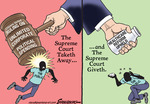
LA Sketchbook: Court giveth

qqxsgCourt Giveth.jpg

The latest by Steve Greenberg.

June 28, 2012

Gary Leonard: #19

LAO_Langers.jpg

June 26, 2012

LA Sketchbook: Border Line

qqxsgBorderLine.jpg

June 24, 2012

What should the Lakers do next?

With the NBA Finals now over, attention locally has turned back to the Lakers. There's a sense that the Lakers are at some sort of crossroads now. The roster as currently constructed is not good enough to win a title, and it's clearly a step below the Oklahoma City Thunder in the West.

So what should the Lakers do? Unfortunately, the team is stuck because there's not a move that I see which can put the Lakers over the hump.

There are some people (including a few individuals in the Lakers front office) who believe that the team should build around Andrew Bynum. If you're one of those people, then I think you're completely delusional.

This was Andrew Bynum's seventh season and it was supposed to be the year that he stepped up and became a leader on the Lakers. On the court, it was his best year, as he started in the All-Star Game and was Second-Team All-NBA at center. It's pretty clear that Bynum is currently the second-best center in the NBA. But there's a big difference between being the second-best center today and being the second-best center 15 years ago when Hakeem Olajuwon, Patrick Ewing, David Robinson, and Shaquille O'Neal were all still in the league.

Outside of Bynum's raw numbers, he was a complete embarrassment. Truly great NBA players don't openly admit that they didn't try hard enough in important games. Players who care about their team's success don't purposely sit out of huddles because they're annoyed with a coach. Smart and mature players don't commit cheap flagrant fouls and then take off their jersey on the court after being ejected.

If anyone thinks that Andrew Bynum "grew up" this season, then I'd be happy to play them audio from one of multiple embarrassing media sessions where he proved that he was still a little kid. His behavior might be understandable if he was still 18 and in his rookie season. But Bynum has been in the league for seven years now, and if he hasn't changed yet, then I don't think he ever will.

Yes, it's true that Bynum reads more books than any of his teammates. And sure, he has worked hard to get this point in his career. But I don't see anything resembling the innate competitiveness that I see in Kobe Bryant. Instead, I see an attitude closer to Lamar Odom's, in which his head is in the clouds, you never know what player you'll get on any given night. That's not a person you can build around.

Even if you want to disagree with me about Bynum's personality, and you think he can still grow, then there's another compelling reason why the Lakers can't build their team around him. He's injury prone. Only once in Bynum's seven seasons has he played 82 games. Heck, only once has he even played more than 65 games. It's true that Bynum played a full season in 2011-2012, but it was a lockout-shortened year, and Bynum missed the first five games due to suspension.

If he felt healthy right now, then he would be training for the Olympics. Instead his knees are so fragile that he's skipping the London Games and hoping that a procedure in Germany can keep him going for another full season.

The Lakers owe Andrew Bynum $16.1 million next season in the final year on his contract. At some point, they will have to decide whether to give him a 5-year maximum deal that could cost them around $100 million. They may feel pressured to do that deal since good big men are so hard to find, and there's really no available superstars that they can just trade for. But if the Lakers give Bynum a max deal, then 18 months is the over-under on when I'd bet they start regretting the contract.

The best option for the Lakers is to trade Bynum this offseason when his value is at its highest, and see what kind of haul they can bring in. Reportedly, the Brooklyn Nets would be open to taking Bynum in a sign-and-trade for Deron Williams (provided Williams actually wants to play here). That's a deal I'd take in a heartbeat. Unfortunately, it's viewed as a longshot right now because of the cap and other reasons. Some Laker fans want Bynum to be traded for Dwight Howard, but I would never trade for a guy coming off of back surgery.

Many Laker fans think the team should trade Pau Gasol. He's owed $38 million over two seasons and his play has clearly declined. Furthermore, he doesn't fit in Mike Brown's system at all if Bynum is still on the team. Gasol works best when he can glide in and out of the paint, and when Bynum is on the floor, it pushes Gasol to the perimeter, where he's out of his comfort zone.

Gasol is now 31, and it's hard to believe he's played 11 full seasons in the NBA. There's a good deal of mileage on his legs and that may be why he's slowed down. It's also possible that his desire isn't as strong now that he has two championship rings. Either way, Gasol is now a complementary player and not a superstar sidekick anymore.

The Lakers should be actively pursuing trades for Gasol, like they did last offseason in the failed Chris Paul deal. In that trade, the Houston Rockets were willing to give up Kevin Martin, Luis Scola, and a first round pick for Gasol. If the Rockets still value Gasol that high, then they might be persuaded to traded Scola and disgruntled point guard Kyle Lowry to the Lakers for the Spanish power forward.

Scola is a power forward that would probably fit better in Mike Brown's system, since he can play outside the paint a little and is a good passer. Lowry might just be a perfect fit for the Lakers at point guard. Plenty of people have called into question Kobe Bryant's game at this late stage in his career. Having a quality passing point guard like Lowry would provide the Lakers with someone to set Bryant up and give him better opportunities. Lowry can also defend the quick point guards in the NBA who give the Lakers so many problems, giving Kobe a bit of a break on defense. That deal may not put the Lakers over the hump, but it will make them a better team.

Some people have wondered if the Lakers should re-sign Ramon Sessions. If I had a choice between signing Sessions or no one, then I'd take Sessions. He showed that he could be a catalyst on offense this year and he gives the Lakers some sorely-needed athleticism. But there's also a reason why Sessions has never been considered an elite point guard. His game has limitations, he's not a great defender, and he was a huge disappointment in the playoffs this year. Perhaps he can come back next season in good health and with a full training camp and be better. It's difficult to spend $30 million to find out if that's true though.

Unfortunately, the NBA's new labor agreement makes it extremely difficult for the Lakers to bring in an impact player. If they can't cut salary soon, then in a few years they'll be paying a $4 luxury tax for every dollar they're over the cap. Even if they decide they want to pay that much of the tax, they have zero cap space to sign top free agents, and it's hard to find a trade where salaries and superstars match. By rejecting the Chris Paul trade, David Stern set the Lakers up for several years of slow decline followed by several more years of rebuilding from scratch.

Still, Mitch Kupchak and Jim Buss do bear some responsibility for the Lakers' current predicament, because they've done a terrible job of giving the team quality depth. The San Antonio Spurs have also had low draft picks and significant cap constraints, and they're in a city that fewer free agents want to play. Yet, the Spurs managed to have one of the deepest teams in the league this year.

Right now, the prevailing sentiment is that the Lakers will essentially stand pat and keep as much of the team together as possible. With a full season of training camp under Mike Brown and a regular season with more rest between games, they should actually be better next year. But unless Kevin Durant blows out his knee or Russell Westbrook has a complete meltdown, the Lakers will be a cut below the Thunder. And they're a cut below the Heat too.

For some teams, going to the second round of the playoffs or the conference finals is good enough. But for the Lakers, it's championship or bust. Right now the choice though is between unattractive options. The first option is to be one of the best teams in the NBA, but only have a shot to win the title if something crazy happens like an injury to a star player on another team. The second option is completely break up the team, get high draft picks over the next few years, and hope that they pan out so the Lakers can be an elite team again in six years or so. The best choice is probably to go with the first option, knowing that they'll be forced to go with the second option in about 2-3 years anyways.

June 21, 2012

Eating cheaply along the Expo Line with the 99 Cent Chef


Billy Vasquez, who blogs as the 99 Cent Chef, lives within walking distance of the new Expo Line route. He offers a night-and-day culinary guide updated with this week's extension into Culver City.
This is not a typical boring travelogue, but a feast for the eyes in which The 99 Cent Chef pulls out all the f-stops!...

From my home in the Village Green, I can walk to L.A.'s latest transportation option, the Expo Line - so now my visitors can ride along with the Chintziest of Commuters to get a cheap-eyed view.

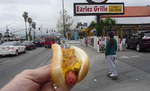
expo-earlez-hotdog-bv.jpgAnd be prepared to stop along the way for economical eats: from flame broiled $1.25 hot dogs at Earlez Grille on Crenshaw Boulevard, to a 99-cent (per piece) sushi Happy Hour at Octopus Japanese Restaurant downtown, from a delicious $1.50 Birria Taco on homemade tortillas at Danny's Tacos (also downtown), to luscious free candy samples from See's Candy in Culver City, and finishing up at the end of the Expo line on Venice Boulevard in Culver City for hormone free hot dogs from Let's Be Frank, and a vegetarian feast at India Sweets & Spices -- both a measly $5.50.

More at his blog...

Western Costume feted at LACMA

moses-schmoozes.jpg

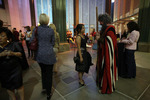
The Costume Council saluted 100 years of service to Hollywood films by the Western Costume Co. on Wednesday night at the Los Angeles County Museum of Art. Moses (Ned Albright) chatted with Miwa Kosuga in the museum's atrium after the program. Photo by Iris Schneider.

Leave it to Beaver guys

LAO_hopeleaveittobeaver.jpg

June 20, 2012

Folding paper: Origami as contemporary art

floderer-boom.jpg

Vincent Floderer's gorgeous construction Boom! assails the retina like a burst of intergalactic activity frozen in time, not the work of a contemporary origami artist. Instead of folding, the French artist's technique involves the application of watercolors and Indian ink to Wenzhou calligraphy paper, which he dampens, stretches and crumples to form jagged three-dimensional corals, sponges and other organic and abstract creations.

Boom! is among the many highlights of The Japanese American National Museum's Folding Paper: The Infinite Possibilities of Origami, the first major exhibition to look at origami as a contemporary art form. Featuring 150 works by 40 international artists from 16 countries, it is also a survey of the explosion in global origami art over the past fifty years.
Some of the show's exquisitely beautiful origami forms are the works of artists with backgrounds in sculpture, architecture or design; others trained as physicists, mathematicians and engineers. Many have turned their childhood passion for origami into complex explorations of tessellation (the creation of repeating abstract and textured patterns), modular origami and sculptural animal, insect and flower shapes. The work of the scientifically based artists has given rise to "origami math," "computational origami," and algorithms that map the way for artists to fold increasingly intricate shapes from a single sheet of paper. The exhibit also includes examples of origami's infiltration into the worlds of fashion, design, architecture, medical research, astronomy and manufacturing.

"Folding Paper" will be on view in Los Angeles through August 26, then travel to museums in Sacramento, CA; Portland, OR; Keene, NH; Peoria, IL, and Wasau, WI through August 2014. Organized by independent curator, author and educator Meher McArthur for the traveling exhibit service of the non-profit organization International Art & Artists, the show, which opened on March 10, has been the hit of the season for JANM.

McArthur, who specializes in Asian art, compares origami in Japan to woodblock prints in the late 19th century, when Japanese treated them so casually they would pack pieces of porcelain in them to send to Europe. Or to Japanese bamboo baskets, which only recently gained the status of an art form in Japan. "There was never a distinction between art and craft," she explains, although today the Japanese have adopted the Western distinction.

One artist represented in the exhibit, physicist and full-time origami artist and educator Robert Lang, has designed and catalogued over 500 original origami patterns, created origami algorithms, and invented a revolutionary new technique that allows for the addition of multiple appendages using a single sheet of paper. Lang has also applied origami techniques in his designs for a folding glass lens for a giant space telescope at Lawrence Livermore National Laboratory and an automobile air bag. The algorithms, he says, involve the principles of both algebra and geometry, and "a lot of manipulating squares and rectangles, like packing shapes in a box."

Yet Lang notes that the "growth and interest in origami preceded the heavy involvement of math," with the real renaissance occurring in the mid-20th century. Pioneer Akira Yoshizawa was responsible for turning what had been considered a children's pastime in Japan into a form of sculptural art. On March 14 of this year, Yoshizawa's birthday, Google asked Lang to design (after signing a non-disclosure agreement) the origami shapes that became this logo on Google's Web site.

The architectural portions of the exhibit include this short documentary on an origami-inspired temporary chapel, St. Loup, in the foothills of the Jura in Switzerland, and a reference to another origami-based building, the Klein Bottle House in Melbourne, Australia. Origami fashion is represented by Linda Tomoko Mihara and L.A. fashion designer Monica Leigh, and the exhibit's one installation is a menacing swarm of origami locusts made from sheets of U.S one dollar bills, by Swiss-South African artist Sipho Mabona.

Nancy Matsumoto is a New York City-based freelance writer who writes frequently on Japanese American issues and culture.

June 18, 2012

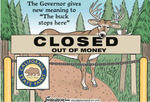
LA Sketchbook: Bucks stop here

qqBuckStops.jpg

June 17, 2012

Watergate, reconsidered

Joel Bellman, formerly an award-winning radio reporter and editorial writer for the Los Angeles Herald Examiner, is a longtime journalism instructor for UCLA Extension and the communications deputy for county Supervisor Zev Yaroslavsky. He submitted this piece as an individual.

Today, along with other dads, I'm celebrating Father's Day with my two sons. We are toasting the memory of my father, Samuel, who passed away almost three years ago, and whose politics, literary passions, and unbridled enthusiasm for popular culture - high and low - helped shape me.

And falling on June 17, this Father's Day we are also toasting someone else, one of those unsung heroes whose quiet competence in a modest job happened to change the course of modern history: Frank Wills, the overnight security guard at the Watergate Hotel who 40 years ago today spotted that persistent piece of Scotch tape on an office door. That was only the first piece of tape that eventually took down the administration of President Richard M. Nixon and sent many of his top aides to federal prison.

For journalists, anniversaries are always a handy excuse to revisit the past for another lazy meander down memory lane. Yet it's virtually impossible to convey to my sons' generation how momentous the Watergate scandal really was. It has redefined American politics for more than a generation, disrupting the natural presidential succession and redirecting the course of domestic and foreign policy as profoundly as the asteroid that smashed into the Yucatan peninsula 65 million years ago extinguished most life on earth. Politically speaking, Watergate was our catastrophic extinction event: it shattered trust in elected officials, destroyed confidence in government, and deeply undermined the fundamental legitimacy of a public sector empowered to levy taxes and undertake projects or activities on behalf of, or deliver vital services to, the general public.

Thanks to Richard Nixon's criminal abuse of his office and attempted usurpation of constitutional authority, Watergate spawned a corrosive and pervasive cynicism that still infects today's body politic like a lethal virus.

The tax revolt? Term limits? Citizen reapportionment commissions? The never-ending cycle of campaign and election "reform"? Government by initiative? Like them or not - and I don't - I would argue that it all started with Watergate. That scandal is surely the ultimate aversion therapy for anybody with naive and idealistic notions of politics as a noble career where principled leaders aspire to serve their country with honesty and dedication.

But even those dark and troubled times had their popular heroes, and all the self-serving myth-makers of the journalism world cannot diminish the indispensable role played by Washington Post reporters Bob Woodward and Carl Bernstein and later by many others, and the superlative reporting achievements that succeeded in calling the Nixon administration to account for its misdeeds. I'm not exaggerating when I say that American democracy, the rule of law, and our constitutional freedoms hung in the balance - and were ultimately rescued by the American press and the pressure they brought to bear on other institutions such as Congress and the courts which ultimately checked the power of a runaway executive branch.

Watergate was not only one of the most dramatic, compelling and memorable political tutorials any generation could possibly experience: it was also the high-water mark for American journalism.

In many respects, it's been an accelerating downhill skid ever since. Woodward and Bernstein embarked on the Watergate saga as a pair of young and inexperienced metro reporters, and emerged two years later as bona fide superstars idolized by their colleagues and canonized - even deified - by Hollywood. If not for them, investigative journalism as we know it today would not exist.

But if it didn't, in some ways we might be a lot better informed about what's going on in our communities, and throughout the world.

Call it the Woodstein paradox. If a couple of brave reporters and their courageous news organization can uncover a monstrous criminal conspiracy in our political system and successfully drive the rascals out of the highest elective office in the land, rescuing democracy and proving The System works, then why - 40 years later - is The System more paralyzed, polarized, sclerotic and delegitimized by the electorate across the ideological spectrum?

Rather than restoring public confidence, the aftermath of the Watergate scandal has seen it demolished. After Woodstein, what fresh-faced journalistic aspirant wouldn't want to become an investigative reporter? All you needed was enough attitude, aggressiveness, and a simple credo: "follow the money."

Reality is a little more nuanced than a pop-culture cartoon. When I transitioned into politics more than 20 years ago, after nearly a decade in print and broadcast journalism, I thought I was a smart and savvy guy.

I got my comeuppance in a hurry.

Not a single issue was what it initially seemed - everything had layers of policy implications, every player part of a vast web of obscure but often defining relationships, every move had reverberating consequences, every stray remark threatened new peril should it be misquoted or misconstrued. Even truthful comments accurately reported afforded no protection: as Michael Kinsley cracked, in politics a gaffe is when somebody accidentally tells the truth.

True heroes and villains are rare, despite the play-acting and atmospherics. Motives are murky, policy outcomes unclear. Much is not what it seems, not because of deception, but because of complexity: politics is, after all, nothing more than individual human behavior, the good, the bad and the ugly, played out on a vastly larger stage with a cast of thousands.

To really understand and explain it, reporters should be embedded in their beats, where they can cultivate sources, develop relationships, learn the routines, know what to look for and who to watch out for. They need to attend all those boring meetings and see firsthand what goes on, gain the confidence of the bureaucrats who control access and information, work the political staffs.

Too often, investigative project teams are little more than a strike force, swooping in to attack a specific and isolated issue, and then, like The Lone Ranger - "Come, Tonto, our work is finished here" - gallop off into the sunset, never to be seen again. It can be exciting, glamorous, award-winning, and lucrative - and ultimately entirely pointless and inconsequential. It's been said that when you're a hammer, every problem looks like a nail. And when you're an "investigative reporter," everything looks like a criminal conspiracy.

Worst of all, as one news organization after another guts its basic reporting staff and cuts back or eliminates entirely beats and bureaus, they continue to tout their high-profile, advertiser and web-view driven "investigative" units. Even as news outlets are patronizing their audiences for being such sophisticated insiders, the poor chumps are growing more ignorant about and irrelevant to a political process that is leaving them behind.

I don't deny there are occasionally genuine conspiracies, and the press can and does play a salutary role in helping to expose them. Iran-Contra, Enron, the Madoff investment scam, the BCCI money-laundering scheme, and closer to home, the City of Bell and criminal mismanagement of the LA Memorial Coliseum. In none of these, however, did the press play the leading role - very often they were chasing work done by legislative or prosecutorial investigators, and reporting the leaked findings later.

Watergate was in many ways truly sui generis - one of a kind. Though we now know that Woodstein's Deep Throat source was the #2 guy in the FBI, pointing them in the right direction, they deserve full bragging rights for the fearless enterprise reporting they did.
But 40 years after Watergate - the epic scandal that kindled my interest in politics and fired my determination to become a journalist - I have gained much more respect for the mostly honest and dedicated people working in government, the vast majority of whom are not crooks, and increasingly soured on a sensation-seeking press corps and the shallow, inattentive readers, viewers and listeners it too often serves so badly.

What would my father say to all this? I don't know - but sometimes, Dad, I almost think that maybe it's better you're not around to see it.

Sports Beat: June 17, 2012

chris-paul-clippers-grab.jpgIt's been too long since my last post, so I figured I'd come back with my take on a few things going on in the LA sports world:

The Kings' Stanley Cup championship is quite a vindication for AEG. For years the knock on the corporation was that they could build and manage stadiums, but they couldn't manage teams. Well, not only are the Kings champions in the NHL, but the AEG-owned LA Galaxy are also the reigning MLS Cup champs. It kind of makes you think Phil Anschutz can get Super Bowl winning NFL team here.

More impressive with the Kings is how they've been managed. They won the Cup with an excellent young corps of players who are mostly locked up to long-term deals. There's few teams in a better salary cap situation right now, setting the Kings up to be a super power in the NHL for the next several years.

* * *

I was disappointed that the Kings didn't have Bob Miller call the Stanley Cup Finals on radio. That's not a knock on Nick Nickson, who does a perfectly good job as the Kings regular radio play-by-play man. However, I've always viewed Miller as having the same status as Vin Scully and Chick Hearn. He's one of the nicest and most genuine people I've ever met, and he's a personal hero who has had a positive influence on my own broadcasting career.

When the Dodgers make the playoffs, and the games are televised by Fox and TBS, Scully does the bulk of games on radio while Charley Steiner and Rick Monday do a few innings. When Hearn was doing Laker games, fans could always listen to him on the radio when network obligations came into play (granted, Hearn normally did a simulcast, as does Scully for some innings).

Miller admitted in an LA Times article this week that it was frustrating he couldn't call the final. He meant on television, and he would never knock Nickson. But most LA fans wanted to hear him, and the Kings should have at least had Miller and Nickson switch off on the radio. I certainly wanted to hear Miller's call live.


* * *

Sometimes you have to admit you're wrong. I've been very critical of Ned Colletti over the years, but I think just accept that him and I see baseball very differently. Right now he's proving that his way works pretty good too.

I still think Colletti works better when he has limitations. For example, the Dodgers are starting A.J. Ellis at catcher because Colletti couldn't afford a Rod Barajas-like veteran to block him. Remember how Colletti attempted to block Matt Kemp by acquiring the likes of Juan Pierre, Andruw Jones, and Luis Gonzalez, only to see Kemp outplay all of them. But it's also true that Colletti has done a pretty good job of recognizing which Dodger prospects are legitimate major leaguers, and which ones couldn't hack it. He got rid of pretenders like Andy La Roche and Joel Guzman, while resisting media calls to trade Kemp and Clayton Kershaw.

The Dodger farm system has been heavily criticized in recent years, but with all the contributions we're seeing from the team's young players, one has to wonder if publications like Baseball America are just wrong in their assessment. Still, perception does matter. If the Dodgers want to make a trade at the deadline, it helps to have prospects that other teams think are good.

* * *

I think Don Mattingly deserves a ton of credit for the Dodgers success. When Mattingly was hired, many media members derided the choice. They said that Mattingly had no managerial experience, and they felt one flukey incident with Jonathan Broxton on the mound was "evidence" that he wasn't ready.

I was one of those who said that Mattingly deserved a chance. It's true that he hadn't managed in the minors, but being groomed for years by Joe Torre had to count for something.

It's not that Mattingly is a brilliant strategist. These days, studies show that most MLB managers employ roughly the same in-game decisions. Rather, what makes a great manager is his ability to manage and motivate 25 personalities over the course of a 162 game season. Over the past 20 years, few people have proven better at handling a clubhouse than Torre. So far, Mattingly has shown that he can handle one too.

Nearly all Dodger players speak highly of Mattingly as a person. And he's done a particularly good job in developing some of the team's young players. Dee Gordon is proving to be the most recent beneficiary of a Mattingly decision.


* * *

T.J. Simers has been writing his Page Two column for well over a decade, but I'm still baffled that some PR reps haven't figured out how to prepare for an interview with him. Dodgers CEO Stan Kasten was the latest to fail the Simers test in a column earlier this week. On the other hand, Albert Pujols passed his test with flying colors.

There's two simple rules to keep in mind when being interviewed by Simers:

1) Don't take yourself too seriously, because Simers doesn't take you seriously.
2) Don't give him PR spin, because Simers will see right through it.

If you're ever indignant or angry around Simers, then he'll tear you up. All you really need to be is open and honest, and it's OK to joke with him.

* * *

I'm not usually a big fan of making moves for PR reasons, but that's basically what the Dodgers did in signing Andre Ethier to a 5-year $85 million contract, and it's a move that I actually agree with.

There's no way that Ethier will be worth $17 million in 2017 when he's older, slower, and 35. Heck, he's been playing old and slow since he was 28. He does hit for some sorely needed power, but $85 million is an awful lot to guarantee a guy who's only hit more than 30 homers once in his career.

Still, in today's warped baseball world, the new ownership group rightly felt that they had to make a "statement" by proving it could keep (and pay) one of its better players. This should make the Dodgers more enticing to big name free agents down the road.

If the new ownership has the money it claims to, then it should be able to absorb large Ethier-like deals the way that the Yankees do. That doesn't mean it's necessarily smart business, and that doesn't mean there aren't other ways to win. But Guggenheim Baseball was tested early in its ownership tenure, and it had to get this done to let the fans, media, and baseball world know that they could back up their words with actions.

* * *

One news item that slipped under the radar this past week was the departure of Clippers GM Neil Olshey, who left for Portland. I'm baffled as to why the Clippers didn't take care of him earlier, and it's enough to make you doubt that Donald Sterling has changed.

It's not that Olshey has proven to be a basketball genius. Blake Griffin is a Clipper because they won the draft lottery a few years ago. Chris Paul is a Clipper because the NBA rejected his trade to the Lakers and because the Knicks didn't have enough tradeable assets. But Olshey has proven to be a particularly astute basketball mind with his other moves, and I really think he's had a significant impact on changing the culture of the organization.

This is a very important time for the Clippers. In the next year, they're going to have to convince Paul and Griffin to both sign long-term contracts, or else they'll risk becoming the Clippers of old. One great way to re-sign them is to have front office stability. That would include keeping the well-regarded GM who helped build the winningest team in franchise history.

Instead, Olshey worked this past season on a month-to-month contract. Instead of giving him security, the Clippers offered him a one-year $750,000 contract. The Portland Trail Blazers offered him three years and $3.6 million, so he left.

I'm convinced that Olshey would have taken a bit of a hometown discount to stay in LA. After all, Olshey should have some loyalty to the organization that took an out-of-work actor and turned him into an NBA GM. But the two offers weren't even close, and I'm not sure why the Clippers weren't even remotely competitive with their offer.

Now, with the NBA Draft less than two weeks away, the Clippers are without a GM. This should be the time of year when the Clippers are working on extensions for Griffin and Paul. Instead it's a time of uncertainty.

Concert at the Getty

dancing-getty-iris.jpg

Dancers enjoy the music on Saturday at the Getty Center's "Saturdays Off the 405" concert series. Photograph by Iris Schneider.
June 14, 2012

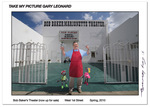
Bob Baker's theater for sale

June 10, 2012

Only in LA: Time to leash dog owners?

Time to leash dog owners?

sh-canine-regs.jpgTurnabout is fair play, I suppose. Jonah King spotted a sign at a Westside apartment that reminds canines that they must, uh, pick up after their owners.


Pecking out a living

sh-acting-rooster.jpgDavid Batterson found an agency that boasts one actor who is an early-riser.


Shootout shrine

sh-nohoshootout-car.jpg

The LA Weekly recently ranked the Los Angeles Police Museum in Highland Park as one of "10 Oddball L.A. Museums Worth Seeing." The newspaper singled out the gallery's permanent exhibit on the 44-minute North Hollywood gun battle of 1997 for "Best Shootout Conservation" honors.

More than 1,600 rounds were fired in that confrontation, which left two heavily-armed bank robbers dead while 11 LAPD officers and seven civilians were injured.

The outdoor portion of the display is temporarily closed because of some construction. It includes four vehicles that came under fire: the robbers' Chevrolet (see photo) as well as an LAPD black-and-white (struck by rounds in 56 places), a battering ram and an armored truck. The inside exhibit, which is open to the public, includes mannequins of the robbers showing the armor and automatic weapons they used, as well as a 22-minute video on the shootout, which is absolutely riveting.


As for the oddball label...

sh-mobile-phone.jpg"Had we known we were in the competition, we could have pulled out some of the really odd stuff we have (in storage)," quipped Glynn Martin, a retired cop who is the museum's executive director.

For instance, there's a mobile phone of sorts that belonged to interim Police Chief D. A. Davidson in the late 1930s. It was an era when local government, and the police department, were the subjects of corruption investigations in L.A.

Davidson would hook up his phone to an outdoors line when he wanted to make a call.
"He figured the phone lines in his office were bugged," Martin explained.


Uneasy neighbors

In 2009, the LAPD moved from Parker Center to a new building across the street from the Times, an event that did not go unnoticed by novelist (and ex-Times reporter) Michael Connelly. His latest thriller, "The Drop," features one officer who is so fearful that reporters are "watching from the newsroom across the way" that she keeps "her shades permanently lowered."

Inside job

Connelly's mention reminded me of a different type of spying incident that occurred in the Times' City Room during the 1970s, back in typewriter days. It was near deadline and a jittery substitute weekend editor was fearful of approaching a temperamental writer to check on the latter's progress on a story. So the editor crept a few rows behind the reporter, pulled out some binoculars, and tried to see what he was writing. (The reporter chased him away, and finished the story in time.)


Fast-breaking up Figueroa

sh-magic-statue.jpgI've always thought it odd that the 8-year-old bronze of Magic Johnson seems to depict him leaving Staples Center. Where is he pointing to? Then it struck me the other day: Magic must have had a premonition that someday he would own a piece of a baseball team. He's pointing in the direction of Dodger Stadium.

Undressed for success

sh-clipper-stripper.jpgOne of the most popular performers at Staples Center this year was Mitchell Lancaster of Rossmoor, a Clippers season-ticket holder known as the Clipper Stripper.

Lancaster, 21, would drive the crowd into a mini-frenzy during time-outs when he appeared on the Jumbotron as he shed eight Clippers shirts, one after another, while jumping up and down.

A family values guy, Lancaster would not doff his 9th shirt, which said, "We Run L.A.," on the back, a clear taunt aimed at the rival Lakers.

The Stripper has received two endorsement offers (one from a cape manufacturer), but turned them down, preferring to rest after the team's intense playoff run. His father Hal joked that he had considered putting a message on the shirt that said, "Also Available for Bar Mitzvahs," but decided against it.


Longest case of road rage?

The Beachcomber newspaper reports that two angry drivers were in "a cut-you-off back-and forth" duel in Long Beach that may still be going. One of the vehicles bore a bumper sticker that said: "Follow Me to Hawaii."


miscelLAny

sh-la-costa-rica.jpgAfter David Harris graduated from Loyola Marymount, he entered the Peace Corps and was sent to a small town with a familiar name in the central highlands of Costa Rica. "Yes," says his dad Roy, pictured here with David (center) and another son, R.J., on the left, "the Peace Corps sent him from Los Angeles, Calif., to Los Angeles, Costa Rica."

Morning commute's not as busy in this L.A.


That's it

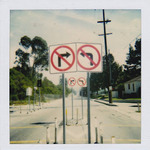
sh-signs-left-right.jpgYou've reached the end of the column. Simply follow the signs on your way out.

Steve Harvey may be reached at steveharvey9@gmail.com. His Twitter handle is @sharvey9


June 8, 2012

The most fleeting moment of sporting fame

While I wait for someone (preferably a King) to be a hero in Saturday's Game 5 of the Stanley Cup Final, I was thinking back to my brief, very brief, and somewhat tragic street hockey career.

For this nerdy kid growing up in the San Fernando Valley, there was one day when hockey fame was in my sight, only to see it taken away in what I still maintain is the greatest refereeing error in the history of North American sports. Also, it is a great example of what happens when you put adults in charge of kids' games.

Let me take you back to the scene at St. John Baptist de la Salle Elementary School in Granada Hills in the spring of 1977. Street hockey has become the popular lunchtime recreational activity for the fifth and sixth graders, thanks in part to a friend who played youth ice hockey, and was a goalie to boot. (I've never played ice hockey as I can barely stand on skates, one in a long line of athletic limitations I have.)

My friend brought in some of his hockey gear to school for us to see. The big catching glove, the mask decorated with a Spider-Man design, and the large blocker were all big hits. After a time, many of us had our parents go to the local sporting goods stores to pick up street hockey sticks. Eventually, a few more kids picked up street hockey balls, which are a little bigger than a baseball and were made of a hard orange plastic, that was designed not to have only minimal bounces.

While the thought of loosely supervised 11- and 12-year olds running around the playground wielding sticks and wearing no facial protection would likely not be allowed now, we were able to get away with it. The games were fun and usually competitive. I don't recall anyone getting hurt enough to require a trip to the nurse's office. The nature of the game made it so that even the gawky, unathletic kids like me were able to be somewhat proficient at it.

For reasons I can't remember, those of us in the fifth grade felt that we needed to take on the sixth graders in a formal game. It would be a game with features like rules, officials, and someone keeping score on a piece of paper that would give it an air of authority. We would not have actual goals with nets to use. Instead, we were granted the privilege of borrowing traffic cones to set up the goals.

Eventually, rules were hashed out and some eighth graders would serve as officials. Each team had to make sure that every player (just the boys played) would see some action during the game, a provision that most of us who had played youth sports of any kind were used to. Although I wasn't a team captain, I sat in with some of my classmates to set up groups of players so that we would have a mixture of someone who could play goalie, some guys who could score, and one or two of the kids who just had to play anyway.

At game time, our careful preparations were thrown out the window by our teacher, who decided to form the teams in alphabetical order into groups of six so there "wouldn't be any hard feelings." However, this just served to tick off those of us who had prepared the lineups. But, few decisions in life are harder to appeal than those set down by a Catholic school nun.

The sixth graders were able to play whatever lineup they wanted, encouraged by their seemingly far more lenient lay teacher. We plucky fifth graders grumbled at the seeming injustice of this. We knew we had better players than the sixth graders. But, we couldn't use them because their surnames all started with letters at the back half of the alphabet. (Alphabetical order is nothing more than a quiet form of discrimination set up by people with names like Aaron and Adams.)

When the game started, our improvised lineup managed to hold on against the sixth graders' best efforts. Eventually, we just started substituting in whatever players we wanted when we realized that the teachers were not paying much attention to just who was out on the playing area, which was the school's parking lot. Also, all of us (on both teams) were playing in our standard school uniforms of a white shirt and brown pants.

After about 10 minutes, I found myself in front of the goal with just the sixth grade goalie in front of me. I took a shot at goal that bounced on a pine cone that was on the asphalt and it bounced over the goalie's head for the first goal of the game

There it was! For the first time in my life, true athletic success had been achieved! It was a great feeling. At the time, I felt like I was my team's Marcel Dionne. (If you're new to hockey, please feel free to Google him.)

I walked off the blacktop to celebrate with my teammates while a new set of players went out to play. Then, I found out some horrifying news The eighth grade refs, after consulting with the teachers, disallowed the goal. It was decided that because the ball took a bad bounce that the goal was "unfair."

You might think that the average kid would not take this news well. You would be correct. I was incredibly upset at this. I could not engage in a full blown tantrum because I would have run afoul of my teacher and principal.

I started pointing out various times when other sporting events had been decided by bad bounces. They really should not have let me go to the library and read all those sports history books and let me bring up references to the end of the 1924 World Series. It ended up on a bad hop double in the 12th inning of Game 7 by Washington's Earl McNeely over the head of New York third baseman Fred Lindstrom. This line of argument proved to be futile in the face of the older kids complaining about stray pine cones.

The call stood. It was no goal. At that point in time, I came to the realization that life is inherently unfair. A good bounce for me was considered a bad bounce for the other team. And bad bounces were "unfair." We were not supposed to win because of "luck." We were supposed to win because, ... well, I didn't know anymore. But, I was pretty sure it wasn't meant for the fifth graders to win.

As I recall, the game ended up a 3-3 tie. I didn't score any goals, or even had any more shots. We were hoping to play longer. But, some parent decided that she had to park her car where we were playing even though school wasn't going to let out for another 30 minutes. And, in 1977, parents had less compunction about driving their cars through a group of kids playing in a parking lot than they do now.

The street hockey fad in my neighborhood seemed to die out after that game. My stick likely ended up in the garage and eventually in the trash. Or it could have broken. Whatever the case, my street hockey career's one moment of fame came and went in a flash. The lucky bounce that may have made me the most minor of sports celebrities at my school proved to be nothing more than a life lesson about how unfair the world can be.

June 7, 2012

Ficus eats parking meter

ficus-vs-meter.jpg
Los Angeles isn't the only jurisdiction where the street trees devour the sidewalks. This was spotted the other day on 32nd Street near Ocean Park in Santa Monica. You might wonder which came first — the ficus or the parking meter — but that's one of the new electronic, credit-card accepting meters. So someone in the past couple of years installed the meter between the roots. Green thumb?

Earlier on LA Observed:
Proof that ficus trees are bad for the sidewalks

LA Observed photo by Judy Graeme

June 6, 2012

The power of firsthand narrative: Outsourcing the NHL finals

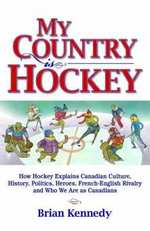
Brian Kennedy, a professor English at Pasadena City College, covers the NHL at night. We think he's the only Ph.D. in the press box at Staples Center. His latest book is "My Country is Hockey: How Hockey Explains Canadian Culture, History, Politics, Heroes, French-English Rivalry and Who We Are As Canadians."

mycountryishockey.jpgYou may not realize it, but if you go to a major hospital in the US for tests, the results of your x-ray or MRI might be read by a doctor as far away as India, who is on contract to provide a preliminary diagnosis based on the evidence sent to her or him online. If you get your taxes done by a large commercial accounting or tax prep firm, what you see in the front office is not representative, necessarily, of where the work is done.

The data could very well be crunched half a world away, and the results shown to you electronically for an e-signature and subsequent submission to the IRS. So says Thomas L. Friedman in his book, "The World Is Flat: A Brief History of the Twenty-First Century," originally published in 2005 and updated a couple of times since. Why is this condition possible? By the intersection of three things: an educated and capable foreign workforce, the "need" (questionable to some) to perform work as cheaply as possible, and the ability to move data around the world quickly and reliably via fiber optics over the Internet.

The upshot of all of this is that jobs done locally prior to the past decade or so may now be exported, with the end user of the product seeing no difference in quality or delivery time.

Friedman spends considerable time discussing how the Internet has decentralized the power of production, with one phenomenon of particular concern: the creation and distribution of news and information. Once held by a few large entities (newspapers, broadcasters), this function is now spread to the masses, with anyone who owns a relatively inexpensive computer and has access to the Internet being able to be his or her own "channel," distributing information and, as a logical outcome, creating the news.

The result is what you see around you: the financial failure of daily newspapers and the increasing reliance on the net for information, to the point where what is a "trusted source for news," to use the old tagline, has been entirely redefined.

Obviously, LA Observed is one such new-style source. But if LA Observed is news outsourced, how close to the action does the writer have to be to write the story?

To marry the terms I began with to the area that I work when you read me here (hockey coverage from the point of view of the "PhD in the Press Box,") leads to a key question:
Could someone in India with sufficient knowledge of hockey cover the Stanley Cup Final effectively? (That is, if she or he wasn't busy reading your MRI or doing your taxes.)

I ask this because at the moment, I'm in the countryside across the Swiss-French border from Geneva. I've been abroad since February, working. And while I covered the Kings for most of the season for a national online sports outlet, I didn't expect the team to get to the very brink of winning the Stanley Cup. So I was caught out when they got to the point they've arrived at, and couldn't get home. Still, my editor had arranged press credentials for me with the NHL. What to do?

One choice was just to leave readers with no coverage. Not an option, and there was nobody to fill in. So it was decided that I would cover the games from afar, without making representation that I was closer than I am. For someone used to creating stories based on firsthand knowledge of events, this felt at first like an odd arrangement. However, I soon realized that the kinds of stories I typically write could have traction from a distance.

Being an academic and having established a style which features historical and literary references and perspectives, and because my mandate is not to write "gamers" but analysis, I found that my stories felt about the same to me as they would were I in LA. In some cases, I could even imagine myself doing the very same pieces sitting in my Pasadena office or at Staples Center rather than half a world away (where the cheese is amazing!) Then, too, I had lots of firsthand information at my disposal, largely because the technology which Friedman discusses. But there were also deficits.

I had to rely on NHL transcripts for my interview material. I couldn't ask players the questions I might have had I been at the arena. And yet even this lack is tempered by what I have learned about covering a series as big as the NHL Final.

Going all the way to the Stanley Cup with the Anaheim Ducks in 2007, I know that there are so many reporters around during the Finals that it's almost impossible for one guy to grab a player and talk to him exclusively. Someone's always listening. Often, nowadays, that person is recording, making video, or tweeting. In addition, players, always careful about what they say, are even more guarded when the stakes get high. Hence, the chances of getting a scoop or an inflammatory quote at this time in a season are slim.

So what makes what the reporter does, whether in print or online, any different from what anyone with a computer and the internet could do from his or her home in Bangor, Maine or Bangalore?

The answer lies in the double bind of technology. It gives the appearance of knowing, and it undeniably spreads a kind of knowledge. Yet machines do not create narrative, people do. Further to that, however, is the sense I've gotten while writing about these games from far away: that narrative is best created on the spot.

With the proliferation of technology and the access given by pro sports teams to players, contemporary fans have essentially the same set of data available to them that reporters have to them. Postgame comments are often broadcast live or close to live via team websites or those of credentialed media members who have captured video.

Thus it may be that technology fools us into thinking that being present isn't crucial and that access to raw data in the form of video of interviews and press conferences as well as statistics about the game is enough, allowing fans to create their own stories out of the data available. It might seem that there is no longer any need for the presence of a filter in the form of a writer. But that's an illusion, because sifting data, creating stories where none exist, figuring out what things mean, is still a skill learned and practiced at cost of time and energy, and this is still best done firsthand.

If I were in LA, I'd be writing analysis pieces. My raw materials would be watching the games, listening to player interviews, coaches' press conferences, and so forth. All of that is available to me from a distance. My job, then, would be what it is now: to digest the
information and present it in a way that readers hadn't thought of themselves, and this might be the last thing left to a journalist in the internet age. This, further, is something no amount of "tweets" will do, no matter how seduced both journalists and fans are by that technology in the moment we live.

Yet as I write this week, I find that it's not enough to rely on what I can learn via the Internet, even with the inside information that having NHL Media access provides. My experiences in covering the team for most of the regular season are essential to draw upon. Things players have said to me, ways I have gotten to understand them, and insights gained from observing up close all came back to give me perspective on what they were saying now.

But I also sense that feeling the energy of a team winning or the sadness of a team losing, dealing with the emotions of the players, no matter how carefully masked, must happen face-to-face in order for the most powerful stories to be created, because sports, like business or education or any human endeavor, is about people doing what people do, and how they react afterwards.

The day the games are played by machines, machines will be able to provide total coverage of the events which transpire. But as long as players are human, prone to highs of joy and angry lows which see them smashing sticks over crossbars or kicking over garbage cans, the only way to give fans a sense of why things happened as they did is to see it for yourself.

Your McDonald's drive-through order may be as accurately taken from several states away as from several feet distant, to cite just one final example from "The World Is Flat," but that's because production of fast food is not essentially an emotional endeavor. Trying to win the greatest trophy in the history of sports is, which is why, to cite an old ad, there's no substitute for being there.

June 4, 2012

Disney Hall 'Don Giovanni' doubles Downtown opera

What? An opera sweepstakes going on in the city formerly known as opera-poor?

Well, try this: at Disney Hall a posse of arts-elite collaborators led by Gustavo Dudamel and the LA Philharmonic put on a new, fanciful, hyper-stylized production of "Don Giovanni," while across the street the LA Opera trotted out its old Herb Ross staging of "La Bohème," both houses doing bang-up box office at the same time.

Not bad at all.

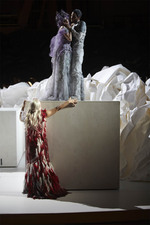
don-giovanni-1.jpg

But now we get to the interesting parts. Frank Gehry's deservedly famous Disney is a favorite tourist attraction. It was built, to acoustic perfection, as a concert hall, the one that would showcase the Philharmonic in all its splendor and provide the proper venue for sending out its glorious sound.

Aspirations do grow, though. And along the way Dudamel et al hatched the idea to "stage" opera: the Mozart-DaPonte trilogy in three successive seasons, for starters, beginning with "Don Giovanni." Nothing standard, of course, because the hull-shaped hall has no proscenium - it cannot accommodate the trappings of scenery, etc. Nor, importantly, is there an orchestra pit.

So they opted for a contemporary realization with creators who are adept at experimental ventures, director Christopher Alden chief among them. And there could hardly be a better choice -- we knew him from his revelatory work years ago at Long Beach Opera, a master at deconstructing a set piece like this, but not one to go in for the usual hijinks.

Even without Rodarte, whose sumptuous-to-sleek costumes are a Baroque eyeful in themselves, and even without Gehry's "installations," crumpled paper icebergs and giant cubes that provide platforms for the singers to cavort on and climb around, Alden brilliantly makes the case for the characters' inner drama - their floating urges, their undersea lusts. These nobles and peasants are no longer cardboard cutouts.

Now we know that Donna Anna openly acknowledges her guilty pleasure with the Don, why she kisses and caresses him while her fiancé - three's a crowd - stands breath-close to them. She's acting out what she feels and will not suppress, rather than just playing a wronged woman vengeful over her father's murder. And, earlier, after their night together, the Don slithers elegantly along a cube's side wall as Anna languishes on top of it, still in her erotic throes. So we actually see him as a louche lingerer. And Alden, defying the moralistic "crime does not pay" meme, even brings him back at the end -- triumphantly alive.

dn-giovanni-2.jpgOver and over they all reveal themselves, in elongated episodes. When Zerlina sings "Batti, batti" to her bridegroom Masetto, she reverses her plea for punishment and beats him instead, frustrated with his non-assertive manner. And Leporello, while "cataloging" his master's many conquests, goes up on his toes and down on twisted knees, to show how hard a task it is to follow the philanderer. Everything Alden maps out telegraphs a value; there are no typical operatic stances here. And that's the beauty of this show.

But then there's the rest - beginning and ending with an irony: the world-class Philharmonic, with its inspired maestro, Dudamel, are consigned to the rear, out of good-hearing range, and nearly covered by the ersatz set. Not surprisingly, the sound has little presence. This, in a hall storied for its vibrant sound.

What's even worse, the singers and conductor have no chance at all for the electric connection, phrase by phrase, that sparks the best opera performances - the swoop and sweep of single-breath music-making that depends crucially on eye-to-eye proximity between stage and orchestra leader.

There's got to be a better way.

But the cast did not disappoint - even while we knew how many notches higher its performances would go under normal circumstances. The men were strikingly lean and virile in their space-suit whites, with hair fashionably slicked back. Mariusz Kwiecien, in the title role, epitomized those features, sometimes brutally, and sang with dark luster to match the persona of history's most obsessive womanizer.

So did the others come through. Kevin Burdette's basso power served up Leporello as both a cowering servant and willing conspirator. Tenor Pavol Breslik, as the good guy Ottavio, did take too many liberties in "Dalla sua pace" (and nearly came to grief, as a result), but recovered in "Il mio tesoro," while Ryan Kuster's Masetto was a tad complacent as cuckolds go.

The women looked delectable in their costumes - all ruffled, be-feathered whimsy. But Carmela Remigio's soprano was not quite up to Donna Anna's outpourings - Aga Mikolaj clearly had the edge here, not to mention the coloratura chops, as Elvira. So did Anna Prohaska excel -- injecting a pert, even defiantly off-center portrayal of Zerlina underlined by her radiant voice.

What we're left wondering is whether the LA Phil has, perhaps inadvertently, set up a strange rivalry with its neighbor the LA Opera - given future plans that indicate more of the same. At any rate, the traffic does get heavier, the more the merrier and all that. Come September, watch for a proscenium-style "Don Giovanni" across the street, bearing the exalted directorial name of Peter Stein. But don't count on that hand to be much in evidence . A relative rookie will direct traffic.

Recently posted at LA Observed
Media
 
Politics
LA Biz
 
Arts, Books & Food
LA Living
 
Sports
 
© 2003-2011   •  About LA Observed  •  Email the editor
Follow LAO
Kevin Roderick blog
11:48 PM Wed | Gary took photos throughout the runoff campaign for mayor between Eric Garcetti and Wendy Greuel. Here is a selection of our favorites.
Mark Lacter, LA Biz Observed
1:55 PM Wed | That would be attorney Ron Galperin, who easily defeated City Hall insider Dennis Zine for a job that reminds me a little of a newspaper ombudsman: Broad discretion in critiquing how the place is run, but little or no authority to force the real honchos to make changes.

Enter your email address:

Delivered by FeedBurner


Get RSS Feeds
of LA Observed
LA Observed publishes several Real Simple Syndication feeds for easy scanning of headlines. If you wish to subscribe to a feed, most popular RSS readers will do it for you. You can also enter the web address from the XML button below or click on a specific feed. For more help with RSS, try here or here.


Add to Google