On Friday, the International Olympic Committee (IOC) will vote on the host of the 2016 Summer Olympic Games, choosing between Chicago, Madrid, Rio de Janeiro, and Tokyo. Olympic voting is a subject that I know quite a bit about, as I once worked as an International Relations Analyst for New York's 2012 bid.
Writing about the vote on this site might not fit its LA theme, but with President Barack Obama's decision to travel to Copenhagen this Friday, the story is receiving considerable national news, and I feel as though I have quite a bit of insight to offer. With the exception of Alan Abrahamson's fantastic writing at Universal Sports, it's very difficult find information written about the Olympic Movement that's accurate or meaningful, so I will try to shed some light on the upcoming vote.
The way the race shapes up right now, Rio is a slight favorite over Chicago, with Madrid and Tokyo a bit further back. That's the way GamesBids.com and Around the Rings see it, two of the leading Olympic sites out there. That being said, this is the most evenly matched Olympic bid race that I can remember, and it is entirely possible that any one of the four cities could be eliminated in the first round or wind up winning the whole thing.
Barack Obama's decision to travel to Copenhagen gives the Chicago bid a tremendous boost, but it does not assure them a victory. Four years ago, I was in Singapore for the 2012 vote when London, Paris, Madrid, New York, and Moscow all competed. Paris was generally considered the favorite, but then-British Prime Minister Tony Blair traveled to Singapore and met with over 30 IOC members. Conversely, then-French President Jacques Chirac showed up the morning of the vote, hardly spoke to any IOC members, didn't say a word during Paris' presentation, and then watched as London eked out 54-50 win.
Like Chirac, Obama will also show up on the morning of the vote, and it's hard to imagine how he'll meet with many IOC members. But unlike Chirac, Obama will speak in the presentation, and all Americans know what a huge advantage that can be. Reportedly, Vice President Joe Biden, First Lady Michelle Obama, and Senior Advisor Valerie Jarrett have been on the phone with IOC Members. Michelle Obama and Jarrett will also meet with as many IOC Members as possible in the days leading up to the vote in Copenhagen, and its certainly plausible to think that President Obama has already had phone conversations with other members.
Obama traveling to Copenhagen was absolutely essential for the Chicago bid. After Blair's work for London and Vladimir Putin's successful lobbying for the Sochi 2014 Winter Bid, the other three bid cities planned to send heads of state and Obama's absence would have been noticed. That being said, the IOC is a fickle body that is wildly unpredictable. Its insistence on using a secret ballot means that members are not held accountable for their votes, and members can also change votes from round to round, causing quick and dramatic shifts in the race.
The favorite seldom wins in Olympic voting. Since the IOC split the summer and winter Olympic Games into separate years, the favorite has only won twice. Consider the following:
1994
Favorite - Sofia
Winner - Lillehammer
1996
Favorite - Athens
Winner - Atlanta
1998
Favorite - Salt Lake City
Winner - Nagano
2000
Favorite - Beijing
Winner - Sydney
2002
Favorite - Salt Lake City
Winner - Salt Lake City
2004
Favorite - Rome
Winner - Athens
2006
Favorite - Sion
Winner - Turin
2008
Favorite - Beijing
Winner - Beijing
2010
Favorite - Salzburg
Winner - Vancouver
2012
Favorite - Paris
Winner - London
2014
Favorite - PyeongChang
Winner - Sochi
2016
Favorite - Rio de Janeiro
Winner - Unknown
As you can see, the IOC rarely does what anyone expects it to. Next, let's take a look at each of the four bid cities' chances:
Tokyo
From a technical standpoint, the Tokyo bid is excellent. Should Tokyo win the right to host the 2016 Games, it could be the most technologically advanced Olympics ever. Just a few months ago, Tokyo was viewed by some as the favorite to win the Games outright. But the Evaluation Commission Report revealed some chinks in Tokyo's armor.
The report subtly criticized the bid on venue completion, hotel rates, traffic, public support, and the fact that its Olympic Village would be near a fish market. Most of these complaints seem exaggerated, but it is enough to indicate that the "IOC Office" would rather not see Tokyo win.
There are a few other factors working against Tokyo. The city hosted has already hosted the Olympics in 1964, while its three competitors have never hosted the Games. The 2016 Games would be just eight years after Beijing, sooner than the IOC might like to return to East Asia. Additionally, East Asia is in a time zone that's very unfriendly to both Europe and North America, potentially diminishing television rights fees.
East Asia is somewhat underrepresented among the IOC membership as well, providing Tokyo with less of a support base than it might otherwise enjoy. PyeongChang in South Korea will make a very strong bid for the 2018 Winter Games after back-to-back close and bitter defeats, and anyone who supports that bid will oppose a Tokyo bid. Harbin in China is bidding for those 2018 Winter Games as well. There's only one IOC member from Korea and two from China, but those bids could have support elsewhere in Asia. It might be enough to eliminate Tokyo early from what could be a very close vote.
Madrid
Madrid is another city with a first-rate bid. It offers the compact, low-cost, existing venue option that the "IOC Office" would like to see. But the language in the Evaluation Commission Report was not completely gung-ho about Madrid either.
The biggest factor working against Madrid is location. After being in London in 2012 and Sochi in 2014, it's unlikely that the IOC would want the Games to return to Europe for a third straight time. Personally, I was very surprised that Madrid even bid for 2016, despite a strong showing 4 years ago. It's not just about Games that have been awarded to Europe, but it's about Games that could be awarded to Europe.
Munich has already announced its bid for the 2018 Winter Games, and Annecy in France will be one of its tougher competitors. Rome would also like to bid for the 2020 Summer Games, and it's possible that other European cities will join that race too. There are three IOC Members from Germany, two from France, and five from Italy. All of them have a compelling reason to vote against Madrid, if only because a Madrid win would undermine the chances of a city in their home country.
Additionally, there are five IOC Members from Switzerland (compared to just two from the U.S.), two from the Netherlands, and members from royal families in countries such as Liechtenstein, Luxembourg, and Monaco. There are also several Francophiles on the IOC in Africa. I'm sure that many of those members are looking two and four years ahead as well, further damaging Madrid's chances.
The one saving grace working for Madrid is former IOC President Juan Antonio Samaranch, who has used his influence to help bids from his native Spain before. Samaranch helped Barcelona win for the 1992 Summer Games. In the 1998 Winter Olympic voting, Samaranch did not want to see underdog Jaca, Spain embarrassed. Jaca finished a surprising second in the first round with 19 votes, forcing favorite Salt Lake City to beat Aosta, Italy in an elimination tiebreaker vote. Once Samaranch's friends knew that Jaca would survive at least one round, the city plummeted to just five votes in the second round and was eliminated. (Salt Lake City wound up losing a close 46-42 vote to Nagano.) Jaca has since bid for three more Winter Games, only to fail in the technical stage all three times.
Even after Samaranch's retirement, he wielded his influence on the 2012 vote. Not wanting Madrid to be embarrassed with an early exit, Samaranch called in old favors and the Spanish city shockingly led the second round with 32 votes, compared to 27 for London and 25 for Paris. New York was eliminated in that round with 16 votes (down from 19 in the previous round). In the third round though, Madrd fell back to 31 votes and London and Paris both moved onto the final round with 39 and 33 votes, respectively.
It remains to be seen how much influence an 89-year old Samaranch can wield this time around. He failed to get his son elected as an IOC Vice President recently. At the same point in time, some of his old friends might vote for Madrid to be awarded the Games in his last years. Oddly enough, Samaranch's influence could come at the expense of Latin American votes for Rio and wind up helping Chicago. I might be wrong, but I would bet that if Chicago and Madrid are in the final round, then Chicago would win.
Chicago
The Chicago bid is excellent, and its one of the best that the U.S. has ever seen. Their bid team has recognized the lessons to be learned from New York, and they have acted with both strength and humility throughout the process. Chicago has put together the best possible bid that it could for the IOC, offering greater cost guarantees than any US bid. Its ability to sign the host city contract with a unanimous City Council vote a month before the IOC Session was a huge development. I would also argue that the Chicago bid is financially sound and will help the region's economy.
Chicago offers the compact, existing venue bid that the IOC would like to see, and it's a new Olympic city that could really receive a boost from hosting a Games, which the IOC loves. For example, after Barcelona hosted the 1992 Games, it became the No. 3 tourist destination in Europe, which is a legacy that the IOC likes as it only encourages more bidding. All of the people working on the Chicago bid are smart, and they have a legacy plan for youth sport and development that should impress IOC members. Chicago also offers the best chance for the IOC to receive significant television and sponsorship revenue going forward, and alienating the U.S. could affect the institution's bottom line, particularly worrisome in the current economic climate.
The biggest factor working against Chicago is the USOC, which has made numerous missteps in recent months. Anti-USOC sentiment played a significant role in New York's loss four years ago. The USOC receives 12.75-percent of the U.S. television rights fees and approximately 16-percent of marketing revenues from the IOC TOP sponsorship program. About half of all those revenues go to host cities, while 204 IOC member nations share approximately 30-percent.
Now, there is a good reason for that disparity, most notably because U.S. companies predominantly fund the TOP sponsorship program, and General Electric (NBC's parent company) is responsible for about one-fourth of all IOC revenue. Also, the USOC is the only National Olympic Committee (NOC) which does not receive any government funding. That all being said, more overseas companies are becoming Olympic sponsors, and most NOCs would like to see the revenue disparity diminished.
After some heated rhetoric in the public press, the USOC wound up reaching a truce with the IOC on this subject about a year ago. Thanks largely to the great work of USOC officials Bob Ctvrtlik and Robert Fasulo in recent years, the USOC had made great progress on improving its standing within the Olympic community, which previously had come to view America as arrogant and out of touch.
Additionally the USOC had gone through a period of instability, mismanagement, and turmoil in the late-1990s and early-2000s. Peter Ueberroth, who is well-known here in Los Angeles, was named USOC Chairman in 2004 and helped clean up the organization, facilitating much of the progress that Ctvrtlik and Fasulo had made.
Ueberroth's term as chairman expired last year, probably not at the best time for the Chicago bid. He remains on the Board, but was succeeded by former Electronic Arts CEO Larry Probst, a very capable corporate executive who is a newcomer to the Olympic scene. In a rather unusual turn of events, well-liked and well-respected USOC President Jim Scherr resigned last March, making some question the relationship between him and Probst. Stephanie Streeter was named Acting USOC President.
IOC members like stability and they have relationships with NOC leaders that goes back decades. While Probst may very well have the USOC on the right track, the IOC knows little about him and Streeter. The IOC does know that Probst is the sixth USOC Chairman this decade, and Streeter is the fifth USOC President since 2000.
While the Scherr resignation hurt Chicago somewhat, the real damage was done when the USOC announced the formation of a television network in July. While it's understandable that the USOC would want to search for new sources of revenue if it will begin to receive a smaller share of TOP sponsorship dollars, the IOC had not yet given the USOC its "OK" on a new network. The IOC is concerned about how television rights would be calculated and does not yet know if such a network would undermine its current relationship with NBC, which started its own cable network Universal Sports. The announcement led to a slew of angry public comments from Puerto Rican IOC member Richard Carrion, who is also the CEO of Banco Popular and a vote that Chicago would hope to get.
Probst wound up flying to Berlin for a meeting with IOC president Jacques Rogge, and agreed to halt plans for the new network. The move helped save face for the USOC, but the entire ordeal led IOC members to again question whether or not America was arrogant and out of touch on Olympic matters.
The only person who can help ameliorate concerns about the USOC this week is President Obama. Political pundits might not realize this, but President Obama, his wife Michelle, and other US leaders might be talking to IOC members more about the USOC's future role in the Olympic community rather than the United States' role in the global community.
Rio de Janeiro
The Olympics have never been held in South America, a fact that is Rio's greatest strength. Many IOC members believe that the Games should rotate through the continents, and some think that a Rio victory for 2016 followed by a South Africa victory (Cape Town or Durban) for 2020 would help bring true universality to the Olympic Movement. (The Olympic Games have never been held in Africa either.)
The language of the Evaluation Commission report was clearly pro-Rio, showing that the "IOC Office" favors a Rio Games. When I say "IOC Office," I'm partially referring to Jacques Rogge and the individuals who work at Olympic headquarters in Lausanne. I'm also referring to top-ranking Olympic officials who hold important positions on some of the IOC's more influential commissions. That being said, the "IOC Office" does not always get its way, as it likely favored Paris four years ago.
Jacques Rogge is very popular within the IOC, but he does not control everyone. When people say "the IOC thinks this" or the "IOC doesn't like that country," they are making broad and sweeping generalizations which are often not true. There are 106 IOC members from 84 different countries, many of whom have highly personal reasons to vote for a particular city. (Only 105 will actually be able to vote, but that's another story)
As noted before, some IOC members vote for 2016 with 2018 and 2020 in mind. Other IOC members care greatly about a particular sport, and may vote for the city that offers the best plan and legacy for track & field, rowing, or judo for example. For other members it could be about something as trite as their favorite hotel, their favorite restaurant, or where their friends live.
The IOC also uses an electronic voting system that many members consider highly confusing. It can even be complex for some of the more computer savvy members. I've heard my fair share of crazy stories about IOC members struggling to work the electronic voting system. For example, it was rumored that one member accidentally hit the wrong button, causing him to vote for a city that he had not intended to pick. Worried that other IOC members might be peering over at him, and concerned that he would look either indecisive or computer illiterate, the IOC member stubbornly clung to the unusual choice. Another rumor was that an older IOC member once was so old and so weak that he could not physically press the button required to vote, and he was officially recorded as having abstained.
I bring all of this up simply to point out that on Saturday many news pundits will be making definitive statements about the results and the symbolism that it has on international affairs. However, any one of the above silly factors could affect the outcome, so it's important that journalists take the results with a grain of salt.
But back to Rio, which is riding high after running an terrific campaign that started the moment it hosted a relatively successful Pan Am games in 2007. Some also think that Rio could still generate hefty TV rights fees since it's in a US-friendly time zone. Rio may have general IOC sentiment in its favor, and that might be enough to put it over the top, but there are some serious concerns about the Rio bid. Alan Abrahamson discusses many of them here, but I'll discuss a few as well.
First off, crime is a major problem in Rio, and many IOC members will have serious concerns about security should the Brazilian city host the Games. Secondly, Rio failed in the technical stage for the 2012 Games, and while the Pan Am Games have helped allay many concerns about the capabilities of the city to host major international events, there are still major questions about its Olympic readiness. The reviews on the Pan Am Games were mixed anyways.
Brazil is hosting the World Cup in 2014, an event that means far more to any Brazilian than the Olympics. When an Olympic Games is awarded to a city, the IOC hopes and expects the host city to put resources behind promoting each Olympic sport in its country for seven years. But with soccer taking up much of those resources for five of the seven years, it remains to be seen how effective Rio can be at spreading goodwill for lesser-known Olympic sports.
Additionally, the Brazilian government is going to have to spend a fortune in stadium construction for the World Cup. Constructing additional facilities for the Olympics will undoubtedly put a strain on its budget. Some IOC members who care about soccer, might worry how an Olympic Games could affect the World Cup. Other members might wonder if Brazil can really pull off the world's two biggest sporting events in three years.
Brazil President Luiz Inacio Lula da Silva will be in Copenhagen this week too, and his enthusiastic work on behalf of Rio has only helped that bid. Bid leader and IOC member Carlos Nuzman is well-liked in the Olympic community and he has been the face of the Rio bid. Additionally, 93-year old IOC member and former FIFA President Joao Havelange has near Samaranch-like status in the IOC, and he will be calling in many favors.
But Havelange might have screwed up when he bragged two weeks ago to Brazilian television station TV Bandeirantes that he has brought in as many as 20 votes, specifically naming several IOC members such as China's Zhenliang He, Hong Kong's Timothy Fok, Tunisia's Mohammed Mzali, and Mexico's Olegario Vazquez Rana. He even cited specific letters that he had received from some of these members. If there's one thing IOC members hate more than anything, it's having their votes made public. They truly cherish the secret ballot, and several members will vote against Rio just because of Havelange's comments.
Final Remarks
Anyone who makes a prediction about the wildly unpredictable IOC votes is foolish. A lot can change between now and Friday as well. The first round could literally go any way, since many IOC members will be changing their votes from round to round, causing any one of the four cities to be eliminated early.
Personally, I think President Obama's decision to travel to Copenhagen is huge, and it's certainly a game changer. What he says to IOC members and how he handles his visit could ultimately decide which city will win. But if Chicago doesn't win, it might not necessarily be his fault. As I've noted above, when you have 105 different voters with 105 different agendas, then anything can happen.
If you get TV One in your cable line-up, and if Ken Burns's National Parks is simultaneously making you dizzy with all that zooming in and out on old photos and just boring you to tears with the word-per-minute narrative, the soft fiddle music, and all that pious mishmash about nature and democracy....
I heartily recommend the new reality show Mario's Green House, in which actor Mario Van Peebles and his exceptionally photogenic and charming family (five children!) try to go green. It's fast, it's funny, and it's sort of a hipper, white-people-aren't-the-only-greens version of Ed Begley's Living With Ed. Which I actually love also, but while the Van Peebles clan does all the cool green-me-up stuff Ed does, they also talk to Van Jones about green jobs for inner-city teens, and they learn about how the poorest Americans live in the most toxic places and are the ones who need the greening initiatives the most.
Now that's democracy.
Plus Mario's dad, celebrated filmmaker Melvin Van Peebles, goes along on some of the adventures. How entirely not boring is that?
At the press preview for Irving Penn's "Small Trades" exhibit at the Getty Center, I was part of a group led through the galleries by curator Virginia Heckert. I should have been paying stricter attention, but I was distracted. All I could think was that this imposing group of 252 photographs represents just part of Penn's body of work. When an important and influential artist like Penn works for as many years as he has, a lot of people are bound to be affected on many different levels. I know I have been.
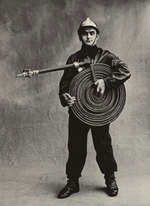
Penn, now 92, began his "Small Trades" series in 1950 while on assignment in Paris to photograph the fall collections for Vogue. In his rented daylight studio, Penn alternated between photographing models in couture clothing, well known portrait subjects, and the petit métiers, or local small tradespeople dressed in work clothes and carrying the tools of their occupations. The magazine hired photographer Robert Doisneau to help scout candidates for Penn's camera. A wide variety of subjects posed, including pastry cooks, a coal man, a glazier, a waiter, and firemen. The series, first published in Vogue, continued in London and New York.
Initially suggested by Vogue's art director, Alexander Liberman, the work was inspired by Penn's admiration of photographer August Sander's portraiture of every-day German people, Eugène Atget's images of Parisian street life, and his own desire to "record what was disappearing," according to Colin Westerbeck, director of UC Riverside's California Museum of Photography and a Penn scholar. The show at the Getty represents the first time the series has been presented in it's entirety.
Throughout his career, Penn would continue to maintain a balance in his work -- alternating fashion, advertising, still life, nudes, portraiture and images of varying "dissolving cultures," which took him to locales as exotic as Nepal and seemingly mundane as San Francisco. A collection of these images, of which the "Small Trades" are a part, were compiled in Penn's 1974 book, "Worlds In A Small Room."
My life has, at times, been punctuated by Mr. Penn's images, and sometimes by the man himself. Until about 1967, when I was 13, my idea of female beauty was largely shaped by magazines like Mademoiselle and Seventeen. The star of Seventeen at the time was Colleen Corby, the late '60's version of a teen super-model. My friends and I aspired to look like her. But in my house were also copies of Vogue. My mom was a subscriber and I began to look through them on a regular basis. Penn's photographs of models like the exotic Veruschka, Jean Shrimpton, and Marisa Berenson jolted me into not only a new concept of female beauty, but an entirely new way of looking at images.
Penn's models were not perky like the ones I was used to looking at in Seventeen. They were often stoic, their long limbs accentuated by his use of low angles and precise, meticulous lighting. Clearly Penn wasn't just trying to sell clothes or a lifestyle. He was also making statements about the human form, about light and texture. These pictures, and the models in them, initially made me uncomfortable. But now, looking back, I realize they were the beginning of my love of photographs. They made me realize that an image can have multiple meanings and, more importantly, tells us something about the photographer.
In the early 1970's I was a photography student at the Rhode Island School of Design in Providence. My boyfriend at the time was a fellow student, Dana Duke, who was a great admirer of Mr. Penn and hoped to snag an assistant's job with him after graduation. Dana managed to arrange an appointment to show Penn his portfolio in New York City. Penn could be tough when meeting with potential assistants. I went along and I remember both of us being extremely nervous sitting there with him.
Dana, who is still working as a photographer in New York, remembers:
He (Penn) looked very slowly through the photographs, then shuffled the order and looked at them again. After what seemed like the longest silence he said, 'You try to say too much about your subjects. Good photography is like a good book. You have to leave something to the imagination. There has to be a bit of mystery'. That's it! That's all he said.After leaving I remember having felt that I expected more input from him. Later I found out how lucky I was. Little did I know Penn had given similar viewings of portfolios to other photographers I held in high regard. Same scenario, dead quiet while sorting through images. One photographer was then told to burn the portfolio. I guess we visited Penn on a good day!
Dana did not get the job, but we succeeded in convincing Penn to visit Providence and lecture to the photo students. It was his first time lecturing since a bad experience at Yale many years before. The fine arts students at Yale had attacked him for making his living from his commercial work and he feared the same would happen at RISD. In the end, the day went smoothly and Penn was a hit. He must have had some faith that things would go well. He took an entire day out of his busy schedule to fly up to Providence to speak to a bunch of strangers for $250.
By 1978 I had returned to Los Angeles. Still transitioning to post-student life, I took any opportunity to find inspiration. One particularly bad day I decided to check out a show of Penn's platinum-palladium images of street trash at Art Center College of Design in Pasadena. The minute I walked in I felt a sense of optimism take over. Soothed first by the velvety brilliance of the prints themselves, it was Penn's genius at taking the messiest bits of life (cigarette butts, old gloves, torn paper) and transforming them into objects of extreme beauty that ministered to me that day. Perhaps it was a metaphor for what I could make of the messiness of my own life. I'll never forget how uplifted I felt when I walked out of that gallery.
It's impossible to gauge how many others have been moved, awed, educated, inspired, or possibly even offended by Penn's photographs. As a photographer, as an artist, he has had a broader reach than most. His work has appeared in magazines, museums and books over a span of six decades. An acknowledged master of the art of photography, it is almost unthinkable to imagine the medium without him alive in the world.
As he has aged, Penn has begun to disperse his archive and body of work to various institutions. Different reports have him now working sporadically, or not at all. He spends more time with his son, who represented him this month at the Getty opening. It's both a thrill and a comfort for me that the entire series of "Small Trades" photographs has found a home at the Getty. The current exhibit is not only the largest of Penn's work ever to be mounted in Los Angeles, it is an invitation for Los Angeles to get to know Irving Penn and his extraordinary photographs.
Small Trades is on exhibit at the Getty through Jan. 10, 2010.
Photo: Pompier, Paris 1950 by Irving Penn, courtesy the J. Paul Getty Museum
When Barack Obama was running for President, he made a point of bringing Native Americans into his fold, understanding that they are America's first citizens. They responded accordingly and joined the hopeful parade. At the inaugural parties, one tribe presented Michelle Obama with a hand-woven shawl, bedecked with running horses - the very horses that the US government wiped out by the thousands in order to vanquish the Indians. She happily donned it and it was a beautiful moment and my heart swelled: there was our great icon of freedom, the animal that blazed our trails and fought our wars, entering the White House, even if in image only. Perhaps, I thought, the voracious wild horse round-ups that have continued across the West for decades would come to a halt; maybe, just maybe, we were about to follow a law that went into effect in 1971 - or what was left of it - and preserve the horse we rode in on.
While we are not quite there yet, a ray of hope cracks the darkness. In fact, a reconciliation that has been a long time coming may be upon us, and it cannot arrive too quickly.
Several years ago, while working on my book Mustang, I met with Joseph Medicine Crow, the oldest living Crow chief, during re-enactments for the Battle of the Little BIghorn. He spoke of his tribe's horse traditions and history, and also of the government's campaign to wipe out the Crow herds during the early part of the 20th Century, when bounty hunters were sent to the reservation; these men kept count by way of ears, and when they were finished, at least 45,000 wild horses that were then flourishing on Crow lands were gone. These killings were just a small part of an era that came to be known as "the great removal," during which America's wild horses were nearly wiped out - and would be completely gone today, if not for the efforts of Wild Horse Annie, who fought for two decades to end this brutal campaign.
Alas, the wild horse has endured yet one more violent season. This summer, the dwindling herds that still roam public lands were again besieged with massive takings. As the round-ups played out, and with more scheduled for the fall, I have found myself wondering what happened to the shawl that Native Americans presented to the First Lady? Is it locked up in government vaults with all the other mementoes that bear images of vanished animals? Where was it when Barack Obama presented Joseph Medicine Crow with a medal of honor this year, at the same time that several more herds were stripped from the range in Nevada?
We are nothing without our memories, and tonight, as Jews around the world gather to remember the fallen, atone for wrong turns, and prepare for a return to the righteous path, I belive that horses - and all animals - must be included in our prayers. After all, it was horses that carried the ancient Hebrews out of bondage, and it was horses that traveled with their descendants when they fled Spain during the Inquisition, and it was horses that carried them to freedom in the New World. For all of these horses, and for the countless other horses that continue to be taken from their homes and perish even as we fight to the death to preserve freedom in foreign wars, tonight is the time to remember them, and to include them in the ancient prayer for the dead:
Yit-gadal v'yit-kadash sh'may raba b'alma dee-v'ra che-ru-tay, ve'yam-lich mal-chutay b'chai-yay-chon uv'yo-may-chon uv-cha-yay d'chol beit Yisrael, ba-agala u'vitze-man ka-riv, ve'imru amen.
Y'hay sh'may raba me'varach le-alam uleh-almay alma-ya.
Yit-barach v'yish-tabach, v'yit-pa-ar v'yit-romam v'yit-nasay, v'yit-hadar v'yit-aleh v'yit-halal sh'may d'koo-d'shah, b'rich hoo. layla (ool-ayla)* meen kol beer-chata v'she-rata, toosh-b'chata v'nay-ch'mata, da-a meran b'alma, ve'imru amen.
Y'hay sh'lama raba meen sh'maya v'cha-yim aleynu v'al kol Yisrael, ve'imru amen.
O'seh shalom beem-romav, hoo ya'ah-seh shalom aleynu v'al kol Yisrael, ve'imru amen.
And, as we turn towards tomorrow, and the ancient words speak of who among us is inscribed in the book of life, let us take note of the good news and endeavor to make it manifest. In recent days, thanks to Senator Mary Landrieu, a long-time friend of the four-legged, the government has been ordered to overhaul its management of wild horses and burros within one year, and it can no longer sell mustangs that it has rounded up to the slaughterhouse - if the House concurs. Also, in recent days, thanks to Senator Robert Byrd, the Senate now must consider the ROAM Act (Restore Our American Mustangs), which has already passed the House by a wide margin. This bill broadens protections for wild horses, and burros too (the other beleaguered beast of burden that is so much a part of our ancient and modern heritage).
A few years ago, I came across an interview with the 19th Century Crow chief Plenty Coups. It was recorded in 1930 by a man named Frank B. Lindeman, near the end of his life, and among other things, he spoke of the wild ones, several years after they had been gunned down on his - and their - homeland.
"...I have been told," said Plenty Coups, "that the white man, who is almost a god, and yet a great fool, does not believe that the horse has a spirit...This cannot be true..."
Perhaps it isn't.
And now, about that shawl...President and Mrs. Obama, where is it?
![]()
In designing a new apartment building for the Skid Row Housing Trust, architect Michael Maltzan decided not to let "freeway adjacent" become a bad thing. The building, alongside the 10 Freeway at Hope and 17th streets, will give homes to 95 homeless and low income residents. Its circular design cleverly minimizes the noise of the freeway, while creating a series of inner walkways around a wide central stair.
Once inside, a community room's panoramic windows turn "freeway close" into an asset, as the traffic flies by at eye level, like a movie looped on the widest wide screen around.
Maltzan has made a commitment to helping the homeless. The New Carver Apartments are the latest in a series of buildings he has designed downtown not merely to house the homeless, but to break conventions and create housing that lifts the spirits and comforts the soul, for the residents and the neighbors, too.
The building includes a community kitchen, office and social services for the residents. This latest collaboration with Skid Row Housing Trust, the second of three, will be open for new residents in November.
It was dark and there was wine so excuse the quality of the photos, but peeking into the workshops of the furniture designers at the Frogtown Art Walk last night was fascinating.
Full of cool stuff, like the tip of an airplane wing:
LOTS of tools. (Quote of the evening: "I want a forklift!)
And more clamps than I've ever seen, which makes sense when you check out that couch, made from thousands of tiny squares of wood.
Don't you just love autumn? It's the time of new beginnings, even for established institutions such as the popular Downtown Art Walk series, which just celebrated its fifth anniversary, but seems to be going through some growing pains.
The Los Angeles Downtown News reports that some gallery owners complain that the monthly festival, which attracts up to 10,000 visitors after sundown, has outgrown its original mission: enticing Angelenos downtown to view and purchase contemporary art. Bert Green, owner of Bert Green Fine Art at Fifth and Main streets, founded the event in September 2004 with just 8 participating galleries. Now, the celebration includes up to 45 gallery stops and draws visitors interested in exploring the area's bars and restaurants as well as its cultural attractions.
This summer, Green elected to minimize his role in Art Walk and recruited Richard Schave to manage event operations and nurture its future. Schave and his wife, Kim Cooper, own a historic tours company called Esotouric. Under Schave's leadership, Art Walk has obtained status as a tax-exempt, non profit organization, established walking tours of the Historic Core and expanded the mix of cultural attractions.
The next Art Walk is Thursday, September 10th.
Below, Schave, an art historian by training, shares some of his ideas about handling Art Walk's latest incarnation:
What new things can we expect from Art Walk in the next few months?
We introduced free walking tours in July and were stunned at the demand. You can expect to see more of these tours scheduled (and interested tour guides, please get in touch). We hope to begin distributing a printed map soon. We don't have a precise timeline, but we also want to soon introduce a lecture series, launch a mobile phone app, and add more shuttles to help people get the lay of the land and move around the Art Walk.
Another goal is not to change Art Walk, but to add new programs and ways of sharing information so that Art Walk visitors have more options and can easily find things to do and explore. We want to immediately address the bottleneck of people that clusters at 5th & Main, sometimes to the detriment of a safe and enjoyable urban experience, and making it hard to see the art. Many first time visitors only know to go to that corner, and we want instead to provide them with options for discovering walking routes to the galleries that show the type of work they're interested in, scheduled talks, tours and performances to attend, and a general sense of the scope of the Art Walk community beyond ground zero.
A big part of this is activating dead zones between clusters of galleries, to get people moving around a wider area. As Art Walk attendance continues to grow, we want to address issues of scalability and sustainability, to keep the event attractive, stimulating and safe for visitors, residents and galleries.
And one group we want to respond to are the downtown stakeholders who have had negative experiences due to the Art Walk - noise, overcrowding, problems getting home -- their concerns are important to us, and we'd like to help improve their experience however we can. We're also striving to improve the Art Walk website, making it easier for the galleries to publicize their programs and for attendees to find what they're looking for.
You speak of Art Walk as becoming a living museum of downtown--can you elaborate with concrete examples for manifesting this vision?
There are already some projects that are active or under development which are indications in this direction. The walking tours, the music, magic and poetry on the Hippodrome shuttle, and Art Walk's upcoming lecture series (planned to have a walking tour component as well), which all speak to our goal to provide stimulating creative experiences in the city itself. The Art Squared project at Pershing Square is a great example of how community artists are collaborating with Parks and Rec to bring contemporary art into civic spaces, and this is something we hope to help facilitate further through the Art Walk.
What are three (3) things you want Art Walk patrons to get from their experience at the event?
1) Break the "Lion Country Safari" mentality which plagues Los Angeles audiences: don't just watch from the car window, immerse yourself and participate!
2) Get to know something about L.A.'s most interesting and misunderstood neighborhood.
3) A desire to return for more, and bring their friends, not just during Art Walk, but all month long.
How do your plans support the independent artist who resides downtown yet has no gallery representation?
A goal of the Art Walk Board in the next twelve months is to create policies on a number of questions beyond how to best serve the entities that are already part of the Art Walk. We need to think about the needs of local artists, how street performance can be an authorized part of the event, and other factors we have yet to recognize. We look to the community to formalize their concerns and share them with us as we seek to formulate good, empathic responses.
How do the Art Walk organizers plan to deal with the LA City street parking restrictions, which extended metered hours to 8 pm and increased rates to $3 per hour? Has this change affected Art Walk attendance?
Parking has always been a bit difficult around the Art Walk, but it doesn't keep people from making the effort. Folks manage to find lots with open spots, and walk to where they want to start exploring. We recommend people begin their Art Walk experience at Pershing Square, downtown's historic "living room," either parking their car in the underground city lot or ideally taking public transportation.
How will Art Walk relate to the treatment of homeless people being pushed from Skid Row in the name of public safety?
The Art Walk is not a policy maker, but we do seek to influence policy and dialogue as decisions are made about how this neighborhood evolves. Our mission statement explicitly supports the historic nature of the neighborhood, which has always included a transient population. We plan to be a part of the feedback loop as public policy is created, and to support the creation of positive public space for all members of the community.
Is Art Walk a form of gentrification?
No. Gentrification is concerned with the raising of property values. The Art Walk is concerned with the creation of free and equitable public space. Property owners seeking to increase the value of their investment have a good understanding of the tools available to foster gentrification, including the creation of local Business Improvement Districts. Since there aren't any such formal tools for fostering positive public space, we have created our own People Improvement District: the Downtown Los Angeles Art Walk in its new manifestation as a California Public Benefit Corporation.
Any plans for including SRO hotels in the event?
We're interested in any and all ways in which the historically transient population of the neighborhood can be included in the Art Walk. We are actively pursuing ways to be of service to all local residents. On my own walking tours, we make a visit to the lobby of the Barclay Hotel, which while not an SRO per se, is the oldest continuously operating hotel in the city, and plays a central role in Raymond Chandler's novel "The Little Sister."
Who is your favorite LA based artist?
Millard Sheets, both for his wonderful paintings of old Bunker Hill and his Home Savings mosaics which sneak up on you in traffic.
Any favorite neon pieces downtown?
The neon on the hotels on 7th Street east of Maple, seen through a moving windshield.
|
Media
|
Politics
|
|
|
LA Biz
|
Arts, Books & Food
|
LA Living
|
Sports
|