What makes L.A. great? Ideas like this one -- walking from downtown L.A. to the ocean, just for the hell of it. You can do all of it or some of it or just meet the intrepid walkers at their noon stop at the Atomic Cafe. The path?
From the Shrine, we'll hike up Figueroa until we get to Adams. From there we start to head west on Adams -- but we'll also be taking a few detours onto side streets north and south of Adams in order to take a look at classic Los Angeles architecture and homes. Later, we'll make our way up to Washington and walk through the Mid-City district. We keep on walking down Washington, and through Culver City, before eventually finding our way to Venice Beach and the ocean.
And there's always the after-party. See all the FAQ (and answers) here.
So break out the daypacks and moleskins and the comfy shoes and take a walk today.
After USC's 55-21 loss to Stanford, it seems like everyone in the college football world is trying to figure out what's wrong with Trojan football. I'm going to take a look at a few explanations I've heard in the past few days:
1) Matt Barkley is the problem
First off, Matt Barkley is as good as any true freshman quarterback I've ever seen. He's leagues ahead anyone else I've seen play the position at such a young age.
Secondly, I don't see how you can blame him for any of USC's losses. He didn't play in the Washington loss, and the Trojan defense did nothing to stop Oregon and Stanford.
Third, USC has as little depth at receiver as they've had in years, with the offense desperately missing Damian Williams, tight end Anthony McCoy, and fullback Stanley Havili when they were out.
There's no question Matt Barkley has struggled lately, and some would say he's regressed in recent weeks. I still wonder if Mitch Mustain would have been a better choice (I know Aaron Corp wouldn't have been), and I think the coaching staff has overhyped the freshman. But Barkley has proven himself enough in my eyes, and USC has not lost three games because of him.
2) All of Pete Carroll's good assistants are gone
This is becoming a hip thing to say, but I think it's an unfair scapegoat. I would agree that the offense hasn't been the same since Norm Chow left. But coaches like Ken Norton, Pat Ruel, Todd McNair, Jethro Franklin, and Rocky Seto are either experienced coaches or people who are very familiar with Pete Carroll. Only play-caller Jeremy Bates is really all that new, and I'd argue he's doing a better job than most of his critics.
Any good program is going to lose assistants to other jobs. It comes with the territory. But the names I listed above aren't idiot know-nothing coaches.
3) The defense is horrible
Since the fourth quarter against Notre Dame, the USC defense has barely looked like a facsimile of its former self. Despite having nine new starters, the Trojans didn't give up two touchdowns in a game until Week 6. Since then, Oregon State, Oregon, and Stanford have almost moved the ball at will against USC.
The defense has had some injuries, but that's never hampered USC before. This is an epic collapse that I simply cannot explain. Despite the offense's inconsistencies, I can say the defense has been consistently bad. The talent is there, but I think there has to be a deeper issue.
4) The gap has closed between USC and the other Pac-10 schools
This is true, but it isn't a valid excuse for USC's struggles. Oregon has always had an excellent football program, and as long as they have Nike money flowing in, they'll get great players. Mike Riley and Jim Harbaugh have done tremendous jobs at Oregon State and Stanford in recent years, while Jeff Tedford still has a good program at Cal. Arizona and Washington seem on the rise, and you can never count out Dennis Erickson at Arizona State.
I think USC has actually recruited too much depth at certain positions, and it's led other good players who want more playing time to go elsewhere in the Pac-10. That being said, USC still has considerably more talent than any other Pac-10 team. They've done a great job of recruiting nationally.
The other Pac-10 schools might be more familiar with USC than tough nonconference opponents whom USC routinely pummels. But when you have the better players, you shouldn't lose.
5) The program has become too complacent
I think this a valid concern. In the last few years, I've seen USC players act with a sense of entitlement. I didn't see that in Pete Carroll's first few years when players were trying to prove themselves and the program was building an identity.
I'm sure Pete Carroll is still working his team hard in practice. But a sense of confidence has been replaced by cockiness. And I was horrified to see the way USC gave up in the fourth quarter against Stanford. Personally, I think Pete Carroll needs to establish a new mental approach for his team.
-----------
Before people panic too much, it's worth mentioning that USC is 6-3 and not 3-6. Every program, including Florida, Oklahoma, LSU, and Texas has an off-year once in a while. Pete Carroll's consistent excellence has been beyond remarkable. That doesn't excuse this year's disappointments. But it should allow for some perspective. USC football is still as talented as any team in the nation, and it will be back very soon.
Should someone be thrown out of the army if their business card identifies the bearer as an "SOA" (soldier of Allah)?
Probably not, but that, along with a number of other warning signs should have indicated that Major Malik Hasan's reported request to leave the army should have been granted before he went 9/11 at Ft. Hood.
In any case, the question of split loyalties inside the military, especially during a time of war, is urgent and troublesome. I first learned of it while working on my book, Twentynine Palms: A True Story of Murder, Marines, and the Mojave, about two girls killed by a Marine after the Gulf War in Twentynine Palms, California. Some of the Marines I spoke with during the 90s - well over ten years ago - told me about radical Saudi clerics trying to recruit them in the supply lines in Kuwait. Mostly these suitors offered money; some offered the idea of a religion that would treat converts fairly (the pitch was often directed to African Americans, but no one was exempted, according to what Marines, both black and white, were telling me). Now remember - this was before 9/11, and I reported the information in my book, which was first published in early 2001 (and recently re-issued in a new, updated edition).
When I first learned that members of the US military were being approached by Islamic clerics, I wasn't really surprised; this is war, I thought, and offers to join the other side or take the first step in a shift of allegiance are probably routine. But the news was curious, and for a time, I wondered where it might lead. Then a few years after the attacks on New York and DC, there came a deadly incident in Kuwait: Muslim soldier Sgt. Asan Akbar fragged three tents of sleeping army officers and senior NCO's at an American base in that country. I wrote about it for Slate and also reported that Beltway sniper and former sergeant John Muhammed (executed last week and under arrest by then) may himself have waged a similar fragging incident while he was in the army during the Gulf War.
Split loyalties inside the military involves a lot of tribes. While writing Twentynine Palms, I found out that there had been a riot between Crips and Bloods, inside the same battalion (!), on the base at Twentynine Palms. It had to be broken up by mp's. What would happen if that fight had erupted in an actual war zone? I wondered. During the course of my research, I also heard that the Aryan Brotherhood was inside the armed services, along with other gangs, just like in the outside world, and then a few years later, the physical evidence emerged: American gang graffiti was found at various Iraqi War locations, adding to the ancient glyphs that characterize the region - themselves inscribed by vanished tribes marking their turf.
Solving the problem of tribes within our own military tribe is beyond my pay grade. But as Christopher Hitchens points out in his latest Slate piece,
"Hard Evidence," members of other communities among our guardians - blacks, Jews, Catholics - have not been involved in attacks on their brothers and sisters, although they may have disagreed with policy or various wars over the years. For sure, one way not to solve the problem is to ignore what certain influential Islamic clerics have been saying to their burgeoning flocks for years - and fail to take note when people announce their beliefs on that strange modern contrivance known as business cards.
We say all sorts of things about ourselves on our cards. Some of us are "Scorpios," we tell the world. Others are "entrepreneurs." Still others wrap it up visually with an image of an animal or an organization logo. What we say so quickly tells a lot - if only about the choice that was made in what to put on the card. It's what we want people to remember about us when they find our cards in a mess of stuff in their wallets. Where did Major Hasan leave his cards? I wonder. Was it in a stripper's g-string at the local club he visited often? On his desk at Ft. Hood, next to a box of tissues for distraught patients? I wonder who saw it, what they made of "SOA," and if mention of the tell-tale card was entered in Hasan's file. As the short story writer Ellen Gilchrist has written, "The truth has a biological urge to come out." Alas, this time around, no one was listening.
![]()
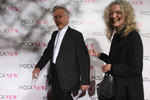
After a tough year of financial woes that had more to do with mismanagement than the bad economy, MOCA put on a huge gala opening to celebrate its 30-year retrospective. Over a thousand of L.A.'s brightest lights in the entertainment and art worlds turned out for the party, which featured Lady Gaga in a seven-minute original performance.
![]()
Brad and Angelina were there, as were James Franco, Eva Mendes, Chloe Sevigny and Gwen Stefani with husband Gavin Rossdale. They perused the contemporary art in the galleries along with David Hockney, John Baldessari, Frank Gehry, Takashi Murikami and Ed Ruscha.
Cocktails were served, live lounge music was played and then the guests filed into a huge tent festooned with red velvet and crystal chandeliers. Lady Gaga's image was everywhere, her striking face featured in Russian revolution-era posters inside and outside the tent, and her performance piece, created with the collaboration of artist and needlepointer Francesco Vezzoli, was dedicated to and inspired by Sergei Diaghilev, founder of the Ballet Russes.
Dressed to the nines in a hat designed by Gehry (echoing the Disney Hall silhouette), dress by Prada, mask by Baz Luhrmann and Kewpie doll makeup, Ms. Gaga sat at a pink Steinway decorated by artist Damien Hirst as members of the Bolshoi Ballet danced along a catwalk. Lady Gaga was more subdued than usual at the high end event, for which a ticket ran in the thousands. After the show, the Damien Hirst piano--with Gaga's prints all over the ivories--was auctioned off and the winning bidder, gallery owner Larry Gagosian, took it home--or perhaps to his gallery--for $450,000.
Ms. Gaga's costume pieces will be auctioned online to add to the $3.5 million the museum raised with the gala. "Collection: MOCA's First Thirty Years" will be free to the public for the coming week to see the real stars--Rothko, Warhol, Bengston, Baldessari, Rauschenberg and friends.
All photos by Iris Schneider. Click to view larger.
From the top: Lady Gaga performing, Mendes and Baldessari, Hockney, Stefani and Rossdale, Ruscha.
A pitched battle to prevent the world's largest garbage dump from being built next to Joshua Tree National Park has been won in the Ninth Circuit of Appeals, thanks largely to Donna and Larry Charpied, a pair of jojoba farmers who live in a trailer at the park's edge and filed the first briefs opposing the project almost twenty years ago, after reading how-to legal books and pouring their own money into the lengthy campaign.
In recent years, a coalition consisting of the Desert Protection Society and the Center for Community Action and Environmental Justice joined the battle, and Oakland attorney Stephan C. Volker argued the case against the Bureau of Land Management and Kaiser Eagle Mountain, Inc. "The land trade BLM approved here would have literally 'trashed' a spectacular national park whose outstanding natural values have earned it designation as a World Biosphere Reserve," Volker said today. "Shy of Yosemite Valley, I cannot think of a worse place to dump LA's trash for the next century than the fragile desert wilderness adjacent to Joshua Tree National Park."
I concur. In fact, I met the Charpieds some time ago, during my many moons of wandering through Joshua Tree National Park, and through them, I have learned much about a place that has become so crucial to my life, and theirs. Over the years, they have taken me on hikes into remote areas of the park, shown me secret petroglyph sites known to few moderns, walked with me down Pleistocene trails, and spoken quietly of the very jojoba plants - Adam and Eve - that spawned their beautiful, little farm in the Colorado Desert. Like many sacred things, the plants cannot be viewed, but they are somewhere in the environs, living their ancient lives together. From these plants have flowed the most wonderful oil, through their descendants, who pour out the park's wonders into an old still at the Charpieds' farm, then fill a mini-assembly line of pretty bottles that pop up at farmer's markets around southern California or are available for purchase right here.
I've been using the organic oil that Donna and Larry make since I met them, and I consider it a magic elixir from the desert - regenerating for skin and hair, and who knows what else? Like a mad prophet, I've extolled the miracle in various publications, and have also chronicled the Charpieds' battle to save the Promised Land at length - first in the now-defunct Buzz Magazine (where the article was buried because the editor feared the subject of garbage would repel readers), and then more recently in my book Joshua Tree: Desolation Tango, and also for the Mother Nature Network (which picked up a piece I first wrote for Plenty Magazine - another vanished publication).
The case to stop the dump took months to make its way through the Ninth Circuit and we were all beginning to wonder what this meant. At a time when the wilderness is under siege in so many ways, would Joshua Tree National Park be the next on the triage list? For the moment, the answer is a resounding no - the place where the streets have no name will remain so, unsullied by refuse, preserved for next Wednesday, and the Wednesday after that, and we can all say thank you to a pair of jojoba farmers who live in a trailer and make oil from a plant that shares its home with the desert tortoise, the raven, the coyote, the mighty rocks, the carpets of stars, and all the fine things that flourish and endure here - and help us do the same, wherever we are.
Steve Jones, the self-proclaimed Sire of Wilshire (a nod to the physical address of his former home at Indie 103.1 FM), is back on the air!
The former host of Jonesy's Jukebox is now hosting a two-hour program every Sunday at BBC 6, according to both MusicWeek and the BBC 6 Web site.
His first show, to which you can listen online, aired Sunday, Nov. 1. The show's title is "A Month of Sundays with Steve Jones."
You'll recall that Indie 103.1 went off the air in January, when pretty much all we heard from Jones appeared in a press release from MSOPR, the public relations company that represented Jones' group, The Sex Pistols. See LA Observed, Variety, LA Weekly and OC Weekly for more background.
This year, for Halloween, my fourteen year-old daughter Franny wanted to dress up as a Swingers waitress - a hip, mini-skirted figure in fishnets and lug-soled boots. Halloween, for so many girls (and sadly, also grown women) is often an excuse to wear skimpy outfits, and I was proud of my daughter for finding a newer, hipper iteration on the over-played sexy kitty/sexy witch motif.
Here's what made her costume choice scary: I had once, in the long-ago days of yore, before I had ever borne a single daughter --- been an actual Swinger's waitress. Back in the sepia-tinted days of the early '90's, I had lived the dream of serving tofu scrambles to the Hollywood hung-over. My daughter's sassy dress-up notion was the uniform I crawled into at 5:30 every morning for the breakfast shift. Her Halloween fantasy was once my grinding, bleary, time-to-make-the-smoothies reality.
Ever the enabling mom, I took Franny and her sister on a pilgrimage to the original shop on Beverly Boulevard where I once slaved worked. Our mission: to cop a Swingers baseball T (that Franny might scissor into fabulous, rib-revealing shreds) and one of the wee, blue Dickies uniform skirts that had once barely covered my ten extra pounds as I bent over to wipe down tables. We settled into a booth and were approached by a fresh-faced, tattooed waitress not much older than my eldest.
"What can I get you?"
We ordered our grub and then I launched into my odd, back-storied request; "My daughter wants to be a Swinger's waitress for Halloween..."
"Wow, cool!" she marvelled.
"Thing is, we need a skirt."
"Oh...people always want those. But they're only for staff."
"Yeah, but see, I used to be a Swinger's waitress myself."
And that's when it happened: this girl ogled me in total disbelief. As if to say is it possible this crone, with her teenagers, her sensible cardigan, her freckled hands and crepey cleavage, could have once been hip and young enough to hustle hash? And then I watched as her mind cartwheeled over to the next logical and more terrifying thought: could this be me one day?
The waitress gaped at me like I was living history -- Miss Jane Pittman come to put her withered lips to the "Young Only" fountain straw of ageism. "No way," she gasped, as though the Crypt Keeper herself had just texted her this news from beyond the grave. I peered at her over the tops of my progressives and said, "Way."
It dawned on me then that I had probably once served this girl smiley face pancakes and wiped down her booster seat afterwards. Possibly the little girl had grokked my groove and begun burnishing the bright dream of someday inking Sanskrit runes on her forearms and slinging soyrizo scramble with the best and the brightest of her generation.
"Yeah, I mostly worked the breakfast/brunch shift," I explained, wanting to prove my provenance. "I still have the apron and the boots, but my daughter wears them now." On cue Franny stuck her Gorrilla-booted foot out from under the table to show her my erstwhile kicks, which she had copped out of my closet the minute she reached my shoe size. "Problem is," I continued, "I got rid of the skirt a few years ago." That tiny, pleated number had lived at the back of my drawer for years, until in a fit of spring cleaning when Franny was four, I offed it, thinking there could never possibly be any further use for it.
The waitress seemed stunned. "Well, in that case, I'm sure you can have one. Wow, you must have been on the original crew!" she said, looking at me like I was an artifact that belonged in the Smithsonian.
When Swinger's opened in early 1991, a scene partner tipped me off that they were looking for wait staff. Ignominiously fired from the Café Figaro, burned out on office temping, I fudged my resume and snagged a shift at the hot, new coffee shop that was owned by a couple of trendy nightclub impresarios. For almost a year, I served vegan burritos to the glitterati - if indeed Rosanna Arquette (then the owner's wife) and Joan Cusack can be counted as glitterati.
It all ended when I spilled a tall orange juice all over a customer during a brunch rush. By then, hipper, fresher girls, girls with actual nose rings and lip piercings were lining up for the job and I was expendable. Married and already dreaming of the daughter I would soon conceive -- and wanting to bring my swinging days to a waddling, leaky, elastic-waisted end, I strode out those glass doors and never looked back.
The waitress left us to go punch in our order. Franny looked across the table at me sympathetically. In her best Wilford Brimley voice she said, "Why, you're an old timer, Ma!"
"Dagnabbit," I geezered back at her, "I remember the days when a power smoothie was only a nickel!"
"Was that before them internets came along, Ma?" Franny countered.
By the time the waitress brought us our drinks, my daughter and I were riffing and laughing so hard on the shtick, we could barely keep our milkshakes from coming out our noses.
|
Media
|
Politics
|
|
|
LA Biz
|
Arts, Books & Food
|
LA Living
|
Sports
|