Jessica Ritz, owner of the TasterTotsla.com blog and mother of two sons, shares pictures of a successful outing to the 94th Aero Squadron Restaurant, next to the Van Nuys Airport.
Counting people for the federal census is to counting for Santa Monica as Marine basic training is to life coaching. The effort last week by volunteers on behalf of the city was part of a greater L.A. County mission to enumerate the population of what the feds call "emergency and transitional shelter populations" and what the rest of us know as the homeless.
In order to qualify for funding, local governments are required by the U.S. Department of Housing and Urban Development to provide this information every two years. Some municipalities, such as Santa Monica, perform the function every year to establish a baseline of need for federal, state and local funds, and to allocate their resources appropriately.
Two years ago, the L.A. County tally was about 48,000 individuals regularly sleeping without benefit of permanent shelter. In Santa Monica last year, 742 people were identified as homeless. Those figures include both the street population and people found in shelters, transitional programs, hospital emergency rooms and jails.
We volunteers gathered late Wednesday night at the Civic Auditorium for training that felt more like a Chamber of Commerce mixer than a low-tech shoe-leather operation. When I signed on in 2000 as a federal enumerator, the process involved a loyalty oath, reams of paperwork in triplicate and pencils, clipboards and flashlights identified by alphanumeric code. In Santa Monica, training was catered. Local establishments provided gourmet sandwiches, crudités, fruit, cookies and coffee with little hazelnut creamers.
The purpose of the first U.S. census in 1790 was to quantify the nation's population in order to determine Congressional representation and to pay the debt of the American Revolution by apportioning it equally among the revolters. It was a clever formula that rewarded an artificial inflation of numbers for greater Congressional muscle with a higher fee for freedom. Additional purposes have piled onto the 23 subsequent decennial censuses, but in addition to congressional division, one constant has been the use of temporary enumerators. The 1790 census fell within the portfolio of Secretary of State Thomas Jefferson, who paid U.S. marshals $1 for every 50 people counted. In 2000, I was paid $14 for every hour worked. In Santa Monica in 2011, we were paid in Peet's coffee and swag bags containing a Santa Monica Library retractable tape measure, Santa Monica Police SWAT-branded sugar-free mints and a fridge magnet imploring you to Buy Local Santa Monica.
About 170 of the 200 volunteers accepted showed up for the midnight gig. Our job was to enumerate individuals and vehicles sheltering them in outdoor, public places. Apparently we small-town Santa Monicans all know each other--training began with remarks by a male and a female who were not introduced. The guy was Mayor Richard Bloom, who gave the standard go-team pep talk, and the lady was Maggie Willis of the Human Services Division. City brass also waved the flag in the persons of Fire Chief Scott Ferguson and Police Chief Tim Jackman, and 25 or so uniformed cops lined the periphery of the room. They would be watching our backs.
By 12:30 Thursday morning when most of the teams had hit the streets, we had learned that the 2010 count had yielded 19% fewer homeless people than 2009. We learned the ABCs of homeless ID--appearance, behavior and condition. We learned that "flashlights are for papers, not people," because we were supposed to be stealth counters. We were not to awaken, engage or in any way disturb people sleeping outside or in cars. This was decidedly different from my federal experience, when we were obliged to extract as much information as possible in interviews with people classified then as "nonsheltered, outdoor location," whom we bribed with hygiene kits that proved wildly popular along with information about veterans' benefits, which we wholly lacked.
Chris, Shahab and I were the team assigned to a Sunset Park neighborhood about a mile from my house and, action-wise, more boring than my back yard. We figured it would take maybe an hour to survey the tract and that we'd probably tally zero homeless which was, Willis said, "a valid number," and also a desirable one.
It was a clear, cool night, and the quarter moon hung huge and low in the east. We moved with alacrity down the streets and up the alleys, undisturbed by cars or pedestrians. It felt like Halloween, late, as if we were the last ones out and all the candy was gone. Except for a stretch along Pico, this was a dark, residential neighborhood punctuated by the light from a big screen TV here, a computer monitor there and not even one barking dog.
We paused at the occasional scruffy van to inspect for condensation, window coverings, sounds and movement from within. Most bore preferential parking stickers, a clear sign of, if not affluence, at least residence, and we rejected them as outside our demographic. About 45 minutes into the survey, we passed two shabby cars parked on Pearl Street that lacked permits. One was stuffed with articles indicating either a remarkably mobile storage system, or what otherwise would be a closet. We tallied it. The second car's windshield was obscured with an aluminum shade, but we could see a man slouched in the front seat. He wasn't sleeping, but he looked exhausted. We tallied him.
Farther east on 20th Street we approached a house for sale with a flier box next to the sidewalk. We slowed our brisk pace and looked at each other. We each took a flier and examined it farther up the block under a streetlight. 2 BR, 1 BA, 1,242 APX SF. LP: $849,000.
A block and a half north, an alley narrowed into an isolated walkway leading to Pico. It was blocked by a shopping cart piled with personal effects that obscured a human-sized lump lying on the ground under a gray blanket. Was it one or more people? Certainty required unwarranted and impermissible intrusion. We tallied one person, noted the address and moved on.
Along Pico, we checked the nooks and crannies by the taco joint, the Fosters Freeze, the picket-fenced motel and several silent, small commercial establishments en route to the car. It was 2 o'clock. What had seemed earlier to be a breezy neighborhood jaunt had been a physically demanding 90-minute mission. Chris anticipated an unproductive, sore day at work. Shahab said he was whipped. I tried to ignore the blister on my right foot. Within the hour, we all would climb into a warm bed with clean sheets in houses we called our own. Hundreds in Santa Monica, tens of thousands in L.A. County, do not. And every day they wake up tired and sore.
If regimes in Syria, Egypt and Jordan can shut down their Internets, how come Hollywood can't shut down Charlie Sheen?
"Tenacious! Stop rolling!"
"Rage! Go!"
"Slam the jammer! Slam the jammer!"
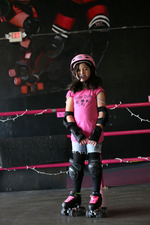
Listening to Killo Kitty, coach of the Junior Derby Dolls, doing her job at a Saturday practice, you can understand why her young charges think this is so much more fun than traditional girls' sports. First, you get to choose your alter ego: Bamber, Rattle Skate, Cleobrattra, Lindsay LoSlam, Hanna Wanna Slam Ya are just a few of the monikers. But 15-year-old Natasha Boyd, aka Jackie the Ripper, summed it all up: "I love that you can be completely yourself and your teammates will always be there for you," she said. "It's so graceful. There is poetry in motion out there."
"Howl" comes to mind.
And while you may not think this is a sport you can explain to your mother, several of the young girls on skates at the Doll Factory on Temple Street have moms who skate in the grown-up league. Others found their way here because it just seemed like fun. "I offered my niece this or Magic Mountain for her 10th birthday," said Edwin Lopez, "and she chose this."
Aside from the rigorous exercise, the girls learn to work as a team. Contrary to popular misconception, there is no hitting or elbowing. A "hit" might be a well-placed shove with your hip or butt. The girls learn to take the roller derby rules seriously, and to pass with grace and power while skating around the banked rink and trying not to take a spill. It's a lot harder than it looks.
At a recent Saturday practice, about thirty girls formed two teams and went at it while their grown-up role models coached, cheered, high-fived and did some explaining on the sidelines. Many of the sedentary parents who waited for practice to end sang the praises of the junior program, open to girls ages 8-17. "It's a hobby she loves," said dad Micah Worley, proud parent of Hannah Wanna Slam Ya. "She's done softball, piano, but she loves roller derby. She's excited to come every day. I never have to make her do it."
Arnold Harrison, grandfather of Allison Harrison, agreed. "It's changed her," he said. "Her grades in school are better. I'm 100% behind it. It's about self-esteem and discipline. They get that here. They talk and interact with each other and Killo Kitty, she's in charge. They look up to her and she's so good with the kids."
For the girls, though, it comes down to a few simple concepts:
"I like to go fast." "We like to hit people." "I like how the people help you out."
Lindsay LoSlam, 13, explained how it works: "You learn new skills and if you're feeling angry, you get to use your anger. And you meet new people."
In addition to keeping the girls in shape, and promoting female empowerment, Derby Dolls as an organization has a strong social conscience. It has sponsored neighborhood cleanups, health and job fairs and is about to do a walk to raise money for Children's Hospital.
Samantha Kinne, aka Jessicka Ravage, skates with the Derby Dolls and coaches the junior league. [Name fixed.] This is how she sees it: "Society tells women how to behave to be accepted. But here's a bunch of tomboys and they think they're great. I work at Disney and there it's all about princesses. I was never a princess. This teaches them to find their inner strength, and about being okay with who you are. I wish I had that when I was twelve."
* Fixed: An earlier version of this post misattributed Samantha Kinne's quote.
League play for the Derby Dolls resumes with two bouts this weekend. The Junior Derby Dolls skate on Sunday.
All photos by Iris Schneider
Thursday, January 20, 2011
Saturday, January 22, 2011
Thursday, January 13, 2011
Saturday, January 15, 2011
Are you shocked about Tucson? Aren't we all?
No. Not the least bit. I expected it--or at least a shooting like it--and I would like to make a desperate plea to everyone to feel the same. 33 people on average get shot and killed in this country every day, in every kind of neighborhood. Every day. 12,000 every year. Mass shootings--at malls, school, stores--happen multiple times every year. Like clockwork.
33 people. 6 people died in Tucson, but about 25-35 people died elsewhere. 214 people on average get injured daily--so while 12 people got injured in Tucson, about 200 got injured elsewhere.
So how dare we be shocked, shocked when a Tucson happens. If you have 250 million guns--and your gun-control laws basically require people to wait 3 days before they can shoot someone--then this is going to continue to happen on a regular basis.
While our gun laws are absurdly ineffective, still a huge piece of the problem is that more than 11,900 of the annual 12,000 tragic deaths don't shock most people at all. At all.
England, Scotland, and Wales combined have about 50 annual gun-related homicides. Which means that people in those countries have earned the right to be shocked when 6 people get shot to death.
Until we find all 12,000 deaths shocking--and until public support materializes for serious, effective restrictions on guns... Well then, at least I beg you, when the next Tucson happens--which will most likely be this year--then, first, to be sad, and then, to say to yourself and all your friends...... "Of course it happened, and it's going to happen again very soon."

Police said the predator glides invisibly through crowds, disguised by his very ordinariness.
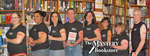
"He looks exactly like you and me," said LAPD Detective Margaret Millar. "He's smart, bookish. He likes a bargain. Maybe he wears glasses and has a ratty paperback crime novel tucked in his back pocket. At this point, we're not ruling anything out."
The most recent victim is Broxton's Mystery Bookstore, which suffered a fatal blow on January 11, 2011, and will expire at month's end.
"We tried to do everything right," said an employee in a gold lame gown, black stilettos and red lipstick who declined to give her name. "We didn't walk down dark alleys at night, we ixnayed rides from handsome strangers and we reached out to LA's literary community, kept our customer mailing list updated, used Twitter and Facebook and held author events every god-damned week. But in the end, the Grim-Lit Reaper found us anyway."
Police, who have plenty of leads, believe that the murderer resides on the Information Superhighway.
This is the second time in as many months that the bookish serial killer has struck in Westwood, an affluent neighborhood that encompasses UCLA.
The first victim was Borders on Westwood Boulevard, which suffered a fatal blow to the head late last fall and is expected to expire later this month.
LAPD detectives believe these slayings are connected to the demise of a bookstore in Brentwood called Dutton's in 2008 that is still mourned by the Westside community. They are investigating at least a dozen earlier fatalities throughout the Southland and caution all remaining independent bookstores in Los Angeles to to stay vigilant.
"It could happen anywhere, to anyone, where they least expect it," said LAPD sergeant Dorothy B. Hughes, who heads the serial killer task force nicknamed "The Amazon Effect."
One recent afternoon, a tough customer named Leigh Brackett strolled into The Mystery Bookstore and asked where a dame could find a book in this joint called Westwood.
The underpaid and over-worked but valiant and cheerful staff helped her find a first edition Raymond Chandler novel and an autographed copy of "Red Harvest" by Dashiell Hammett. They also suggested several new authors that Brackett might like, even a few frails.
"A gal could get used to a place like this," Brackett said, sighing with delight as she sank into a leather club chair.
"Don't get too comfortable, Missy," said the sad man behind the desk. "Ya got til the end of the month, and that's all she wrote."

This morning I opened the Los Angeles Times -- which I've frankly been doing more often lately (web overload?) -- and was rewarded by discovering a very nice review of a book I co-authored almost ten years ago.
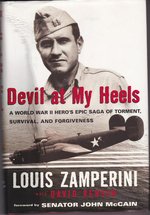
DEVIL AT MY HEELS is the autobiography of Louis Zamperini, whose story has lately received much notice because Laura ("Seabiscuit") Hillenbrand's biography of Louie, "Unbroken," is everywhere, including at the pole position on both Amazon and the New York Times non-fiction bestseller list.
Universal Pictures bought the rights to Louie's life in 1956, on the heels of the same-titled, first book version of his life, with plans for Tony Curtis to star (it didn't happen). Now they plan to give the movie another try.
I'm glad that the Los Angeles Times graciously acknowledged Louie's own book -- especially eight years after publication! -- when, in the flood of publicity and praise for "Unbroken," the paper could have easily acted as if Louie's own words didn't exist at all.
Louie's going to be 94 later this month. He's lived an incredible life and I'm thrilled that it's finally getting the wide recognition it deserves. He's a great guy, too, a constant inspiration, and I'm fortunate to still have him in my life.
Here's the Times story link.
|
Media
|
Politics
|
|
|
LA Biz
|
Arts, Books & Food
|
LA Living
|
Sports
|