Native Intelligence
 
Archive by Month

« January 2011 | Home | March 2011 »

February 25, 2011

Angeleno Datebook- February 25, 2011

Friday, February 25, 2011

  • Women In Film Fourth Annual Pre-Oscar Cocktail Party at Soho House. 7:00 PM

Saturday, February 26, 2011
  • Media archaeologist Erkki Huhtamo gives an illustrated presentation "Maréorama Resurrected" at The Velaslavasay Panorama, 1122 West 24th Street, Los Angeles, California 90007. 8 PM.
  • Melba Levick, Douglas Woods and D.J. Waldie will be signing their new book, Classic Homes of Los Angeles , at Hennesey and Ingalls, Santa Monica, from 4:00-6:00 PM.
  • Assistance League of Long Beach benefit "Espiritu de Espana" lunch and fashion show at Long Beach Convention & Entertainment Center. Long Beach
  • Fritz Coleman, NBC4 reporter, will emceeHillsides children's charity's annual "Diamonds Are Forever" Benefit at the California Club. Downtown.
  • 26th Annual Spirit Awards are back on the Santa Monica Beach. 2:00 PM
  • Razzie Awards presented at the Barnsdall Theatre. 7:30 PM

Sunday, February 27, 2011

  • Afghan Writer Tamin Ansary lectures on "Destiny Disrupted: A History of the World Through Islamic Eyes: Islam: A Parallel History" at the Pacific Asia Museum in Pasadena. 2 PM
  • Cancer Schmancer benefit honors Vin Scully at the Beverly Hills Wine Festival in the InterContinental Hotel at Century City. 2:00 PM
  • 83rd Academy Awards at the Kodak Theatre in Hollywood.
Monday, February 28, 2011
  • TED: Technology, Entertainment, Design 2011 Conference Opening Day (continues through March 4) in Long Beach Performing Arts Center
  • C-CAP-Careers Through Culinary Arts Program Benefit Dinner at the LA Farm, 3000 Olympic Boulevard, Santa Monica 6:30 PM Santa Monica.
  • Venice Family Clinic honors Judd Apatow at its Silver Circle Gala in the Beverly Wilshire Four Seasons Hotel.
  • An Evening with Madeleine Albright, Colin Powell and Condoleezza Rice on tap at American Jewish University's 2011 Public Lecture series at Gibson Amphitheatre in Universal City. 7:30 PM
Tuesday, March 1, 2011
  • Joan Schenkar & Kathleen Chalfant discuss "The Talented Miss Highsmith" at ALOUD, Mark Taper Auditorium-Central Library. 7:00 PM
  • Wednesday, March 2, 2011
  • Children's Burn Foundation hosts its16th Annual Giving New Hope Benefit at the Beverly Hilton Hotel in Beverly Hills
Thursday, March 3, 2011
  • Sabrina Ramet, Norwegian University of Science and Technology, Political Science, lectures on Italian Fascism vs. German Naziism at UCLA, 10383 Bunche Hall. Noon.
  • Awards Luncheon for the Los Angeles Fire Department Foundation starts at 11:30 AM at the Hollywood Palladium in Hollywood.
  • Japan Business Association of Southern California 50th Anniversary Dinner at JW Marriott at LA Live. 5:30 PM

February 24, 2011

Imported from Detroit ... Really?

SpiritofDetroitTJS.jpgThat commercial about the Big D. The one hawking a sweet ride. That stylistic pitch that plants the words "Imported from Detroit" in the brains of loyal American-car buyers nationwide. The TV ad that first aired at a two-minute length with a 313 rapper at the wheel ... all stereotypically super-serious ... leering at the camera ... saying ... declaring ... contradicting the stereotypical portrayals of Motown as a source of decay ...

"This is the Motor City, and this is what we do ..."

I liked it.

A lot of current and former Detroiters liked it too.

It imbued us with a rare strain of pride. Not the pride that accompanies the grand achievements of athletes who play in suburban arenas, or of local boys and girls who make good and forget where they're from. Pride that comes from what the city once was, as well as from what it is. Pride that runs as deep as the pigments in Diego Rivera's Detroit Industry murals. Pride as enduring as the Spirit of Detroit statue, or that 24-foot, fist-and-forearm monument to Joe Louis. Pride that, despite deep wounds and unprecedented losses, our hometown remains tough, rough, resolute and straight-up raw.

The message was made in Detroit, but to my ears, and I expect to the ears of a few others, the pronouncement was more majestically profane. Something like: Made in #$@&-ing Detroit!

Then a couple weeks went by.

A couple weeks of reading news.

A couple of weeks of pondering whether a TV ad could do a whole town proud.

I decided otherwise.

I changed my mind because, as the commercial suggests, Detroit defies the canards. It's been there, way down there, in a place no other city has been, or wants to go. It hasn't just been down those roads, it built those roads. In some parts of the city, those roads are all that's left.

The idea of a car being "imported from Detroit" is so retro it's cool. It'd be even cooler if the car was actually built in the actual City of Detroit. But, as the car maker's Web site explains, this sedan is assembled in Sterling Heights.
No games. No lies. Sterling Heights is part of the Detroit Metropolitan Area, as entitled as any neighboring municipality to warm itself beneath the blanket brand name of "Detroit." And, as any Detroiter knows, the auto industry once put plants all over the metro area. But, to be clear, as most any real-estate agent in the region can attest, in 2006, Sterling Heights ranked as one of the top-10 safest cities in the US among cities with populations between 100,000 and 500,000, which is to say, the suburb of Sterling Heights is no City of Detroit.

When homeowners in Sterling Heights put their houses on the market, they surely emphasize the suburban identity, the safety, the schools ...

When Homeowners in the City of Detroit put their houses on the market, they don't often boast about the schools, especially now that state officials in Michigan have ordered Detroit Public Schools to begin implementing a plan to close half the city's schools.

Close.

Half.

The.

Schools.

Nothing new to Detroiters. A long time coming. Old story. Dire straits. A distraction from good news, like the recent boost in graduation rates to a four-year high. Some say such closures will never happen. But, there it is. A plan. An alternative to bankruptcy. An order. Close 'em. Close half the schools.

Half.

The Detroit News broke down the potential in terms of classroom sizes:

"Grades K-3 from 17-25 students to 29 in 2012-13 and 31 in 2013-14."

"Grades 4-5 from 30 students to 37 in 2012-13 and 39 in 2013-14."

"Grades 6-8 from 35 students to 45 in 2012-13 and 47 in 2013-14."

"Grades 9-12 from 35 students to 60 in 2012-13 and 62 in 2013-14."

Which reminds me ... "Say nice things about Detroit!"

When I was a kid, growing up in the City of Detroit, back in the '70s, a booster began a campaign to improve the city's image. "Say nice things ..." The message appeared on billboards, stickers, buttons ... They figured it'd help if Detroiters thought of their city as a "nice" place. A city has to want to change. So, say "nice things" for a change.

I recall snickering.

Nice? What was nice?

My whole kid world was consumed by caution. Lock the doors ... Close the windows ... Stay away from there ... Don't go looking for trouble ...

Every Oct. 30th, an annual doomsday dubbed "Devil's Night," we stood sentry behind the bushes out front to ward off vandals as hundreds of buildings citywide were set ablaze.

When I was in the sixth grade (at a Catholic school, by the way), my class was told that a classmate's father, a public-school teacher, was in the hospital recovering from stab wounds he received when one of his students attacked him.

We were programed to flee. Getting good grades was important, we were told, not just to get better jobs, or to live better lives, but to get out. To get to the suburbs. To get to another state. Wherever. Just get someplace nice. But, oh yeah, "say nice things about Detroit."

By the time the rest of the nation began to freak out over kids taking guns to school, the metal detectors in some Detroit public schools had rust on them.

Nice things existed. Nice things remain. New money in the form of movie and TV production has transformed Detroit's bombed-out neighborhoods into post-apocalyptic backlots, though, local talk of turning the Motor City into Hollywood East seems about as likely as a return to hatchbacks and T-tops. The impressive, on-location, TV cop drama "Detroit 187" gets better every episode, and even manages to posit the possibility that Detroit is on the verge of a renaissance. But inexplicably bad ratings could send cast and crew packing come spring.

Regardless, it's all nice for now. The commercial. The movies. The TV show. But, just as I found it hard to notice nice things when I was a kid in Detroit Catholic schools, it's even harder to imagine kids in Detroit public schools noticing what's on the blackboard, let alone anything nice, when they're packed 60 to a classroom.

Sixty students ... Sixty cell phones ... Sixty iPods ... One teacher.

Detroit means a lot of things. Tough ... Rough ... Dangerous ... Music ... Motors ... Business ... The Detroit Hotel of this suburb ... The Detroit Association of that suburban group.

Being an adjective is nice, same as being Imported from near Detroit is preferable to being Imported from China.

But being Imported from the City of Detroit ... That'd be really #$@&-ing nice.

* Photo by TJ Sullivan

February 20, 2011

Focusing on the Getty's tree exhibit

tree-talbot-getty.jpg
William Henry Fox Talbot, "An Oak Tree in Winter," 1842/43

One of my college student daughter's favorite photographic subjects during her recent semester in London was trees. Trees of all shapes and sizes caught Sean's eye on outings in the city and day trips around the countryside. I first noticed when she posted pictures on Facebook from a day in Hampstead Heath. Time spent walking around the Victoria Embankment Gardens, Hyde Park, Buckingham Palace Gardens, Oxford, and even Liverpool yielded more arboreal subject matter. I wondered the cause of her attraction. She grew up in Los Angeles, and while she's been avidly using a camera for years now, she's never shown any interest in photographing trees.

Who better to invite along to view "In Focus: The Tree," the newest offering in the Getty Center's series of thematic photography exhibits. This is a small show, about 40 images, but it gives viewers a chance to see how the tree has been interpreted by a variety of photographers throughout the history of the medium. William Henry Fox Talbot's 1842/43 An Oak Tree in Winter is one of the show's earliest pieces. There are images by photographers famously associated with trees, such as Ansel Adams and Carleton Watkins, and surprises by some who are not, like Man Ray and Dorothea Lange. There are pictures which faithfully record trees in their environment, like a Henri Cartier Bresson from Brie, France , and also works like Simryn Gill's large-scale black and white close-up conceptual image of a tree trunk.

trees-loggers-kinsey-getty.jpgSean gravitated to an image from London, naturally: John Jabez Edwin Mayall's 1851 daguerreotype showing a tree growing inside the Crystal Palace in Hyde Park. She saw irony in Darius Kinsey's photo of loggers trying to saw through a giant cedar, 76 feet in circumference, by hand near Seattle in 1906. Robert Adam's closeup of a blossoming tree in Utah struck her as more optimistic. I sensed that as she looked at the photographs she felt the stirrings of a bond. Maybe she was realizing that these photographers were drawn to trees in part by the need to understand and connect with what's unique about a particular location. No surprise, then, that someone who has taken trees for granted in her hometown would suddenly pay them close attention while far away in a new place for an extended period.

The exhibit — co-curated by Francoise Reynaud (photography curator at Paris' Musee Carnavalet) and Getty associate photography curator Anne Lyden — began as a research project when Reynaud was a guest scholar at the Getty in 2004. Walking through the exhibit with us a few weeks ago, Reynaud explained that she has been fascinated by trees since childhood. Especially trees standing alone in the countryside.

"I thought that they were like people looking at us, trying to send us messages that we probably wouldn't understand," she said. Reynaud collected images of trees from books and auction catalogues with the thought of someday doing a project on the subject. When she arrived at the Getty and was asked what she would like to concentrate on, Reynaud requested to explore the trees represented in the museum's photography collection. "It was like a gift — doing something I really wanted to do."

Lyden said that Reynaud "brought to light many aspects of the collection that we hadn't realized existed in our storeroom and vaults....We asked her in 2008 if she would be interested in working on an exhibit and she very graciously said yes!"

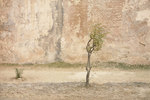
Reynaud pointed us to some of her favorites in the show, among them Eliot Porter's richly colored dye-transfer print "Juniper Tree, Arches National Monument, Utah, 1958." She takes delight in mentioning that the show's popular favorite so far seems to be William Eggleston's "Untitled, (Small Tree against Wall), 1980," which depicts a tiny, almost-bare tree struggling to survive in dirt against the backdrop of a wall.

trees-eggleston-getty.jpg
William Eggleston, "Untitled (Small Tree against Wall), 1980

Before leaving us, Reynaud recalls a friend's experience with a neighbor's burning house and the tree growing next to it. The friend was instructed to tell the firemen, "save the tree — I can always rebuild the house!" Those words stayed with her. In the exhibit's book, Reynaud writes: "Such a desperate plea highlights the fierce attachment a person may feel for the presence and company of a tree; in fact, human identification with the tree is a recognized phenomenon....The tree has, for millennia, also been a symbol of life, and the structure of a tree's branches, leaves and roots is mirrored in other living systems."

On our way out of the exhibit, I asked Sean if she had gained any new perspective. Unaccustomed to analyzing her photographic motives, she simply said, "whenever I saw something that turned a light on in my head I took a picture. I think that with the trees I just really wanted to capture something that was naturally there." And really, when you think about it, what more reason does a traveler need to make a photograph?

In Focus: The Tree is on view at the Getty Center through July 3, 2011

Curator Lyden leads a gallery talk on the exhibition on April 7 at 2:30 p.m.

Photographs courtesy of the Getty. Click on the image to see bigger.

The Anaheim Kings?

Reports out of NBA All-Star Weekend are that the Sacramento Kings are seriously considering a move to Anaheim's for next season. ESPN's Marc Stein says the Kings have until March 1 to file for relocation to the Honda Center.

I find such a move perplexing, and have serious doubts about whether this would be the right move for the franchise. It's well-known that the Kings are in an undesirable arena situation in Sacramento and have been unable to secure a new building in the city for years. Apparently the election of former NBA player Kevin Johnson as Sacramento mayor has not helped the King's cause. But there are several viable NBA markets and is it really smart to be the No. 3 team in this region?

The Lakers are clearly the No. 1 team in Orange County, and it's hard to imagine a wide swath of people suddenly changing their affiliation and rooting for one of the Purple and Gold's biggest rivals from a few years ago. The Clippers are also rapidly gaining in stature with the rise of Blake Griffin to stardom.

The Kings do have a promising nucleus with Tyreke Evans, DeMarcus Cousins, and Omri Casspi. But Cousins has already had bouts with immaturity this year, and I'm not sure if Evans can ever be as good as say, Derek Rose. In other words, in a superstar-driven league, playing in a superstar-driven region, the Kings figure to have the third best collection of superstars for the next few years.

Orange County is a nice sized market and it actually did a great job of supporting the Clippers when they played eight home games there a year in the late 1990s. But even Donald Sterling recognized that his franchise had a limited ceiling out there and the value of the Clippers is higher because it stayed in Los Angeles.

Kings owners Joe and Gavin Maloof do have Orange County ties, hosting the popular Maloof Money Cup skateboarding event in the area every year. If anyone can make a team successful there, it's the Maloof brothers, who are savvy businessman that have style and know how to appeal to families. There's no question that there are enough people and corporate dollars there to support a team (on paper), and an Anaheim NBA team could probably be a sustainable business seeing as how basketball has become the Southland's No. 1 sport.

But I've yet to see a real demand for an Orange County NBA franchise. It would take a great deal of time and savvy marketing for the team to forge its own identity and be more respected than say, the New Jersey Nets, who have almost no traction in the Tri-State area. It's also likely the Lakers and Clippers will object to a third team in the region.

If the Maloof brothers do move the Kings down here, then it would be advisable for them to change the team's name. It's tough enough to be the No. 3 team in the region, but being the No. 2 team called "Kings" would further hamper their abilities to market locally. Unlike the Angels, they couldn't get away with calling themselves "Los Angeles" as they could invite a trademark lawsuit from AEG. I'm sure Ducks fans won't like a team called "Kings" sharing their building either. "Anaheim Kings" also has an awkward ring to it, although "O.C. Kings" doesn't sound half-bad. Changing team names is a very difficult thing to do (I speak from experience, having worked on the Tampa Bay Rays rebranding), but the Seattle Supersonics became the Oklahoma City Thunder in one offseason, so the NBA has proven that it's doable.

I know the Maloof brothers have looked into other cities, but I would think that Las Vegas be a great location for their team. The brothers own the Palms Hotel and Casino, and there have been several proposals for a new arena there. The name "Las Vegas Kings" also has a nice ring to it. But other cities could work out too. There's an NBA-ready AEG-owned arena in Kansas City, although it's a small market and it's unclear how awkward it would be for the Kings to move back to the city they left in 1985. Other cities with NBA quality arenas include San Jose, St. Louis, Tampa, Vancouver, and Pittsburgh, to name just a few. The NBA would like another team in Seattle, but the city needs a new arena.

Either way, if staying in Sacramento isn't possible, then a move to Anaheim comes with significant challenges.

February 17, 2011

Angeleno Datebook- February 17, 2011

Thursday, February 17, 2011

  • Tamara Knutsen, PhD Candidate, Computation and Neural Systems Department at Caltech, discusses "How Sex, the Red Queen and Parasites Control the World" at this month's Mindshare LA at LA Center Studios, 1037 West 6th Street, Downtown. Additional presentations include lectures on sensual foods and a brief history of masturbation. Doors open at 7 PM.
  • Booksigning by 1936 Olympic athlete and WWII crash survivor and POW Louis Zamperini, the subject of a book by Laura Hillenbrand, at El Cholo, 1121 S. Western Ave. from 5:30 to 7:30 PM.
  • Move LA honors U.S. Senator Barbara Boxer and Representative Jane Harman at its 2nd annual We Love LA! Celebration at the Center at Cathedral Plaza, 555 West Temple St., Los Angeles. 6 PM
  • Future LAUSD superintendent John Deasy does the RAND Corporation Distinguished Speaker Series at Rand offices, 1776 Main St, in Santa Monica. 6 PM
Friday, February 18, 2011
  • Photographer Al Satterwhite signs his book Titans at Calumet Photo Hollywood during a Color Calibration seminar with Datacolor's Josh Fischer at 11 AM. Calumet Photo Hollywood, 1135 N Highland Ave.
  • Los Angeles Philharmonic hosts its Affiliates Invitational Rehearsal and Luncheon (Luncheon takes place in fifth floor dining salon at Dorothy Chandler Pavilion) at the Walt Disney Concert Hall. Noonish

Saturday, February 19, 2011

  • Deborah Painter presents her new book, FORRY-the Life of Forrest J. Ackerman, at Larry Edmunds Bookshop at 5:00 PM. Forry friend Joe Moe will also be on hand as well as other surprises and guests.
  • Richard Foss shares his lecture "Drinking with Shakespeare and Jane Austen" with the Culinary Historians of Southern California at the Palisades Library, 861 Alma Real Drive, Pacific Palisades. 2 PM
  • LAO Editor Kevin Roderick lectures on "Architects and Architecture of Los Angeles: From 1781 to 1900" in the Mark Taper Auditorium of Central Library at 2 PM.
  • Cinema Audio Society honors Jeffrey S. Wexler and director Taylor Hackford at its 47th Award in the Millennium Biltmore Hotel Los Angeles. Los Angeles. 5 PM
  • Laurie Wheeler, Amy Scattergood, James Greer and John Albert will join others to read their contributions to Slake No. 2 at Stories Books and Cafe in Echo Park at 7:30 PM. Reservations suggested.
  • Youth Justice Coalition presents its "A Tribute to Social Justice" benefit at the Chucos Justice Center, 1137 East Redondo Boulevard in Inglewood. 6:00 PM
Sunday, February 20, 2011
  • Los Angeles Italia 2011 Festival Opening Day (continues through February 26) honors the late Dino De Laurentiis at Mann Chinese 6 in Hollywood.
  • Motion Picture Sound Editors honor Walter Murch and Brian Grazer at its 58th Golden Reel Awards in the Westin Bonaventure Hotel & Suites. Downtown. 5:30 PMMonday,February 21, 2011
    • Cartoon Network presents the Hall of Game Awards at Barker Hangar in Santa Monica.
    • Phyllis Diller and the Actors Fund host the Carol Channing's 90th Birthday Tribute at the Pantages Theatre 7:30 PM
    • Tuesday, February 22, 2011
    • History of Eagle Rock - Illustrated Lecture and Book Signing with Eric Warren at the Pasadena Museum of History in Pasadena. 7:30 PM
    • CANCELLED Octavia Butler Tribute, commemorating the 5th anniversary of the author's death, at the Tribal Cafe, 1651 West Temple, Los Angeles, 7-9 PM
    • Costume Designers Guild hosts its 13th Annual Awards at the Beverly Hilton Hotel in Beverly Hills.
    • Donna Karan and the Urban Zen Foundation host the "Nomad: Two Worlds" Exhibition Opening Gala at Pier 59 Studios West in Santa Monica at 7:00 PM
    Wednesday, February 23, 2011
    • Andrei Codrescu presents The Poetry Lesson in the Harold M. Williams Auditorium at the The Getty Center at 7 PM. Reservations required.
    • Zocalo presents Susan Jacoby's lecture "Is Old Age Over?" at MOCA Grand Avenue, Downtown. 7:30PM
    • Children Uniting Nations presents its Children's Dream Awards Gala & Dinner at Club Nokia. 5:30 PM
    • Global Green USA hosts its Eighth Annual Pre-Oscar Party at Avalon Hollywood. 8:30 PM
    • Magic Johnson speaks at the Family Office Investment symposium in the Beverly Hilton Hotel. Event runs through Thursday.
    Thursday, February 24, 2011
    • Stefanie Powers visits Larry Edmunds book store to sign her new book, One From the Hart 7 PM

February 16, 2011

Adventures in Swagland: the Talent and the Talented, Pt. 2 (Grammys & Golden Globes version)

** What I learned this time: The Talent (celebrities) and the Talented (media) get different colors of wristbands--which I hadn't realized at my inaugural swag lounges, for the Emmys, and which is how they know whether to give you the free Caribbean vacation or the free Caribbean Living magazine.

** What that really means: Hollywood discriminates by color on a regular basis.

** Sample swag this time around--most of which the Talented didn't get: Hawaiian soda with multiple anti-oxidants; a papaya-enzyme exfoliator that works on a molecular level; a scalar-energy pendant with volcanic minerals that radiate in a circular motion and protect your body's natural energy field from electro-pollution; vegan-certified anti-aging pills that extend the life span of mice by 30% and the mice die of natural causes and not dementia or stroke or heart disease; and a no-rinse laundry wash infused with pure beneficial oils.

** Why I got that cool t-shirt: The Smalls were almost out, but there were still lots of Mediums.

** Why I got the exfoliator that works on the molecular level: She didn't see my blue wristband until it was too late--and then she had to give one to my Talented swag-lounge-buddy Lynn too.

** What I tried to get for my Mom but just couldn't convince them: A corn-resin watch with a bamboo dial--and did I mention that my Mom loves watches, and that she collects them, and that she finished her chemo last year?

** Nicest to the Talented: CGear, with Sand Free Multimats--the coolest, highest-quality beach mats that you've ever seen! Really. And reasonably priced. And never tested on mice.

** More swag for the Talent: vegan gluten-free shampoo with anti-aging properties; youth pleasure walnut body scrub; endless youth and life super food supplements; youngevity mineral makeup; longevity bioceuticals supplements; advanced anti-aging skin cream with Swiss alpine plant cells; and an anti-wrinkle bio-cellulose mask with fermented coconut juice bacteria.

** # of the Talent I recognized: Zero--and as I've mentioned in the past, I do in fact watch way way too much TV.

** What I had that none of the Talent had: Grey hair.

** What I had that none of the other Talented had: Grey hair.

** The Keep-Talking-and-You-Just-Might-Win-the-Keep-Talking-It's-Hysterical-Award Award:

Grammys: "Put the [scalar-energy] pendant in a glass of beer or a glass of wine. It won't taste great, but it'll alter the molecular structure. That's my best proof.... I don't know why."

Golden Globes: "This has 1000 times the science as açai...The mice were running around up to the last day."

** Couture Award: the tall, Titian-ish woman in mountain-high black heels and a black mini-halter thing, but the halter was both front and back. Close second: the twins in the matching white mini-pant-suits, like sort of a Heidi porn twins theme.

** Biggest disappointment: Where were the sex toys?--unlike at the Emmys green-products lounge. After all, California Exotics was so nice to the Talented, and their really nice Jewish PR rep even made me one of their Sexperts after we met there. And not only are their toys sweet and fun and high-quality, and free--as long as I plug them, which I'm happy to do because they're sweet and fun and high-quality and designed by women (just think about it, women!)--but also, they're phthalate-free plus a lot of the vibrators are solar-powered and/or have rechargeable batteries.

** Confession: I pass on most of the beauty-related swag to my friend Cindy--because I say, "Huh, arctic cloudberry collagen-reducing day creme??!" and she says, "Wow, arctic cloudberry collagen-reducing day creme!!!"

** Still waiting for: the carbon-neutral shredder they promised they'd send me in biodegradable packaging.

** Still haven't taken: the 5 (count 'em, 5) anti-aging pills the Talented could get.

February 13, 2011

Green Me Up, JJ

logo150.jpg"Advice for Greenies in a Complicated World"


Dear JJ:

My husband Justin and I are in our early 30s, and my biological clock is ticking! We'd always planned to have children, but some of our greenest friends are joining the Childless by Choice movement. What do you think? Should we at least consider whether adding more people to the planet is a good idea?

Maggie, greenApplechick
Brooklyn


Dear Maggie:

Wow, the ultimate question--the big Greenie kahuna. And such a tough one for me to weigh in on--and not just because this is such a deeply personal decision.

Should you and Justin add more resource-gobbling humans to the planet? That has to be entirely up to you.

The trouble is, we don't actually know whether it's greener to have children or not overall. If you think about it, for example, there are lots of ways in which children can actually discourage the rampant use of resources--an obvious example being that you'll probably want to avoid air travel for the first 10 years.

I can certainly urge you to consider all the pros and cons before you make such a spectacularly important decision--and yet, the debate over the Childless by Choice movement really hasn't even begun to do so.

A few of the more obvious pros, for example--i.e. ways that having kids in fact will help you reduce your impact on the earth:

• You'll have a lot less sex--tons less, let's just be honest--so you won't accidentally have more children than you might otherwise.
• When you teach kids about recycling, they become instant recycling nazis--in a good way.
• The Tea Party is going to keep having children. Think about it.
• Changing diapers for 3 years (especially in the 2nd and 3rd years) will make you completely comfortable with the idea of compost toilets.
• When the climate-change apocalypse arrives, you'll be able to eat for 2 months off the floor of your car on cereal, fruit-roll bits, and cookie and cracker crumbs.
• The most effective environmental organizations are run by people who have parents.
• We need a huge market for all the wonderful new toys without BPA, PVC, mercury, lead, and colors not found in nature.

By the same token, children can also be highly problematic planet-wise--and we need to examine that problem honestly and in a lot more detail than the debate so far has generally done. A few obvious examples:

• Kids never turn off the lights.
• Juice boxes aren't recyclable.
• It's just embarrassing to own a hybrid SUV that gets 22 mpg. Or it should be.
• Grandparents often embark on orgies of consumption, which can last 30 or 40 years.

And the most significant impact? Well, children have a way, we know, of making you care about them more than anything else. A lot more. Maybe it's the genetic imperative. Or their smiles. Or how they look when they're asleep. And yet, your car mileage? How much electricity you use? How long that shower is? Even those of us who love children have to admit that the biggest threat they pose to the planet is that they can make our strongest Greenie intentions fly right out the window.

On the other hand, you're probably not going to live as long yourselves--what with the years (decades!) of lost sleep and the worrying that never ends. Which is itself a huge argument in favor of having those kids, especially since old age... Well, the incredible resource-intensiveness of old age can be a subject for another whole column.

Of course, if you do decide to have children, then the next question you're going to want to ask is.... Are boys or girls greener?--which clearly will become more important as we develop more technologies to influence which one you have.

And it's just as complicated a question. Boys, for example, can eat 9 meals and take 7 showers a day as teenagers. And they don't eat vegetables--which can make it awfully challenging when the CSA box arrives with lettuce, mustard greens, collard greens, 2 kinds of chard, and 5 kinds of kale. And girls.... Well, girls, OMG. Girls, too, will require another whole column.

Good luck with your decision!


Green Me Up, JJ is an occasional advice column. You can e-mail JJ with your burning questions about how to act and think environmentally smart in our complicated 21st-century world.

For previous entries, click here.

E-mail JJ to be on the e-mail list for future columns.

Like JJ? Become a Facebook fan here!

Getting to know Bill Cunningham

billcunninghamnewyork.photo01.jpg
Bill Cunningham at work

I have a confession to make. I'm a Bill-a-holic. I can't start the weekend without first checking out legendary photographer Bill Cunningham's column of street fashion on the New York Times website. If I miss his latest pictures for some reason, I feel like something's off, like I've misplaced some piece of vital information that is my fashion touchstone for the week.

I'm especially addicted to his "On the Street" audio slideshows. When I press play and the cool, man-about-town theme music reaches my ears, I'm transported to the streets of New York. His distinctive voice makes me happy. Former Los Angeles Times photographer Iris Schneider, who met Cunningham when she was freelancing in NYC, says you can almost hear the twinkle in his eye. "I'd say he sounds like an upper-crust leprechaun," she says. "There is an upper-crust polish straight out of Sutton Place, but he's got an infectious lilt that is totally his own."

Cunningham also chronicles New York society parties in his weekly "Evening Hours" column, but fashion is his love. A ladies' hat designer in his younger days (he's now in his 80s), Cunningham has been documenting fashion trends in New York and Paris since the mid 1960's — for Women's Wear Daily and Details Magazine as well as the Times. Not merely a reporter, Cunningham is a fashion historian and anthropologist, detailing shifting styles and eras of fashion. He photographs everyone from society matrons in Chanel to kids showing off the latest trend in t-shirts, if he thinks they're interesting. Subjects who make the cut are usually thrilled. "We all get dressed for Bill," says Vogue editor Anna Wintour, part of the sartorial royalty that respects Cunningham's fashion eye. Harold Koda, curator of the Metropolitan Museum of Art Costume Institute, is another fan.

As someone who has shot a bit of street fashion, I marvel at how easy Cunningham makes it look. Shooting street fashion is not easy. First you have to spot someone who's wearing something interesting. Then it's about getting just the right angle, in the right light, at just the right moment (and that's when your subjects are cooperating.) Cunningham has the advantage of hunting his subjects in the highly compressed geography of Manhattan. On any given day, hundreds of fashionistas parade before his camera. But Cunningham isn't interested in just the well-dressed. He's looking for men and women who think creatively with their clothing. That's the stuff that really excites him.

And get this: This 80-something photographer gets around New York's wild streets on a bicycle, day and night. He's on at least his 29th bike. The others have been stolen.

Every weekend it's a treat for me to see what he comes up with. In the early 1980's, Cunningham was pursuing one of his favorite recurring themes: women dressed all in black. Susan Hagen, a friend of mine who is an L.A. fashion designer, turned up by surprise in Cunningham's column. She didn't even know she had been photographed. "I was shopping fabrics for my collection and spending time with my friend who is always in the chicest designer looks," she recalls. "She wore a tangerine Azzadine Alaia mini and I wore my own design, a midcalf tube dress, head to toe black. It was a warm spring day and we were walking all over Soho." I saw Susan's picture in the paper and called to tell her; the news made her day.

Cunningham likes to show complete outfits, but he's also a genius at zeroing in on the details. One of my favorite columns was a picture page entirely of cameos, everything from pins on a woman's jacket lapel to buttons on a blouse. Looking at those pictures, you would have sworn that cameos were the most important fashion statement in NYC that week. (And if anybody has that page, I would love to see it again.)

bcny_gallery8.jpg
Cunningham in the New York Times newsroom.

In addition to his admirers n the fashion world, I've learned that Cunningham's co-workers at the Times are fans too. NYT staff photographer Monica Almeida told me that "running into Bill at the office is always a treat. He is the quintessential gentleman, with a quick smile and a gracious 'hello dear' — when he's not standing over the light table completely engrossed in editing his film. He is the most prolific photographer on staff. He makes it look so effortless, he is truly amazing."

As I've followed Cunningham's work through the years, I've developed a growing curiosity about him as a person. What kind of photographer rides around on a bicycle, year after year? What drives his enthusiasm for fashion? For a long time I've wondered what makes Bill Cunningham tick.

I've finally gotten some answers in the form of a new documentary. Bill Cunningham New York will screen at the Nuart Theatre for one week starting March 25. It took producer Philip Gefter and filmmaker Richard Press ten years to convince Cunningham to cooperate and to get the 88-minute film made. Gefter was a picture editor at the NYT when he got to know the intensely private photographer. They follow him through his workday, go home with him (he lives alone), and tag along on a trip to Paris for Fashion Week.

I don't want to review the film or spoil it for anyone. I do want to say that I ate up every moment. Seeing it is like savoring an extended DVD version of "On the Street" with special features. I took in everything they showed about his obsession and how he lives. But any artist who pursues a subject so obsessively has complex motivations held deep inside. There are a few heartbreaking moments in the film that convince me Cunningham is driven by something he will never completely disclose. That's OK. It's enough to take what this wonderful film has to offer and then continue tuning into "On the Street" each week for as long as Cunningham wants to keep doing it.

Film trailer:

Photos: Zeitgeist Films

February 10, 2011

Angeleno Datebook- February 10, 2011

Thursday, February 10, 2011

  • Mimi Sheraton, author and food critic, lectures on "Not by Bialys Alone: Iconic Foods of Ashkenazic Jews" at UCLA Faculty Center. 5 PM
  • Zocalo Presents a panel entitled "Focusing on the New China" at The Getty Center. 7 PM
  • Kate Capshaw and Steven Spielberg and Tom Hanks and Rita Wilson, Jamie Tisch and Kelly Meyer co-chair the "Unforgettable Evening" benefit for the Women's Cancer Research Fund at the Beverly Wilshire Four Seasons Hotel.

Friday, February 11, 2011
  • Power and Performance in Imperial Spain: Theater Production in the Hispanic World of the Declining Hapsburg Monarchy conference starts at the William Andrews Clark Memorial Library.10:00 AM
  • MusiCares Foundation honors Barbra Streisand at its 21st Annual Benefit Gala at the Los Angeles Convention Center. Event starts at 5:30 PM
  • Break the Cycle hosts its Third Annual Unmasquerade Fashion Show and Auction in the Atrium of the California Market Center, 110 E. 9th Street, Downtown. 8 PM

Saturday, February 12, 2011

  • Opening Celebration for Central Nigeria Unmasked: Arts of the Benue River Valley at the Fowler Museum, UCLA. 6:30-9 PM
  • Academy of Motion Picture Arts and Sciences hosts its Scientific and Technical Academy Awards Presentation at the Beverly Wilshire Four Seasons Hotel in Beverly Hills.
  • NAACP hosts its 42nd Image Awards Nominees' Luncheon in Los Angeles.
  • Los Angeles Chamber Orchestra honors Carol Henry and Warner Henry at its Ninth Annual Concert Gala at the Dorothy Chandler Pavilion. 5:30 PM
  • Lesbian & Gay Lawyers Association of Los Angeles honors Laurie Hasencamp of The Trevor Project at its Changing Hearts and Minds: 32nd Annual Awards Dinner Gala at the Renaissance Hollywood Hotel 6:30 PM
  • Anne Byrn discusses The Cake Mix Doctor Bakes Gluten-Free at Vroman's Bookstore. 2:00 PM
  • Jane Velez-Mitchell discusses Addict Nation: An Intervention for America at Book Soup. 5:00 PM
  • Glen Hirshberg explores The Book of Bunk at Skylight Books. 5:00 PM.
  • 8th Annual Romeo & Juliet Theme Italian Renaissance Ball at UCLA Powell College Library. 8 PM
  • MONAs Sweetheart Neon Cruise of Los Angeles. 6:30 PM

Sunday, February 13, 2011
Monday, February 14, 2011
  • Valentine's Day

Tuesday, February 15, 2011
Wednesday, February 16, 2011
  • Los Angeles County Economic Development Corporation delivers its 2011-2012 Economic Forecast & Industry Outlook at its Breakfast program at the Los Angeles Marriott Downtown. 7:00 AM

  • Thursday, February 17, 2011
  • SurveyLA Community Meeting held at Neutra VDL House, 2300 Silver Lake Boulevard, Silver Lake. 7 - 9 pm
  • Exhibition Walkthrough: All of this and nothing with the artist Charlie White at Hammer Museum. 7 PM
  • February 7, 2011

    Time to surrender the national anthem

    Oh, say, can you see that it's time to retire our national anthem? Really, my fellow Americans, we need a new theme song.

    Don't blame Christina Aguilera--she's only the last in a series of sports-venue performers who lost the battle with that unsingable tune and its repugnantly martial lyrics. When doffing your pre-game Dodger cap, are you ever as offended by The Star Spangled Banner's violent sentiment as you were with Groupon's Super Bowl diss of whales and Tibet? What the hell's a rampart, anyway? It's a fort thing, isn't it, and do we really do forts anymore? Do you ever sing this range-defying, war-mongering song anywhere other than a sports event? O'er the loge level we watch the flag so flaccidly hanging, so who are we kidding?

    Citizens, let us follow in the melodic tradition of O Canada and Advance Australia Fair. Let us relieve all the professional singers and Girl Scout cookie winners given the anthem honorific only to dishonor themselves and the key of B flat. Let us embrace anthem.2, let us ensure, in the colorful sentiment from the beta anthem's third verse, that their blood has wash'd out their foul footsteps' pollution.

    You didn't know there was a third verse? Nobody does, and, really, what's the point of playing our song if we don't know the words to a melody we can't sing anyway? Heaven help the valiant person who essays to sing all four verses lest, in the colorful sentiment from Aguilera, we witness the last reaming.

    Americans are singularly committed to torturing singers and sports audiences with a pro forma "Star Spangled Banner" only by habit. The first documented jock performance of this ditty was in 1918 during the seventh-inning stretch of a World Series game between the Chicago Cubs and the Boston Red Sox, but it wasn't the national anthem then, it was just another in-your-face song of support for the World War I troops overseas. The United States didn't have a national anthem until 1931, when Congress chose an unalloyed musical fist over the equally (French and Indian) war-lusting "Yankee Doodle" and its odd allusions to food and womanizing. That our nation's leaders rejected "America the Beautiful," which also was in the running, was an ominous signal of our future attraction to such vapidly aggressive adventures as monster truck smash-a-thons and "Jersey Shore."

    The Star Spangled Banner wasn't routinely inflicted on sports fans until World War II, when we cranked up the military music in patriotic support once again for the troops overseas. I get that. But I do not get the enduring association of that song with sticky stadium floors and the aroma of mustardy hot dogs. I do not get that we pay tribute to ourselves with a song celebrating "the land of the free" that was written by a guy who owned slaves.

    Oh, say, can you see the dawn's early light of a new fight song? One that is less fight and more song? Why not invoke our nation's better nature and physical glory instead of its Ultimate Fighting persona? What's wrong with "This Land Is Your Land," "America the Beautiful," or some new tune that people can actually sing and understand, one that does not detract from the games people play, wardrobe malfunctions and the fact that there is no such thing as fish curry in Tibet?

    February 6, 2011

    Where's our 'can do' attitude?

    There are dozens of reasons why Los Angeles doesn't have an NFL team, but chief among them is lack of a "can do" attitude from the city's political and opinion leaders. In the week that AEG announced a historic $700 million rights deal for Farmer Field, the boo-birds came out in full force, trying to derail the downtown football stadium before a formal proposal has even been submitted.

    Earlier this week, the LA Daily News' Kerry Cavanaugh wrote: "What L.A. needs is a skeptical politician. Some elected leader who is willing to be the skunk at the garden party."

    Funny how all I see in LA are skeptical politicians and a City Council filled with skunks. The same day Cavanaugh's column came out, the LA Times ran an article headlined: "L.A. City Council takes cooler view of football stadium plans" and quoted several politicians who laid the ground work for their opposition.

    All we've gotten in LA for the past 16 years is a City Council that has done its best to prevent the NFL from coming here. It was City Council who forced Peter O'Malley to abandon plans for a Chavez Ravine football stadium, which ultimately led to the unfortunate sale of the Dodgers. It was the City Council that nixed a very reasonable stadium idea in South Park before it even had a chance to get off the ground. And it was the City Council that tried to shove the Coliseum down the NFL's throats, when the league obviously hated the venue.

    While Cavanaugh used the word "skeptical," I'd be more inclined to use words like "obstructionist," "self-interested," or "haters" to describe our local leaders' attitudes and actions towards the NFL.

    What LA needs are leaders who are willing to work to get something built, rather than work to get something torn down. What LA needs are politicians who want to make this city great by moving it forward instead of appeasing those who want to hold it back.

    This isn't necessarily about having Los Angeles compete with NFL cities like Cleveland or Charlotte. This is really about positioning Los Angeles to compete as a global city with places with like Shanghai and Singapore.

    I truly believe that Los Angeles is the greatest city in the world. But there are powerful forces here that are too accepting of the status quo and prevent us from making the investments needed to keep LA positioned as a leading city for the future.

    We're a city that has a horrible airport and in some places has a crumbling infrastructure. I'm aghast when I see lines like those from fellow LAObserved writer Bill Boyarsky who question the need for LA to tear down "a perfectly good convention center."

    Perhaps Bill and I have very different views of the LA Convention Center and what its purpose should be, but "perfectly good" is one of the last descriptions I'd use. In my view, it's entirely too small and inadequate for a city of LA's size and stature, and we regularly lose conventions to less interesting and less prestigious cities because of it. The West Hall itself is a big blue eyesore along the 110 Freeway, and turning it into a venue that can hold spectacular conventions - as well as football, the Super Bowl, the Final Four, etc. - would be a major boost to the city. I'd argue that it will lead to greater tax revenues from those events and from visitors who stay in city hotels.

    Now, while I support building a downtown football stadium, I'd be one of the first to say that the deal has to be right for the city. There are still unanswered questions about the financing of the stadium, the repayment of bonds used to build a convention center addition, the tenant at the stadium, how revenues would be distributed between AEG and an NFL owner, and we still don't have an environmental impact report.

    But it would be refreshing if our local political and opinion leaders approached the idea from the standpoint of "how can we make this work for everyone?" rather than "how can we prove this doesn't work for everyone and therefore shouldn't happen?" Columns and interviews in the past week bear out this negative bias in examining the stadium proposal.

    There's a certain civic spirit missing from many influential people in this city, who saw AEG executives, business leaders, and a handful of upbeat local politicians high-fiving this past week and simply assumed that the taxpayers were going to get a raw deal. If there's any group that deserves our respect, it's AEG, who has shown the vision and leadership in its developments that is lacking elsewhere in Los Angeles. They've navigated the LA political muck better than anyone, and as a result, they've single-handedly transformed downtown in the last decade and provided several great deals for the city.

    Part of the reason for the high-fives was because AEG is the one group with the credibility to get a special venue like this built. But another reason for the optimistic press conference was that Farmers Insurance showed it still believes Los Angeles is a great city, as evidenced by its record $700 million naming rights deal that will help the stadium get be built without taxpayer funds. Such a deal is really historic for the sports industry.

    "What's the rush?" asked councilman Paul Krekorian (who hails from my home district) this week.

    Well, the rush is that if Los Angeles doesn't get this done soon, then it will lose out on the benefits of having pro football to the City of Industry, which already has its political approval in place. And then it will also lose out on this unique opportunity to take its convention center into the 21st century. Additionally, there are several NFL teams in a position to move in the very near future (Chargers, Vikings, and Rams being the most likely candidates), and they won't come here unless they know a stadium will be built.

    But beyond that, I think Los Angeles needs to prove that it can build great things in an organized and efficient way, and not let good ideas die in red tape, bureaucracy, and lawsuits.

    Some people may say: "Los Angeles doesn't need the NFL. The sun will still shine every morning." But you could also argue that Los Angeles doesn't need the Lakers, and we'll still see the sun too.

    I love professional football and I've wanted a home team to root for since 1995. I believe that most of Southern California wants the NFL here too, but that silent majority simply isn't organized and is not in tune with our complicated local politics to make their voice heard.

    However, beyond that, we have an opportunity to get a shining jewel built for Los Angeles that can do more than just bring pro football here. Asking questions and seeking a fair deal for the city is completely understandable. But approaching this project from a "can kill" mindset will prevent us from realizing something special. Los Angeles needs a "can do" attitude.

    February 5, 2011

    The L.A. Kings and their unique definition of "in front of"

    While it may have just been one bad night for Staples Center staff (see I didn't use 'the' just like AEG likes), my last trip to see a Kings game turned out to be a night when things went so bad, that they almost became comical. If I'm lucky, I can turn my experience into one of those silly sports "curses" (see, "Bambino, Curse of the", "Billy Goat, Curse of the", "Rick Neuheisel, Hiring by UCLA of').

    Back on December 26, I had my much anticipated bachelor party, at a Kings-Ducks game, before my wedding on the December 30. It was anticipated in the sense that it took me until I was 45 to finally get married. (And it was well worth the wait I may add.)

    The party was far from anything out of "The Hangover." It was a small gathering of 10 people, including my three brothers, two nephews, my father-in-law, and three other friends. Since my father-in-law was still rehabbing from knee surgery, we needed a wheelchair accessible seat. And with that, our comedy of errors began.

    My brother Michael was in charge of buying the tickets. You can't buy accessible seats easily online, so you need to call in for them. After a few calls back and forth, the Kings sold him two seats in a wheelchair accessible row, and eight more in the row in front of them.

    It seemed like a good idea. Everyone would be fairly close to one another and we could rotate people around to the seat next to my father-in-law.

    When we showed up for the game, the ushers told us that we couldn't sit in our seats until after the National Anthem because the area was occupied by some special equipment that is used for a pregame laser show. Presumably, the Kings don't want fans sitting next to some giant death ray machine that could possibly be the subject to examination under the terms of the START Treaty.

    Eventually, we got to go to our seats, which turned out to be in unexpected places.

    The accessible seats were Aisle 108, Row 18W. It's a long row of folding chairs and we were assigned to two seats somewhere in the middle of it. The rest of the group was in Aisle 108, Row 20.

    You might think that Rows 18 and 20 are fairly close to one another. But, if you look at the seating chart linked here, and look closely at section 108, the accessible seats are where the wheelchair symbol is located. Row 20, however, is in a little notch area BEHIND and to the RIGHT of the accessible seats. (If I could cut it out an blow it up, I would. But, that would presume I know how to do such things. A friend made a closeup to show it better.)

    So, we ended up with two people in one section and eight others about 20 feet away. Compounding the problem, the other eight seats were at the far end of that section and there were another eight seats between the accessible seats and Row 20. Also, we were somewhat arbitrarily stuck in the middle of the accessible row.

    My brother and I figured that at the first intermission, we could sort out the problem. The accessible row was nearly empty after all. Or maybe we could move to another section.

    So, first we asked the ushers if some people could move over. The answer was no, you can't sit in seats that we've sold to someone else. My brother then opted to go find a supervisor. And nothing speaks authority more than a guy in a bright red blazer. Red blazers should always outrank purple shirts.

    My brother appealed to the supervisor and told him of the situation. He talked of people traveling from distant places (Michigan, Missouri, Canada, Oakland!). One guy in a red blazer consulted with another guy in a red blazer. They came to a solution: deal with it. Those are your seats and that's where you have to sit. This violated one of the cardinal rules of customer service: when a customer comes to you with a problem, present an option. Even if it's a really bad option. The worst answer possible is "No."

    My father-in-law and I ended up having a good time at the game, even though we felt like we had been sent to exile. My brother and one of my nephews performed a stirring feat of civil disobedience by walking over to the wheelchair sections during the third period. (My parents instilled in me a healthy respect for the importance of assigned seating. Or maybe it was just a healthy fear of speaking up and causing trouble. The family motto is "Sorry to bother you, but...")

    Eventually, the wheelchair row did get filled in toward the end of the game. Some of the Kings staff (they wore badges that said STAFF) came by and asked the ushers "Can we sit here?" The answer: "Sure, no one's been there all night!"

    After the game, my brother started contacting various Kings ticketing officials to discuss the situation, but nobody seemed to understand the problem. Or care. Or bother to return calls. Or emails. (My plan to get Eli Broad and Magic Johnson to lobby for me didn't work. Tim Leiweke got to them first!)

    The Kings, who presumably should be the ones trying harder to win fan support, seemed to be bending over backward to make sure that a group of people who bought $1,000 worth of tickets (OK, that's not a lot compared to the whole arena) were kept as unhappy as possible.

    Toward the end of the game, a fan in the section above my father-in-law and me knocked a beer over by accident. The cup landed next to us. The staff sprung into action. They put up a "Wet Floor" sign. Of course, we could have been hit by the cup. Or had beer spilled on us. It just seemed like a symbol for the night. We weren't people there paying our money to enjoy the game, but rather just people there to create extra work for the ushers.

    The bachelor party fiasco fortunately did not lead to any wedding night mishaps. The people at the Autry National Center did a great job. And they even let my family and friends sit next to each other. It's not as hard as you think it is to pull that off.

    After the Kings won on December 26, they won in San Jose the next night. Then they went through a rough patch, losing 11 of 13 games. Did I have anything to do with it? No, I'm afraid not. I don't believe in such things. The Kings lost those games on merit.

    But am I going to a Kings game again soon? Maybe.
    Will I ever go to an NFL game at Farmers Field, if it ever gets built? Most decidedly never. But, that would be yet another story.

    Film costumes open at FIDM

    The 19th annual Art of Motion Picture Costume Design exhibition opens Tuesday at the Fashion Institute of Design & Merchandising in Downtown. The exhibit includes Oscar-nominated costumes for "The King's Speech," "The Tempest," "True Grit" and "Alice in Wonderland" — more than 20 of last year's films in all — and it's free. Here's a preview from this afternoon.

    burlesque-fidm.jpg

    true-grit-fidm.jpg

    colleen-atwood-fidm.jpg

    fidm-costumes-2011.jpg

    From the top: Costumes from Burlesque; True Grit; Colleen Atwood, Oscar nominee for Alice in Wonderland; inside the exhibition.

    Photos by Sean Roderick


    Recently posted at LA Observed
    Media
     
    Politics
    LA Biz
     
    Arts, Books & Food
    LA Living
     
    Sports
     
    © 2003-2011   •  About LA Observed  •  Email the editor
    Follow LAO
    Kevin Roderick blog
    2:01 PM Fri | The Getty Center’s Central Garden will reopen to visitors on Saturday, May 26. It has been closed since February for maintenance to the walkways and planters.
    Mark Lacter, LA Biz Observed
    2:35 PM Fri | A long time ago in a galaxy far, far away, a smallish movie called "Star Wars" opened in just 32 theaters, including the Avco on Wilshire Boulevard. No fanfare, no text-messaged reviews - just a bunch of weird characters, a compelling good vs. evil plotline, and a towering soundtrack.
    8:54 AM Fri | Friday morning headlines

    Enter your email address:

    Delivered by FeedBurner


    Get RSS Feeds
    of LA Observed
    LA Observed publishes several Real Simple Syndication feeds for easy scanning of headlines. If you wish to subscribe to a feed, most popular RSS readers will do it for you. You can also enter the web address from the XML button below or click on a specific feed. For more help with RSS, try here or here.


    Add to Google