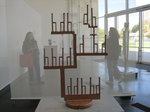
David Smith, considered the greatest American sculptor of the 20th century, is the subject of a new exhibit opening April 3 at LACMA's Resnick Pavilion. That's almost poignant. He died in a car accident in 1965 (at the age of 59) during the planning of a major exhibit for the new Los Angeles County Museum of Art, which opened on Wilshire Boulevard that year. Thursday is the 46th anniversary of LACMA's debut.
David Smith: Cubes and Anarchy is the first West Coast exhibition of his work since then.
Born in Indiana in 1906, Smith worked as a welder and riveter at a Studebaker auto factory while attending college. He later moved to New York City to study art and was heavily influenced by Pablo Picasso and Cubism, Italian sculptor Alberto Giacometti, and Spanish artist Joan Miró. When Smith saw images of Picasso's iron constructions in 1932 he realized that he could use his welding skill and knowledge of industrial materials for making art.
Smith, who preferred to work with steel, iron, and aluminum, has "often been presented as a counterpart to the abstract expressionist painters or as a draftsman in space." The welder from Indiana befriended many other prominent artists, including Adolph Gottlieb and Milton Avery in the 1930's and Robert Motherwell, Jackson Pollock, and Franz Kline in the 1950's.
The new exhibit was designed by Brenda Levin, more known for her work as a preservation architect. She discusses the project on LACMA's blog. "David Smith: Cubes and Anarchy" runs through July 24.
All photos by Judy Graeme
Friday, March 25, 2011
Sunday, March 27, 2011
Los Angeles Times sports columnist T.J. Simers, or as he prefers to refer to himself "Page Two", has made a name for himself with a humorous, yet often abrasive, style. Simers style is marked by a lack of reverence for just about any sports figure, including people like John Wooden and Vin Scully.
Simers like two types of subjects to write about:
In his Tuesday column, Simers decided to make one of the new Dodgers, backup outfielder Marcus Thames, the subject of his column. And Thames, who likely did not know who Simers was, fell into the second category. The results would not be good for Thames. However, the reaction from the baseball blogosphere turned out to be even more vicious toward Simers than Simers was toward Thames.
Thames, a 34-year old hoping to start his tenth season in the majors has made his living as a backup outfielder and designated hitter. He made his debut on June 10, 2002 with the Yankees and hit a home run in his first major league at bat (on the first pitch no less) against Randy Johnson, then of Arizona. He later moved on to Texas, Detroit, and then back to the Yankees. While Thames has always been a decent hitter for power, he's not exactly the most graceful of outfielders. Simers seized on this information in his greeting to Thames.
"Are you that horrible on defense that teams don't think it's worth playing such a home run threat?'' I asked by way of introduction.
Thames did not reply to Simers.
He said he wasn't going to talk to me because I hadn't introduced myself. That would have allowed him to pull out the little card the Dodgers' PR department provides players advising them how to get a running start on Page 2.I can't imagine this is the first time in 10 years that Tims/Tems has been asked why he stinks on defense, thereby limiting his time as a regular player.
Unable to answer, he just stood and walked away.
The point of Simers column was mainly to point out that the Dodgers were signing a stopgap player to fill in a spot in the outfield and weren't going to spend money on a better free agent because of the financial problems the team has.
However, Simers kept bringing up Thames' defensive lapses, low batting average, and a confusion over how the player's surname is pronounced. It has been pronounced been "Timms" throughout his career, but Simers heard "Tems" (like the river, not taking into account that a short e and a short i sound may differ because of regional accents).
When I ask Don Mattingly about Tims/Tems' horrific problems on defense, the manager says, "I'm not going to say he's [crummy] on defense. He's not a Gold Glove outfielder . . . he's OK. All we've asked Marcus to do is what he's supposed to do."You can see what a motivational speaker Mattingly can be when it's necessary.
"All we will ask him to do," Mattingly says in giving it another try, "is to play up to his capabilities."
So right away I want to know, "Who won't you ask to play up to their capabilities?" I'm expecting him to say Matt Kemp, but he says he wants the best out of everyone.
He goes on to say Tims/Tems' problems go way beyond criticism of his defense. "Maybe it's because he doesn't hit righties as good as lefties," Mattingly says.
So now we understand the Dodgers have a guy in left who can't catch, can't hit right-handed pitchers and can't answer questions about his obvious shortcomings.
Was Thames treated worse than any other sports figure that Simers has written about in the past? It's hard to say. But this particular column drew heated responses among baseball bloggers.
Craig Calcaterra of NBC's Hardball Talk wrote a piece on the column titled "One of the Most Insulting Columns You Will Read This Year." Tyler Duffy of The Big Lead opted for "T.J. Simers unnecessarily cruel hatchet job on Marcus Thames.
On Twitter, the reaction was resoundingly negative. Curtis Granderson of the Yankees, who played with Thames in both Detroit and New York, Tweeted:
I don't like to criticize media. They have a job to do & sometimes have to be the bad guy. But @LATimesTJSimers should be ashamed of himself
(Note, in researching this, I noticed that Granderson retweeted a link of mine. I am expecting a wave of new followers. OK, maybe not.)
Peter Gammons, formerly of ESPN and now working for the MLB network, replied:
@cgrand14 I know that to be true. Thank you for defending a good person
There were many more examples I could link to, but this has already gone on way too long. I was struck at the vitriol toward Simers that this column stirred up. What would the aftermath be? Rule of thumb: If Jeff Pearlman thinks a writer is being obnoxious, it's bad.
What I expected would happen would be damage control on the part of the Dodgers and Thames. And that is what happened Wednesday when Simers wrote about Thames taking ground balls at first and discussing his defensive abilities in a seemingly good-natured way.
Simers is, despite this column, a well-regarded journalist by his peers. And it's doubtful that he could write anything about a backup outfielder for the Dodgers that would damage his career. The Thames column was not going to be a Joseph Welch vs. Joe McCarthy moment for Simers.
But it does seem that the only way to avoid being the target of one of Simers' columns is to make sure he never learns of your existence. It's a little late for him to develop a new style.
The second weekend of America's three week obsession with looking at names of universities written in brackets that are normally a power of two has a stop in Anaheim this weekend at the Honda Center. The NCAA men's basketball tournament has filled America's need to watch sports for eight hours a day, along with giving people a reason to find out where Belmont College is. (Nashville)
(For people on the East Coast, the NCAA tournament gives them an excuse to learn where UC Santa Barbara is. I believe that some people in ACC/Big East territory believe Santa Barbara is near the beach.)
One fourth of the Sweet Sixteen, the West Regional, will be played on Thursday and Saturday. The first game will start about 4:15 pm and match up the second seed in the region, San Diego State (California's lone representative left in the tournament) and Connecticut. At about 6:45 pm, defending champion and #1 seed Duke will play the #5 seed, Arizona. The winners will play again on Saturday for a spot in the Final Four in Houston, which starts on April 2.
The Aztecs had never won an NCAA tournament game prior to this season. San Diego State lost two games in the regular season, both to BYU, but beat the Cougars in the Mountain West Conference championship game. Connecticut has won seven straight games, including a stretch of five wins in five days to win the Big East conference tournament.
San Diego State won its first game in the tournament with relative ease over Northern Colorado, but needed two overtimes to defeat Temple. Connecticut had relatively easy wins over Bucknell and fellow Big East member Cincinnati.
Defending champion Duke won its first game against Hampton easily, but then held on for dear life against Michigan in its next game. Arizona had narrow wins over both Memphis and Texas to make it to Anaheim.
Thursday's game will be a chance for Arizona's star player, Derrick Williams, to get home to see his family. Williams starred at La Mirada High.
This year's tournament has been subject to much more mathematical analysis than it has in the past. Newer methods of evaluating basketball statistics have made it further into the mainstream. The New York Times has had Nate Silver making regular updates to his predictions on winners for each game as well as updates for the tournament's most likely winner. Silver's work is based in great part on that of Ken Pomeroy.
Silver gives San Diego State a 70% chance of beating UConn, while Pomeroy only gives the Aztecs a 67% chance. Las Vegas books have the game more or less even. Both Silver and Pomeroy give Duke at least an 80% chance of defeating Arizona.
Despite all the probabilities, both Silver and Pomeroy would acknowledge that any one basketball game could see just about anything happen. (Silver is 15th out of 28 among New York Times staffers who made picks.) The first weekend of the tournament saw its usual share of games with buzzer beaters, controversial officiating decisions, and upsets that make the tournament such compelling viewing. Or in my case for the weird ending to the Butler-Pitt game, compelling hits of the refresh button on my phone to figure out what was going on because I was stuck in line at Philippe's when that game ended. (It was a very good sandwich, so I was happy.)
And this year, watching the tournament changed greatly. CBS decided to share the cost of broadcasting the tournament with TBS, TNT, and TruTV (formerly Court TV). Also, CBS streams all the games online for free over the Internet. In the past, CBS had control of all the games and you would only be able to see whichever game was deemed to be of the greatest local interest to you. If another game was more exciting, you had to hope that CBS had the chance to switch over. Now, each game is shown from start to finish on one channel. (The games from Anaheim will be on CBS with Verne Lundquist and Bill Raftery calling the action. Except lots of shouts of "My Goodness" and "Onions!" and healthy-sized helpings of sycophancy for Jim Calhoun and Mike Krzyzewski.)
The other three regions each have their own intriguing themes.
The Southeast Region, played in New Orleans, will have #2 Florida (which eliminated UCLA on Saturday) take on #3 BYU, with the sensational Jimmer Fredette, who has averaged 28.8 points per game this season. He scored 32 in BYU's win against Wofford last Thursday and then 34 on Saturday against Gonzaga. The other game in New Orleans will have last year's runnerup, #8 Butler against #4 seed Wisconsin. This region is regarded as the most wide open for any team to win. This is also the regional that Gus Johnson is working.
The Southwest Region, played in San Antonio, has #1 seed Kansas seemingly primed to move on to the Final Four. The Jayhawks play #12 seed Richmond on Friday. The winner of that game will face the winner of a game between #10 seed Florida State and #11 seed Virginia Commonwealth. VCU has won three games in the tournament already, defeating USC last Wednesday in one of "the First Four" games that the NCAA used this season. This is the first time since the tournament expanded to 64 teams in 1985 where three double digit seeds made it to the second week in one region. While Kansas is the likeliest winner out of this region, the allure of an all-Richmond final would be delightfully odd.
Few people picked the Rams (that's VCU for those not paying attention to such things) to go far in the tournament because on most websites for filling out brackets, the teams that played in the "First Four" games were just considered automatic losses in the second round. For a lot of people, they might have VCU in the Sweet Sixteen because they thought USC was going to make it.
The East Region, played in Newark, is full of basketball bluebloods. In one game #1 seed Ohio State will play #4 seed Kentucky. The other sees #2 seed North Carolina playing #11 Marquette. All four teams have won championships before. Ohio State is Nate Silver's choice as the likeliest winner of the entire tournament, although it's only a 28% chance. Marquette is the longest shot left in the tournament at 0.3% according to Sliver, primarily because Marquette would likely have to beat a #2 seed and a #1 seed to get to the Final Four.
In the women's tournament, UCLA was the only local school to get an invitation. Despite a 27-4 regular season, the Bruins were given a #3 seed and sent to Spokane to play Montana, whom they beat, and then got to face #11 seed Gonzaga on the Bulldogs' home court. The Zags, behind a 29-point, 17-assist performance from Courtney Vandersloot, beat the Bruins Tuesday night, 89-75. The #1 seeds Tennessee, Connecticut, Stanford, and Baylor are all heavy favorites to make it to the Final Four in Indianapolis.
I was visiting a mentoring and art center for homeless teens in Portland last week when my cell phone rang. It was Gordon (not his real name), calling from Orange County. I went to grade school with Gordon, and had not had contact with him since 1980. Earlier in the day, I had received a Facebook message from a fellow schoolmate, asking whether Gordon had also contacted me saying he needed $2500 or would be evicted by 3 PM. I told the classmate no; that I was sure it was SPAM, and that he should contact Gordon to let him know.
Standing yards away from a dozen homeless teenagers, two of them in wheelchairs, I asked Gordon if that was why he was calling, to let me know, the SPAM was not from him.
"No," he said. "I actually do need $2500 or I will be evicted."
I processed this, looking at the kids who come to the center each day for two meals, to make art and to read and use the computer until 2:30, when, rain or shine, the center closes and the kids are back on the street. I was visiting because the week before, I published a novel, The Bad Mother, about homeless teens in Hollywood. The kids at the center had found out about the book, they wanted to read it and to meet me. One girl told me she'd essentially been on the streets since age five, and then followed me around like a puppy, telling me her story, not with self-pity, just the facts, which included that she is, with the assistance of the center, renting a studio apartment and attending community college classes to become a CPA.
And here was Gordon, if it was Gordon, on the phone. We attended private school together in Brooklyn; last I heard, he had a white-collar job and was living in Southern California. I told him, his request had the sound of a common scam, and how did I even know it was him? I asked him what he called me in 7th grade. He got the answer right, and even sang the little ditty he'd sing when he said it.
I asked Gordon, what was going on? How did he find himself in this place? He said something about his business having lost clients, some bad financial decisions. He said he needed money and that he needed it today or would be out on the street. I asked him about his wife and children; he said they were with him and fine. He sounded cavalier. I told him, I was not going to give him money, and that his reaching out to people he had not seen in 30 years was very suspect.
"I appreciate you saying that, Nancy, but I always thought, once a Saint Anner, always a Saint Anner," he said, referring to the name of our school. "And if it was you calling me for money, even thirty years later, I would give it to you."
I told Gordon, I had to go. I might have added, take care, or get help, but did not. I have, as have nearly all of us, been around the block with people and their addictions, to drugs, booze, gambling, lying. We have learned that throwing money at the problem does not help.
I walked back into the center, thinking how bizarre it was to get this call here. I thought about the characters in my book, without homes, often without hope. And I met E, who was playing around on an espresso machine donated to the center. He told me he was learning to be a barista; that he didn't know a lot yet about coffee but he loved it. I told him, my husband was in the coffee business.
"Really?" he said, his face becoming both bright and shy. "Do you think I could meet him?"
I told him, I would be happy to help.
With the Sacramento Kings seriously considering a move to Anaheim, an official trademark application has been filed for the names "Los Angeles Royals", "Anaheim Royals", "Anaheim Royals of Southern California", and "Orange County Royals".
Last month, I expressed skepticism about whether a move south would be good for the Kings. On paper, the numbers would dictate that Orange County has the population, demographics, and corporate base to support an NBA franchise. And the Maloof brothers have the Orange County ties that could make such a move work. But being the third team in Southern California comes with significant challenges, and it might take years for the franchise to win over the hearts and minds of locals.
As for the potential Royals names, I think the Maloofs can do better. It's understandable that the team would want to change names, since Angelinos think of the Kings as a hockey team. The name Royals has history since they used to be the Rochester Royals and later the Cincinnati Royals. Reportedly, the city of Anaheim (which owns the Honda Center) is insisting that the team name include "Anaheim."
But "Royals" seems like... well, a Kansas City baseball team. In fact, I wouldn't be surprised if the Maloofs are dissatisfied with the result of their trademark application, since Major League Baseball likely owns "Royals" in several trademark classes. I know a few things about trademark law as it pertains to sports teams having worked on the Tampa Bay Rays rebranding. I can say it's extremely difficult to get complete ownership of a trademark if it exists in another professional sports league, and MLB cannot be thrilled with this application. That being said, it's possible that the NBA has some trademark rights to "Royals" dating back to the Rochester and Cincinnati days, and that would explain the retro jerseys that the Kings wear a few times a year.
I do have some better suggestions for a nickname if the Kings really do move here. One idea would be for the Kings to engage in a nickname swap with the Memphis Grizzlies. Of course a grizzly bear is on the California state flag and "Memphis Kings" would work with that city's Elvis history. Anaheim Grizzlies sounds like a pretty good name.
A handful of other names come to mind. There used to be an ABA team called the Anaheim Amigos, which has some nice alliteration and may appeal to Hispanic fans. I always liked the name Anaheim Piranhas, which was an Arena Football team that existed for one season. If the Kings want to stick with the royalty theme, then they could consider "Monarchs" now that the WNBA's Sacramento Monarchs have folded. A name like "Orange County Monarchs" could also work. Other names I'll throw out there: Anaheim Aces, Anaheim Admirals, Anaheim Aeros, Anaheim Orange, Orange County Barons, Orange County Coastals, and the Orange County Waves.
If you have some ideas for a new name for the Kings, then please feel free to e-mail me. I may post some of the really good suggestions.
With the official Opening Day/Night for the Dodgers still a couple weeks away on March 31, local baseball fans got a chance to see some game action at Dodger Stadium last Sunday when USC and UCLA met in the Dodgertown Classic.
College baseball is never a big draw in Southern California, but the doubleheader (an earlier game matched up Georgia and St. Mary's), but a crowd of 11,000 took advantage of $7 tickets, free parking, and reduced priced concessions to listen to the ping of aluminum hitting a baseball.
The Bruins, coached by John Savage, had started out the season ranked as high as #2 in some polls. UCLA ended years of frustration of poor play in the postseason by getting all the way to the final games of the College World Series before finishing second to South Carolina. The Bruins returned the nation's #1 pro prospect in pitcher Gerrit Cole, as well as another ace in Trevor Bauer.
USC, which is to college baseball as UCLA is to college basketball, was a program in turmoil. Former Dodger catcher Chad Kreuter was let go in August after four seasons and a .487 winning percentage. Frank Cruz was named interim head coach for this season by Athletic Director Pat Haden.
UCLA started out 4-0, giving up just one run in those games. After that, the Bruins bats went cold. Extremely cold. Coming into Sunday's game, the Bruins were 8-5 and down to #13 in the polls.
USC was 4-10 entering the game and had lost its last five games against the Bruins.
A crowd of around 11,000 settled into the first and second decks of Dodger Stadium to take in the game. Each school brought a portion of its band as well as cheerleaders to give the game a much different vibe.
UCLA started freshman Adam Plutko, the team's best pitcher not named Cole or Bauer. USC started senior Logan Odom. Cole had pitched on Friday and Bauer on Saturday.
The game was like watching a baseball game from 1966. The pitchers dominated the action. Plutko struck out eight Trojans in six innings of work, but gave up two runs on four hits.
Odom struck out just four, but the Bruins were unable to make solid contact for most of the game, grounding out to the pitcher five times. (And two of those ended up as double plays.) The Bruins had two scoring "chances."
In the fourth, left fielders Cody Keefer walked and stole second with two outs. Right fielder Jeff Gelalich followed with an infield hit to short, but Keefer rounded third too far and was tagged out trying to get back to end the inning.
The Bruins other chance to score came in the eighth. Catcher Steve Rodriguez reached on an error by first baseman Ricky Oropesa. Then, with two outs, two consecutive Trojan relievers came in and hit UCLA batters with their first (and only) pitches of the game. (It wasn't a case of bad blood, but merely bad curve balls.) Finally, Chad Smith, the fifth pitcher of the inning, struck out UCLA first baseman Dean Espy to end the threat.
UCLA does not play again until Saturday at Cal Poly San Luis Obispo. USC swept a two-game series from Louisville in the interim to bring their record up to 7-10. The Bruins and Trojans will meet for games that count in the Pac-10 standings starting on March 25 at USC.
The Bruins have now slid all the way to #24 in the Baseball America poll. Cole has put up a 1.78 ERA in his first four starts of the year, although he's only won just one of them. He has struck out 37 batters in just 30 1/3 innings pitched. Cole also retired the first 19 Georgia hitters he faced Friday night, although he ended up the losing pitcher. Bauer has a 1.71 ERA with 46 strikeouts in 31 2/3 innings. Bauer struck out 17 in 10 innings in a no-decision at Nebraska.
Through their first 14 games, the Bruins pitching staff has an ERA of 1.80 and has held opposing hitters to a .179 average. The Bruins hitters are batting just .245 on the season and have hit just three home runs on the season. However, as long as Cole and Bauer are pitching the way they are, the Bruins should be able to make the NCAA tournament, where pitching becomes even more important. UCLA is going to make people think that they are watching the 1966 Dodgers, who won the pennant despite batting .256 on the season and scoring just 606 runs.
Part of the reason for the low offensive output has been a change in the standards for aluminum bats. The NCAA has been trying to get aluminum bats to behave the same way as wood in order to reduce offense. And this year, those changes seem to have worked. USC has just four home runs in 17 games. #13 Cal State Fullerton has hit just one home run in 14 games this season.
At Dodger Stadium last Sunday, no Trojan or Bruin hitter hit a ball anywhere near the warning track. There was just one extra base hit, a double by UCLA DH Marc Navarro that landed in a fortunate spot along the left field line.
USC's first run was driven in on a bloop single by Oropesa on the mighty swing depicted below.
![]()
Whether or not the Dodgertown Classic returns for another year though is up to the Dodgers. NCAA regulations require that money from the event go to the Dodgers, not the participating schools. So the Dodgers will have to decide if the goodwill in giving the local baseball teams a chance to play in a big league park is profitable. However, since Dodger Stadium is making the McCourts a total of zero dollars when nothing is happening there, whatever is made from the Dodgertown Classic is likely more than zero.
Check out the screengrabs from a trio of news sites from just a minute ago -- 1:45 p.m. -- which reveal a bit about their respective DNA:
The sober NY Times, which lets you know the crisis is still unfolding, but points out the encouraging fact that radiation levels have fallen:

The LA Times, which leads with the stricken nation's mood, and also updates you on the severity of ongoing events:
And then there's the the Huffington Post, those wily wizards of SEO, who go all out with a screaming DANGER ZONE banner hed, a "brink" and "crisis" and "catastrophe" drop hed, and a doomsday frenzy of subheds.
Talk about brinksmanship.
Friday, March 11, 2011
Sunday, March 13, 2011
Send event listings to Adrienne Crew at adrienne at laobserved.com
Ever since I turned 18, I've voted in every election that's been held. Whether it's a presidential election, a city council race, or even a special election, I've always made sure to cast my vote. I was a political science in major in college and I care deeply about issues that face our community as well as our political process.
Typically I vote absentee because I never know what my Election Day schedule will bring. But the past few weeks I've been so busy running my site Picktainment.com (OK, that's my only plug of the day) that I didn't get around to filling out my ballot in advance.
I showed up at my polling station in Council District 2 at 7:45 AM this morning and was greeted by five ridiculously excited pollworkers.
"You're number three!" exclaimed a nice elderly woman, noting that in the 45 minutes that the polls had been open, I was just the third voter. However, disappointment quickly set in as they realized that because I was sent an absentee ballot, I would need to return to the station with it or else I'd be stuck filling out a provisional ballot.
Worried that I'd be late for a morning meeting, I didn't have time to quickly run home and grab my absentee ballot. So I promised that I'd return in the afternoon.
I made my way back to the polling station at 3 PM and the same woman told me I was now "number 50." So in eight hours, just 50 people in my area had voted.
"Am I the only one under the age of 30?" I asked.
"Probably," the woman replied.
The whole time I couldn't help but wonder why Los Angeles insists on holding a citywide election just five months after a state election. And in two years, we'll have a major mayoral race just five months after what is likely to be another exhaustive and draining presidential election.
If turnout is a priority for our city, then we should align our local races so that they can be held at the same time as our state and national races. People's political attention spans only go so far, and they're more likely to put in the research on local candidates and referendums when they're already planning to head to the polls anyways.
Besides, it would probably save the city a little money if we combined these elections.
Now, I recognize that would mess with the terms of existing local elected officials. But is it really the end of the world if we ask the current mayor and City Council members to serve three years and seven months instead of four full years, so that we can recalibrate the election cycle?
We could also propose having a special two-year term for the mayoral job so that race could take place at the same time as the gubernatorial race. I also realize that we'll need to have a date for potential run-offs, but I still believe we'll all benefit by having fewer election days on our calendar.
Building off the turnout issue, I was also disappointed that seemingly no other young people in my area cast their ballot today (at least before 3 PM). The 2008 Election was supposed to usher in a new era of political engagement for America's youth and change campaigns forever. That may be true on a national level. But when it comes to local elections, apathy is still high... especially in Los Angeles.
Part of this could be the fault of my own generation. Most people my age have made little or no effort to learn about our local governing structure and they're completely oblivious to the power that a Los Angeles City Councilman has. With the exception of my friends who work in politics or those who are lawyers, I'm not aware of anyone in my age range who voted today (and I have over 2400 Facebook friends). And it's not as though I'm hanging out with shlubs either. I went to Harvard-Westlake for high school, Columbia for college, and I received my MBA at USC. Most of my friends are well-educated working professionals and one would hope they'd care about these important local races.
Considering the power that the City Council has in running Los Angeles, and the importance of the local measures during this time of budget strife, the disinterest from local young people is extremely disconcerting.
But the politicians also bear plenty of blame for failing to bring out the youth vote. Not a single candidate in this year's election organized a campaign that was remotely appealing to young people. Perhaps it's because they didn't want to spend money on a group of voters that traditionally has a poor turnout rate. Or perhaps it's because they didn't really know how to reach young people in the first place.
Either way, all of the local candidates threw their resources at same small sliver of voters who show up for these small elections: special interest groups, retired people, and angry neighbors. As a result, our local policy will continue to aim to appease these segments of the population that are hardly representative of the entire region.
It's time for young people in LA to get themselves educated on local issues so that they can actually hold some influence on the way our city is run. But in the meantime, the city could help us out with some better scheduling.
Friday, March 4, 2011
Sunday, March 6, 2011
|
Media
|
Politics
|
|
|
LA Biz
|
Arts, Books & Food
|
LA Living
|
Sports
|