Wednesday, November 30, 2011
Saturday, December 3, 2011
My photographs from the clean-up scene Wednesday morning at Occupy L.A. More inside, the last one a shot from Sunday night's general assembly. All by Iris Schneider.
Earlier images of Occupy L.A. by Iris Schneider. Here and here
Once there was a somewhat skeptical UCLA fan. He had gone to school when the team was pretty good. He had seen his shares of highs and lows.
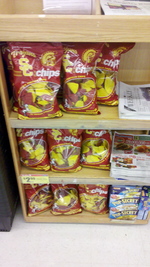
The skeptical UCLA fan went to his local market back in September and saw that they sold novelty tortilla chips in his school's colors. So he bought a bag.
The skeptical UCLA fan used the chips either to drown his sorrows after one of the team's horrific losses (like the one by 29 points to Texas or by 36 points to Arizona), or to celebrate an unlikely win (like beating Cal by 17 points).
As the season drew to a close, the skeptical UCLA fan knew that the Bruins likely would have to beat their crosstown rivals, USC, to win their division in the Pac-12. The Trojans had several advantages over the Bruins. The principal one being that they had better players at every single position. Fortunately for the Bruins, the Trojans were not eligible to win the division.
He went back to his local market to check out the novelty tortilla chips. He had a bad feeling that things weren't going to go well against USC. The Bruin chips had become greatly outnumbered.
When the skeptical UCLA fan was out of town, he saw a miracle. Utah lost at home to a woeful Colorado team. When he got home, he took the bag he had at home and declared them to be the Pac-12 South Divisional Chips.
Then came Saturday night. The skeptical UCLA fan ate the chips with guacamole while he watched USC run over, around, and through the Bruins at the Coliseum. The final score was 50-0. Since there was family around, there was no binge eating.
Today, the skeptical UCLA fan realized that he still needed some more chips because UCLA was going to play in the Pac-12 Championship game at Oregon on Friday night. He needed the chips in anticipation of easing the pain of watching his favorite team likely lose in an even worse way. Oddsmakers had already declared the Bruins to be 30 point underdogs.
But the skeptical UCLA fan was denied. This was what he saw in the market:
![]()
The skeptical UCLA fan will just have vegetable dip and fruit on Friday night. Perhaps it's all for the best.
There might be 8 million stories in the naked city, but there are more than 312 million in the United States. StoryCorps wants to hear all of them.
Radio documentarian David Isay (is there a better name for a guy whose job is producing oral histories?) and a host of individual and foundation supporters have built StoryCorps into a Library of Congress archive and a grass-roots movement to get Americans talking to each other. StoryCorps spreads the word--its mission and your recorded stories--with the help of NPR, which airs excerpts of conversations participants have given permission to share.
Through a handful of permanent recording booths throughout the country and a mobile studio housed in an Airstream trailer, people memorialize pieces of a life with the help of trained facilitators. Angelenos are telling tales at the Los Angeles County Museum of Art until Dec. 18, the latest of several such L.A. visits since going mobile in 2003. Local NPR affiliate KCRW is airing bits of these oral histories Monday and Wednesday afternoons.
Ten days ago, Judith Mulryan showed up at LACMA to reserve a recording slot. She had tried to sign up online, but those spots were filled, and there was no way she was going to miss talking about her 92-year-old father, John Drury. He lives in the Midwest and is too frail to travel for an interview, but she's keen to capture his experiences in the Pacific Theater of World War II.
She never knew what they were until she overheard a conversation recently between him and her spouse, Joe Mulryan, who also saw action at the end of that war. Like many vets, Drury is reluctant to speak of the horrors of war with people who weren't there. He kept that part of his life from her, Mulryan said, but "he opened up [to Joe] like a ripe melon about [what happened to him on] Kwajalein."
She'll be opening up those memories, probably with the assistance of Joe, in the recording studio next week.
Mac Billups reserved a spot for two members of his congregation at Trinity Baptist Church. The retro-looking Airstream trailer parked at the California African American Museum earlier this year had intrigued him. Via the StoryCorps mailing list, he learned that the mobile studio would be back at LACMA and tried to secure an online reservation. Same response as Mulryan--sorry, we're booked.
So he, too, showed up to secure one of the last spots for a new, young member of Trinity Baptist to interview an older deacon. They'll cut that slice of cross-generational spiritual life next week as well.
On Saturday, Gerhard Gross and his daughter, Rebekah Bartz, emerged from the recording booth. In addition to her smile, Bartz was wearing a T-shirt that read "Reading is Sexy" and waxing enthusiastic about the 40-minute interview in which she learned about her Ukrainian grandparents. Grandpa had fought in World War II, as had Bartz's maternal grandfather ... but on the other side.
Then came Hila Wright, 35, and Edith de Guzman, 31, sisters who allowed a reporter to listen to their remarkably frank, loving and at times gob-smacking conversation about two Europeans who were turned into Californians after their parents immigrated from Milan when they were 13 and 9.
They settled into the booth for a sound check and instructions by facilitator Anaid Reyes, a young San Diegan with a degree in history and Spanish (Amherst '08) and real-life experience as a union organizer. Reyes adjusted the microphones, between which sat a box of tissues. Anyone who listens to the three-minute StoryCorps excerpts on NPR every Friday morning understands their purpose. Often in these conversations, there is laughter; sometimes, there are tears.
De Guzman was the instigator of this tete-a-tete, and you could tell she'd been down this road before. She interviewed their father when the StoryCorps trailer was stationed on Santa Monica's Promenade in 2007, and had elicited life stories from her husband and mother using home recording equipment in 2009 and 2010 on the day after Thanksgiving. Many people worship at the temple of conspicuous consumption that day, but people like de Guzman and others encouraged by StoryCorps' annual promotion of the National Day of Listening prefer to stay home, talk to each other and worship conversation. Is there a better holiday gift?
In a wide-ranging discussion that covered three continents and four generations, Wright served up a steady diet of confessional epiphany that, for a reporter, is a fastball across the plate. She gradually built flesh onto the bony structure of the incisive questions de Guzman kept feeding her.
There was the early memory of dad photographing the newly toilet-trained Wright almost falling into the commode; the time she spat water onto the carpet and blamed the wet spot on the incontinent dog; the early desire to become a princess, an occupation supplanted later by that of private investigator. (Today, she's a scientist.)
There was the painful account of her teenage decision to quit playing the piano, and, as a result, to be told by her father that she was "worthless." (Only later, outside the Airstream, did Wright explain that mom was a concert pianist and dad was a piano technician at La Scala).
When asked to compare the culture of her early childhood with that of her later years, Wright returns to a common theme--that although it was more difficult than everyone had anticipated leaving the old country for the "promised land," the diversity of America is a welcome and wonderful thing. Yes, it was difficult for her, at 13, to change countries and learn a language, but the shock of Woodland Hills middle-schoolers wearing makeup was transient; not so the common sight of swastikas on the Italian buildings of her youth.
De Guzman observed that Wright and their parents had never lived in the same country as their extended family, and asked her sister who, among those far-flung relatives, had influenced her anyway. Almost immediately Wright withdrew from her memory bank the time they visited grandma in Israel. The two were out walking one day when they passed an Arab man, maybe a gardener, at work. Grandma yelled at him, Wright said, "maybe even spat at him. It was really extreme. I was shocked; it came out of no where. ... She told me, 'He's an Arab, I hate Arabs.'"
"Wow," said de Guzman, "I had no idea. I remember hearing stories about grandma living in Palestine and being friends with Arabs, smuggling bombs in Jerusalem as an 8-year-old..."
"... against British occupation," Wright broke in. "She was not friendly to Arabs."
The sisters pondered the moment in silence. "Maybe the antagonism developed after the wars," Wright said. "I feel she behaved wrongly. There's a big difference between living in the Middle East and here--my boss is Lebanese. We have a good working relationship, even when Israel and Lebanon were at war. In the U.S., it's taken for granted that we'll get along."
De Guzman, with a degree in urban planning, is a research manager for an environmental nonprofit. Wright has a master's degree in industrial hygiene and works as a health and safety consultant for businesses. But she wants to work for the U.N., or an NGO, wants to take her expertise to developing nations. "It's a basic human right to have a job that doesn't kill or hurt you."
"Where did that come from?" de Guzman asked, clearly surprised by her sister's desire to leave commercial enterprise.
"We're as useful as we are useful to others."
De Guzman wanted to know if Wright had ever had an experience she considered sacred. "No," was the complete reply.
Wright's concern about one part of the conversation is the reason it will not be archived at The American Folklife Center at the Library of Congress. Although StoryCorps wants to build its oral history collection, it wants even more to encourage meaningful conversation between people with stories to tell each other, even if they're private. All records pertaining to Wright and de Guzman's StoryCorps interview, except for the CD they're given and this account, have been destroyed.
The sisters concluded their recording by celebrating their differences, prompted by one of the few questions posed by Reyes, the facilitator: "Why do you have such a great relationship?"
"I find it enriching," de Guzman said to her sister, "to witness your path in life... I learn from that. Some siblings have a closer relationship [than we do] ... because they're so similar. How interesting is that? I'd rather be surprised. ... I'm glad you're my big sister even though you're shorter and smaller than me. Whaddya say we continue this conversation over the next few decades?"
![]()
Weegee's plastic lens turned on Elizabeth Taylor circa 1950..
Here's a riddle from the art world: Who was part huckster, part experimental trailblazer and part social commentator, lampooning society's adoration of celebrity, but longing to be one at the same time? Warhol, you say? No, turns out it's Weegee, the cigar chomping photographer — aka Arthur Fellig — who fled New York in 1946, where he made his reputation as a chronicler of the night, of crime scenes and the spectators who gathered to watch, to turn his sights on Hollywood.
Claiming he was "through with the newspaper game," after selling the title of his book of New York photographs called "The Naked City" to a producer who turned it into a movie, he was drawn to Hollywood. But, as the sweeping show currently up at MOCA proves, Weegee was a lot more complicated than we thought.
As a photojournalist, I have covered my share of news. Like Weegee, I love shooting at night and I am fascinated by what happens behind the scenes of major events and celebrations. I love to turn around and focus on the crowd, the fans, the workers, to get behind the artifice of fame and fortune.
But Weegee did it first, in a raw and powerful way. There was nothing elegant about his images, like those of Cartier Bresson. There was little poetry, lots of grit.
Fans at a Hollywood premiere in 1951.
When I think of Weegee, the iconic New York photos come to mind: the two society matrons, dressed to the nines, walking out of their limousine, oblivious to the sad gaze of a woman dressed in tatters ("You could smell the smugness," he said); the distraught witnesses to a nighttime neighborhood fire; the photographer himself, cigar firmly clenched in his teeth, showing off a portable darkroom in the trunk of his car which made it easy to live up to his name, thought to come from the Ouija board since he touted his ability to predict where a crime would occur, and be first on the scene.
But the MOCA show reveals Weegee's many layers and contradictions.
As a social commentator, he was ahead of his time. He had a clear agenda and an attitude when it came to Hollywood. He wanted to skewer the celebrities who enjoyed so much fame for what he thought was nothing more than being famous. Weegee caught the hoi polloi eating, drinking and unaware--years before TMZ tapped into the public's insatiable appetite for celebrities caught in the act of being human. He invented plastic lenses that could be squeezed and squished to manipulate the image, creating what he called "photo caricatures" to make the stars look like they came straight out of the funhouse or to distort and exaggerate their features. Jackie Kennedy, the Duke and Duchess of Windsor and Lucille Ball were among his subjects and he nailed them perfectly.
Marilyn Monroe through Weegee's plastic lens about 1960.
But Weegee had a special axe to grind in mocking the Hollywood elite: "When Debbie and Eddie occupied more newspaper space on their wedding day than the international situation, my plastic lens cut them down to size," he is quoted as saying.
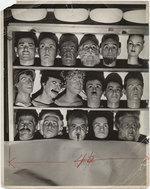
At the same time, he reveled in his own celebrity. The show is full of images of the photographer himself. Self-portraits in which he becomes part of an elaborate Hollywood tableau--in shops looking almost like a mannequin (which also were some of his favorite subjects), his face among many masks in a costume shop, driving a car with mannequins as his passengers or in movie stills from his career as an extra in Hollywood crime movies. Curiously, none of the myriad photos documenting Weegee's hijinks is credited to anyone other than "unknown photographer."
Who is that photographer in the window?
He was brilliant at self-promotion, starting with his copyright stamped on the back of his photos: "Weegee the Famous," and cannily proven with a series of cardboard counter displays, wrappers for Westinghouse flashbulbs, available by mail order, touting "Weegee's Secrets of Shooting with Photoflash." For only 25 cents, you could order a booklet and learn "How to take flash photos of pets...children...parties" and all Weegee's secrets would be revealed.
Weegee was much more than a one trick pony. He was also an avant-garde artist of still and moving images, manipulating negatives, sandwiching them, repeating portions to create op-art patterns. Some are interesting, some gimmicky, some crude. But some of his street scenes of Los Angeles are beautiful and I love the humor and irony in many of his photos.
One of my favorite parts of the show is his early movie, from 1948, called "Weegee's New York." Made with mirrors and trick lenses I found it a poetic homage to the city, shot in black and white but with touches of vibrant color and out-of-focus images of skyscrapers and traffic. It is mesmerizing, and its artistry surprised me. I spent a long time watching and trying to figure out how he did it.
Actress Hedy Lamarr's pantyhose as objet d' art.
I also learned that he was hired by Stanley Kubrick to shoot stills and consult on "Dr. Strangelove or How I Learned to Stop Worrying and Love the Bomb." According to Weegee, Kubrick, himself a photographer, hated the technique of using available light which became possible when cameras and developers improved and film like Tri-x enabled photographers to make pictures without flash in low light situations. Kubrick wanted the crude flash photography that Weegee was famous for to document his film. While none of those stills is on display, don't miss the opportunity to listen to an interview done with Weegee for the BBC by Peter Sellers.
Sellers, all upper class British and soft spoken, can barely get a word in as Weegee tells story after story about himself and his escapades--while also paying homage to Cartier Bresson, Ernst Haas, Gene Smith and Karsh. "Let me tell one more story and then I'll let you ask me a question," he says, begging Sellers to continue and "turn the tape over" as he sensed the interview was drawing to a close.
Sellers, himself a formidably talented actor, wit and writer, behaved like MOCA's museum-goers might, in Weegee's thrall following the path of his odd, fascinating and sometimes groundbreaking career. Unable to resist this force of nature, Sellers kept quiet and went happily, or helplessly, along for the ride.
![]()
Weegee among the wax faces of Hollywood, 1951.
Photos: Weegee/International Center of Photography/Getty Images
Thursday, November 17, 2011
Saturday, November 19, 2011
Friday, November 25, 2011
If Black Friday shopping isn't your thing, Loscon 38 starts today at the LAX Marriott. Get your tickets now.
![]()
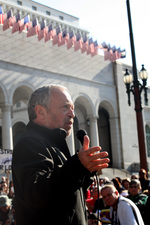
Former Secretary of Labor Robert Reich speaking on Saturday at Occupy Los Angeles, outside City Hall.
This weekend, Robert Reich, former Labor Secretary under Bill Clinton, visited Occupy LA and spoke to a small crowd gathered on Spring Street shadowed by City Hall's American flags. It was exhilarating to hear someone who had been in Washington's inner circle speak honestly about bringing fairness, compassion and equality back to the American economy and thereby restore the principles of our democracy and of capitalism itself. "Capitalism cannot function when so much wealth goes to the top," he said. It's one thing to walk through the Occupy LA camp and see statements like that scrawled on a cardboard sign, but quite another to hear someone of Reich's background—as Clinton's Secretary of Labor and a respected teacher and writer—state it.
Reich started his talk by thanking everyone from the Occupy LA movement, and urging them to give themselves a pat on the back. "Because of you, people in this country are beginning to discuss issues that have been avoided for years...Nothing good happens in Washington unless good people outside of Washington are mobilized, energized and organized to make sure that good things happen," he said.
Reich is currently Chancellor's Professor of Public Policy at the Goldman School of Public Policy at the University of California, Berkeley. He has been a professor of economics at Harvard and Brandeis and has published 13 books on the economy. He knows this stuff. And like a patient and wise educator, he told the crowd: "Let me tell you the facts. And we've all got to make sure we have the facts together because they are the truth and we've got to speak the truth over and over and over again."
"This economy is richer than it has ever been but we are cutting education, child welfare services, getting rid of teachers. They are saying we can't afford it. We CAN afford it. Our economy is twice as large as it was in 1980 but wages have stagnated for 3 decades. Where did the money go? To the top 1%. This is not class warfare. Our system has gone out of balance. We have to save the system from itself...It is not just our economy that suffers with these inequties. It is also our democracy that suffers."
He named individuals like the Koch brothers as some who have benefited from this inequity. "Our democracy is too precious to allow it to fall into the hands of a few people who are usuing their fortune to pollute and corrupt American democracy."
It was shocking and refreshing to hear someone who knows the economy and the way our government works--or doesn't--speak so plainly. He went on to name some other culprits who have helped get America where it is today: the Supreme Court, whose recent decision about campaign finance, namely that corporations can be treated like people when contributing to political candidates, has done its part to send our democracy down the wrong path. "I'll believe corporations are people when Texas and Georgia start executing corporations," he said.
After his rousing, validating speech—in which he told the occupiers that, while the Occupy movement may not be a movement yet in terms of defining its' demands and refining its methods, it is "motivated by a moral vision of what America could be. There is a powerful and indestructible moral vision underlying this movement"—he lingered to chat and debate with individuals in the crowd, signing autographs but mainly talking economics and solutions and commiserating with beleaguered veterans of our country's current economic woes.
He said one of his great regrets in life is that he failed to get the endorsement of the Democratic party in 2002 when he attempted a run for Governor of Massachusetts against Mitt Romney. "I would have beaten the pants off him," he said.
And perhaps changed the course of our upcoming Presidential election.
Sadly, only a smattering of the occupiers gathered on Spring Street to hear these words. Many others probably did not even know he was speaking, or chose instead to hear the speakers from the south steps advocating the benefits of hemp, or engage in small debates on communism vs. democracy, or just hang out and enjoy a beautiful California Saturday.
Journalists are an arrogant lot.
Not that that's a bad thing. See, sometimes people need to be told what they need to know. A fair, functioning society depends on its members having the information they need to make smart choices and hold powerbrokers accountable. A healthy culture cannot thrive on a media diet of the Kardashians, Tebowing and the McRib.
Some journalists are too arrogant, but they're not the reason newspapers are dying. The reason, at least one really big reason, is that not enough newspapers are owned by locals of the market they serve. The reason is remote corporate masters who place profits so far above public service that the people in the executive suites think good journalism is giving people what they want. What about what they need?
In light of this week's announcement, I worry about my friends who still work at my former place of employment. The editor of the Tribune-owned Los Angeles Times warned that as many as 20 more editorial staffers will be cut loose early next year from the newspaper with the fifth-largest circulation in the U.S.
I worry about readers who still depend on careful reports framed in useful context, readers who want to be informed citizens who exercise their franchise, readers who care less about "trending" than about "news."
Today, the L.A. Times published a report on the op-ed page headlined "Didn't anyone edit this?" Its point was to assure readers that although errors will always find their way into the paper -- hey it is a deadline business -- every story is edited. But I worry that a paper capable of posting big circulation numbers might forget about readers who also expect it to retain a staff big enough to be able to pay attention.
Los Angeles Times Nov. 5, 2011 page A8
Employer confirms settlement in '99 Case
... Cain spoke to a Washington convention of conservative activists, giving no indication that he was distressed by the allegations.
So far, there has been no indication the allegations have harmed his campaign, which says donations have risen this week. ...
Los Angeles Times Nov. 5, 2011, page A9
Cain links latest controversy to race
But now that his campaign is floundering due to the emergence of sexual harassment allegations made when he ran the National Restaurant Assn. in the 1990s, Cain has advanced the idea...
Friday, November 4, 2011
Sunday, November 6, 2011
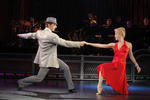
Yes, the physical distance between Northridge and Hollywood and Vine might seem daunting. But an adventurer needn't miss either Twyla Tharp's extravaganza "Come Fly Away," her latest ode to Frank Sinatra, or the new Valley Performing Arts Center's headliner, Valery Gergiev with his Mariinsky Orchestra, those venerable Russians.
Both, you see, are storied artists. And what's a few scrappy miles down the freeway for the hardiest among us? Right now it's possible to catch the ultimate Sinatra-phile's show at the Pantages. It was only a few blocks from there, actually, that dance fans feasted on the choreographer's "Nine Sinatra Songs," back in 1982.
Remember? We left swooning over "Strangers in the Night," which Tharp's lead dancer Gary Chryst let us see as the sleek tango rhythm that underpins ol' blue eyes balladeering. No less were the other songs/dances in this black velvet dazzler, the women in Oscar de la Renta's swirly chiffon dresses, the men in black tie.
But don't start thinking Fred and Ginger - because, in contrast to them, Tharp came up with wonderfully inventive subtexts for each song, often cued to night-time mischief or silly weariness or lush nostalgia, with touches of sly humor when least expected.
Both in "Come Fly Away" and in "Nine Sinatra Songs" Tharp gives us "That's Life" as a low-down, treat 'em rough, deadpan farce. And in the closing number, "My Way," she's back to dreamy idealization. But no matter what the song in her earlier work it became potent stuff, tapping images in the collective pop unconscious.
There ends the similarity between Tharp 1982 and Tharp 2011. Sorry to say, the road gets rougher here. From the upside-down splits for women -- aka crotch dancing that's featured in at least 15 lifts -- to the sleazy-schlock costumes, to the glaring back-lit tinsel set imitating a chintzy exurban roadhouse club, "Come Fly Away" has transformed the original into a coarse spectacle.
Still, it's Sinatra - boasting some newly-discovered tapes from his voice-troubled years (sung slightly off-pitch) - and it's Tharp. So the show's credits outweigh its debits.
It was credits also that piled up at Valley Performing Arts Center, when Cal State Northridge's new $17 milliion edifice hosted Gergiev/Mariinsky. First came the shock of this ensemble's crystal-clear sound in Stravinsky's "Firebird" Suite: each section and each instrument within it emerged as a separate entity that massed into a gleaming, smooth, and rich avalanche. Then, together with long-time Russian compatriot Alexandre Toradze, they dug deep for an earthy, inward, dark but still explosive Prokofiev 3rd Piano Concerto, unlike the purely lyric/percussive piece we usually hear.
![]()
Valery Gerviev by Valentin Baranovsky
Shostakovich's 1st Symphony, written when the composer that Stalin hated was a teen, completed the bill. A pity there was no Tchaikovsky, but Gergiev had fully exhausted that realm on his previous nights in Orange County.
Not to be outdone by these Russian riches, though, was Los Angeles Chamber Orchestra at UCLA's Royce Hall - in a concert that featured Britten's ravishing "Les Illuminations." So, yes, the world of poetry - Rimbaud's, for instance, which the British composer set so powerfully to music here - can pierce the thickest skin. And thanks to conductor/director Jeffrey Kahane and Co. who delivered this song cycle's shimmering vivaciousness we're left to wonder why it is rarely performed.
Maybe because the evening's protagonist, soprano Katrina Gauvin, is also a rarity. She took us through the texts - an outsider's observations of life as "a savage parade" - by getting inside the physical nature of the words with her whole being, her whole demeanor. And she painted those words in a myriad of colors, with a voice ranging from its pure, delicately disembodied high notes to broad, dramatic ones. A standout event.
For different reasons, we can remember Gustavo Dudamel's last concert with the Los Angeles Philharmonic for a few months. Why, exactly? Well, because I can't recall a program that opened with so sparse a composition and ended with one so ferociously packed.
Start with sparse: That would be Kurtág's "Grabstein für Stephan," consisting of a few musicians scattered around stations within Disney Hall, each emitting a single note or two, then another, and another. The whole 10-minute thing could stand as a parody of new music, or so this non-elite perceived it.
End with enormous: That would be Strauss's "Also sprach Zarathustra," the pan-Galactic piece, now an icon, because its opening bars are used in Kubric's classic "2001: A Space Odyssey." Well, folks, you can imagine the mighty Philharmonic spilling over the stage (as augmented orchestras do) and making splendid Straussian noise in the manner Dudamel luxuriates in. It was that, and more. It was also, after the sonic fireworks, a darkly somber, back-to-earth splashdown of Nietzschean matter.
Everything you can think of seems to happen in L.A.
|
Media
|
Politics
|
|
|
LA Biz
|
Arts, Books & Food
|
LA Living
|
Sports
|