One more reason why L.A.'s the Entertainment Capital of the World: Leaving a Clippers game the other night, I passed a street person who was chanting to passersby: "50 pushups for a dollar, 50 pushups for a dollar."
Unclear on the Concept
A friend of ours lives in the Long Beach house inhabited by Matthew Broderick in the movie, "Ferris Bueller's Day Off." The home, being in Southern California (not in Chicago, as the movie portrayed it), is featured on various websites. Some folks apparently think "Ferris Bueller" was a documentary, not a work of fiction. Twice my buddy's family has received junk-mail solicitations addressed to Ferris, including one from a Trenton, N.J., health care provider.
Rescuing the Oscars
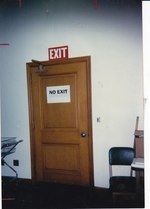
One idea I have for improving the slumping ratings of the Academy Awards is to add a new category: Best Theater Marquee. I've gotten more laughs out of such signs than I have from some entire movies. Here are three of my favorites. (Maybe some day I'll get the Jean Hersholt Humanitarian Award for this suggestion.)
How about an award for Best Supporting Biker...
Don't know if you caught it, but Octavia Spencer ("The Help") told Jay Leno that, before she received her Best Supporting Actress nomination, her car stalled on Sunset Boulevard. Passers-by whizzed by without taking notice---all except one motorcyclist. When he took off his helmet, with its darkened visor, she recognized him as actor Keanu Reeves. All of a sudden, Spencer said she was besieged by motorists and passersby wishing to help out.
This sounds like a horror movie title
![]()
Whatever it is, blogger Jay Christensen says he's avoiding this Valley pharmacy.
My favorite sports marquee
A reader sent me this disastrous misspelling from Orange County a few years ago. (Of course, people HAVE been known to over-eat and over-drink at the event.)
Tales of the Metro Rail
A man boarded the Blue Line the other day carrying a 6-foot-cross, and attempted to convert the riders. He didn't have much luck. Nor did the fellow who commandeered one Blue Line car on another day and, in a verbal group message, appealed for handouts---first in English, then in Spanish. As usual no security was present.
There was drama aplenty on the morning a rider demanded (unsuccessfully) a seat occupied by another's bewigged mannequin head. Much cursing ensued though the mannequin remained quiet.
On another run, the Blue Line slammed to a halt between stops, prompting talk that a pedestrian had been hit. Suddenly it started up again and a voice over the intercom proclaimed, "I didn't run over nobody!"
Metro Rail ought to consider a slogan along the lines of: "Always an Adventure!"
Here's animal trick I bet you haven't seen on the Internet
Officials at Mission Viejo High School have banned golfing hounds from the grounds.
Food for thought
I've encountered lots of elusive waiters in the my time. But reader Paula Van Gelder found a place with elusive food.
MiscelLAny
Winners at the recent Southern California Sports Broadcasters luncheon were quick to single out their idols, especially Vin Scully, for inspiration. The 84-year-old Scully, of course, was not to be outdone. When he received an award, he told the crowd: "My inspiration is Betty White."
That's it
It's Oscar weekend and the entertainment industry's one hundredth year in Hollywood. Is it just a lucky accident that two front-running Academy Award nominees for Best Picture --"The Artist" and "Hugo" --celebrate important moments in film history? Not only do these films recreate famous moments in cinematic development but also highlight the beauty of movie birthplaces. Who can resist the joys of Paris as seen through the eyes of Hugo Cabret and Martin Scorsese? And "The Artist" pays homage to the silent film era by recapturing film locations in our area relevant to the time period.
So in honor of Sunday's Academy Awards ceremony, I bring you an interview with a Hollywood expert: a tour guide. Philip Mershon is a researcher of Old Hollywood history who shares his love of Hollywood on his blog, Felix in Hollywood. Philip also conducts walking tours of the old studio district surrounding Sunset and Vine in Hollywood. Flavorpill.com labeled his "In A Place Called Hollywood: A Stroll Through The First 100 Years Of Tinseltown" tour "a city gem".
I took the tour earlier this month and enjoyed the way Philip shared his vast knowledge about early Hollywood with wit and affection. Afterwards, I sent him some follow up questions via email.
What did you think of the film The Artist--it seems to have captured many Old Hollywood locations from the silent era.
I really enjoyed "The Artist", though I don't consider it a 'sweep the Oscars' kind of movie like some people do. I suppose that's because I've watched plenty of for-real silent movies and know how brilliant they can be. Watch "Piccadilly" or "Sunrise" for sheer atmospheric other-worldliness, and "The Patsy" or "Exit Smiling" for hilarious comedy and you'll see what I mean. I am, however both delighted and grateful that the "The Artist" was made, made so well, and has found a wide-release audience. Bravo!!! Now if we could just get more American productions to shoot in Los Angeles like this French company did.....
What's your favorite film and why?
Oh no you don't! You're not gonna do a "Sophie's Choice" on me! Someday, over several pots of coffee, we can talk about my 40 or 70 or 100 favorite films, but it's simply impossible to reduce it down to one. For instance the 4 silent titles I mentioned above would probably be on the list but so would a whole bunch of pre-coders, a ton of 30s musicals and gangster pictures, several serials, gobs of noirs, a few surf pictures and - as much as I hate to admit it - even a some modern-era films. An example of that would be: I could watch "The Last Emperor" on a loop for the rest of my life!
What's your favorite stop on your walking tour and why?
[Though it's impossible to answer that question accurately,] I will tell you my favorite part of giving the tour. Not long after I started, I discovered a very unexpected aspect of the tour that people were experiencing. They think that they are just buying a ticket to journey through the history of Hollywood, but then in the middle of talking about movies that maybe their parents or grandparents introduced them to, or TV shows that they watched as children (many of which were old re-runs to begin with), or hit songs that sound tracked the seminal moments of their lives, they realize they are taking a very personal journey as well. These little "entertainments" were quite foundational in all of our personal developments, and I love being able to give that to my guests. It's why giving this tour will never get old for me.
Give me one Old Hollywood anecdote
The private office of Columbia Pictures President Harry Cohn was about as easy to get to as Fort Knox. First, of course, you had to get through the front gate of the studio lot. This was no easier a feat back then than it is now.
After which you would locate and enter the Administration Building. Up on the second floor you would walk into what could be considered the President's Suite. That first room was a large and busy reception area where you would announce yourself to the girl at the desk. Phone calls would then be made, intercoms would be buzzed and those that were deemed admissible would be ushered into the next office, Mr. Cohn's Personal Secretary.
At this point you would want to have a seat because regardless of whether you were on time or early for your appointment, there was going to be a wait. No one could tell you for how long - that was up to Harry. Could be 10 minutes, could be 2 hours. Now don't get too comfortable in that chair because you see there is no knob on the door you will use to enter the Holy of Holies. It is unlocked by a buzzer on Harry's desk that he will depress, when ready, for only about a second. And if you miss pushing that door open during that second-long duration and force him to push it again, well, let's just say I feel sorry for you when you get inside! Glenn Ford said there was an area of the door at about chest height where the paint was eaten away from all the sweaty palms that pushed it open.
Why is your site/tour called Felix in Hollywood?
I'll give you the shorter version of a long and boring story. Felix is the nickname given me by my best. He experienced this revelation from a Felix The Cat t-shirt I was wearing one day about 15 years ago. He's a pretty persuasive guy and in a short period of time a number of other people started calling me Felix too. "Felix In Hollywood" is the name of a 1923 silent Felix The Cat cartoon that I decided to use as the title of the blog I started in 2009. Due to the popularity of the blog, I decided to carry the magic of Felix into the tour branding as well. Hey, you still awake?
You can chat up Philip at Musso & Franks on April 30th where he will be the "on-site history guy" entertaining guests at the next LAVA Literary Salon- Down These Mean Streets: Raymond Chandler's Underworld .
We start the day in Seattle. My husband and I meet a guy who buys green coffee beans. He's getting on a plane to Uganda in two hours, but has time for a chat that includes a brief discussion of the "magnificent bastards" one sometimes meets in various African countries, the ones who sluice your way to product, to connections, who offer outsize hospitality and big belly laughs, until the talk turns to money, which is when it all comes apart, and you realize you have once again fallen for a magnificent bastard.
I tell the guy, I just read and reviewed Behind the Beautiful Forevers, the actually magnificent book by Katherine Boo, about a slum in Mumbai and the commerce that rages there, the recycling of the tiniest of objects (used tampon applicators, anyone?), the micro-saboteurs, the NGO money that never goes where it's supposed to go, the smiling for the Western cameras. And yet, life goes on, as does death.
Two hours later, we are on our way back to Portland, driving south on the 5 freeway with several hundred pounds of green coffee in the back of the car. We've just picked up drive-thru. I am dumping fries into a bag my husband can easily access while driving when, POP! CRACK CRACK!
"Holy shit, what the fuck?" or something like it comes from our mouths, as does, "What happened?" Though we don't need to ask; the cold air rushing in the window just behind my husband tells us the window has exploded, as does the green glass that continues to shatter and pop.
"That did not come from a rock," says my husband, who does not slow down, who does not swerve. "Someone shot at us."
I undo my seatbelt and scrabble through the glass and coats in the backseat. I tell him, I see no shell...
"It wouldn't have been a bullet because that would have gone out through the opposite window," he says. "It was probably from a pellet gun."
We have no idea what car it came from; we're in the middle lane, cars and trucks passing on the left. But what an incredibly stupid thing, I am thinking, and then, as I look at the fish sandwich in my hand, what if they had shot through the driver's window? What if they had shot my husband in the head? I am not sure what sound I make, but he reaches over and says, "It's okay."
Yes, it is okay. Also, disturbing, to the point where terror is in your throat when you think about it, but what are you going to do?
What I am going to do, ninety minutes after we get back to Portland, is interview Katherine Boo. I had admired her book so much; at the work she did over a three-year period. We all, those of us who practice long-form narrative, have walked into projects with a great deal of gung-ho; sometimes, we falter. Boo did not falter. The opportunities for her to not merely leave, but to flee, were everywhere, as was dying, nearly always brutally, especially among the young. But she stayed, and with her staying, wrote a great book.
"Nancy?"
Boo approaches the table where I am to interview her. She is a tiny thing, I might easily cup both her hands in mine. As soon as she sits, we are in the thick of talking, of what it can feel like to be in the midst of a story, the trespassing nature of it, the slowness, the small moments of beauty you would never get if you did not stick around, the toll it can take and the push back from authorities, which in Boo's case meant being held by police. Also, the immense gratitude to friends, editors, spouses who say, don't be afraid to do this, and, you must do this.
I check the phone app I am using to record, files from which can be instantly loaded into the cloud for human transcription.
"Maybe in India," Boo says. Maybe. And it might be transcribed by the time I drive home. Not that I am driving tonight, glass still all over the car, and as I will later find, in my shoe.
After the interview, Boo and I hang out in front of her hotel. It's her first reading tonight. I tell her, the butterflies subside by the third or fourth. She asks what I am working on. I tell her, two projects, one for which everyone wants to tell me their stories, the second, about a murder, for which few will, people are afraid, not even the cops will talk to me...
"But they will, you know they will," Boo says, the subtext being, if you stay, if you commit. Standing in the light rain, smiling, she is so little but so big.
I take a cab home, and think what I nearly lost today, and what I was given, and how much I need both.
Nancy Rommelmann is the author of The Queens of Montague Street, which was recently excepted by the New York Times Magazine ("Dazed and Confused," February 5.)
Thursday night marked my what has become mostly a once a year event for me: a trip to a UCLA basketball game. This year, that became more complicated because Pauley Pavilion is being renovated. Nearly all of the sports that require an indoor arena moved over to the Wooden Center, but the men's basketball team went out on a journey that saw them play home games in Ontario, Anaheim, but mostly, at Southern California's least beloved sporting facility, the Los Angeles Memorial Sports Arena.
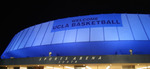
Despite the banner on the roof shown above and UCLA markings on the court, the Sports Arena has not been a popular destination for UCLA fans. The game against Stanford on Thursday drew just over 5000 fans. (Capacity for basketball is around 16,000, although figures vary from sources I checked.) The Bruins didn't help matters by losing their first two games at the Sports Arena to Loyola Marymount and Middle Tennessee State.
Sitting at the southeast corner of Exposition Park, the Sports Arena, with its distinct lack of frills, was a state of the art arena for a little over five years before pro teams in the area started to look at ways to get out of there. The Coliseum Commission, which operates the Sports Arena, has started to look at other uses for the space, but no plans have been set. And the Sports Arena still stands.
I went to the game with my father-in-law, who attended UCLA games back in the days when the Bruins made the Sports Arena its regular home (1959-65). The Sports Arena also hosted the Final Four for the Bruins' 1968 and 1972 championships.
The Sports Arena that was home to the Walt Hazzard-Gail Goodrich Bruins (gratuitous side note: my father-in-law was Gail Goodrich's R.A. at Dykstra Hall) isn't too much different from the Sports Arena of the 2011-12 UCLA squad that is 14-11, 7-6 in Pac-12 play, and will be lucky to get an NIT berth. Since the Sports Arena opened in 1959, the only major addition to the facility was a ticket office on the south side of the arena. The roof has been redone a bit and the floors have been replaced in the concourses.
Today, the Sports Arena is used mostly for concerts and to serve as a filming location. Bruce Springsteen will be playing a pair of concerts there on April 26 and 27.
After World War II, Los Angeles government officials and civic boosters tried looking for various locations to put up a multipurpose arena. The goal, according to the history of the Sports Arena in the linked EIR above, was to create L.A.'s own Madison Square Garden.
The location that was favored was in Downtown between 3rd and 5th west of Flower, home of the Bonaventure Hotel now along with other buildings. But, as things go in Los Angeles, that site was never made available. The southwest corner of Exposition Park ended up as the fallback position.
Plans for the arena had been drawn up by Stiles and Robert Clements in the 1940s and they were the first choice for the Coliseum Commission in 1955. The Clements plan would have created a rectangular arena as seen in this drawing that ran in the Los Angeles Examiner back in 1955.
However, the Clements plan never came to fruition and the job went to Welton Becket, who was the architect for hundreds of buildings in Los Angeles in the 1950s and 1960s. Becket came up with the circular design (technically it's an ellipse I have discovered, but it looks circular to me) that the Sports Arena features today.
The Sports Arena opened on July 4, 1959 with Vice President Richard Nixon inaugurating the facility with a rousing speech denouncing Communism. The first NBA game at the Sports Arena was an exhibition between the St. Louis Hawks and the Philadelphia Warriors on September 30, 1959. It was the NBA debut of Wilt Chamberlain, who scored 28 points in a 106-102 win by the Warriors.
USC and UCLA played the first college basketball game at the Sports Arena on December 1, 1959. A disappointing crowd of 6,880 saw UCLA upset USC 47-45. The LA Times referred to it as a crowd from back in the days of the Pan-Pacific Auditorium.
The Sports Arena received some exposure during the 1960 Democratic Convention. However, John F. Kennedy would make his acceptance speech at the other side of Exposition Park at the Coliseum.
The Lakers moved in to the Sports Arena in 1960; but, they were not a hit at the box office, finishing seventh in attendance out of the eight teams in the NBA at the time. But by 1963, the Lakers topped the NBA in attendance. Nevertheless, Lakers owner Jack Kent Cooke wanted a fancier arena for both the Lakers and his expansion hockey team, the Kings, and he set up shop in the Forum in Inglewood in 1967.
After UCLA moved into Pauley Pavilion on campus in 1966, USC was the lone college tenant of the Sports Arena. Despite being close to campus, the Trojans never drew well at the Sports Arena. Toward the end of USC's tenure at the Sports Arena, a large black curtain would be draped over part of the arena to hide the empty seats. Now, the Trojans play in a more appropriately sized on campus arena, the Galen Center. (This year, the Trojans, beset by injuries, have had a disastrous 6-20 season.)
In 1984, the Sports Arena underwent a renaissance of sorts when Donald Sterling moved the Clippers north from San Diego. But, Sterling did not add much to the Sports Arena in the way of amenities. It was still a no frills arena with seats that still remained from the days when Fred Schaus coached the Lakers. When Staples Center opened in 1999, the Clippers moved about 25 blocks north on Figueroa to their present home.
As a place to watch a game, the Sports Arena actually isn't a bad place. It has very good sightlines. The seats are fairly comfortable, although a bit aged. Risers are pulled out on the floor for basketball games and concerts. They have folding chairs on them that are marked "Dallas Convention Center."
The concourses seemed spacious, although that may not be the case in April when Springsteen comes to town. (If you're at the April 27 concert, look for me. I'll be the white guy in his 40s at the concert.)
UCLA has three more home games at the Sports Arena this season. They play USC on Wednesday night and then Washington State on March 1 and Pac-12 conference co-leader Washington on March 3. After that, the Sports Arena will go back to its life as a concert venue. Whether anyone will ever dribble a basketball in anger there again is unlikely.
Will the Sports Arena ever be torn down? It is not a facility packed with historical significance. It is not an architectural marvel. Yet it is not an eyesore either. The Sports Arena does not have cachet. It just is. Since no one is throwing money at the Coliseum Commission asking for the property, there is no hurry in tearing it down.
In a city where many historic buildings were torn down with little thought, the Sports Arena is an old building that no one seems to love, but no one can figure out a way to get rid of it. The Sports Arena may just outlive all of us.
How is it that until about a week ago I'd never heard of the photographer Francesca Woodman? She has been hovering about in my universe for years, but I'm embarrassed that I completely missed her. It took a look through LACMA's newly opened In Wonderland: Surrealist Adventures of Women Artists to be enlightened. Fate intervened and our paths finally crossed.
Woodman is one of the nearly 50 artists included in this "first exhibition devoted to the female surrealist artists who worked in Mexico and the U.S," as the press materials read. Born in 1958, she is the youngest and one of the lesser known artists in the show that includes superstars of the movement Frida Kahlo, Louise Bourgeois and Louise Nevelson.
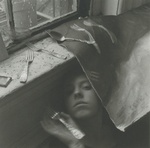
Woodman's black and white images, made primarily with a square format camera and printed small, demand that the viewer come in close. Reading the wall label next to the first photograph, "Self Portrait talking to Vince" (top photo here), told me that her life was shockingly brief (1958-1981) and that she photographed in Providence, R.I. My first thought was that perhaps she had been a student at the Rhode Island School of Design, where I graduated. Later in the day a Google search confirmed it. Woodman was a photography student at RISD from 1975 to 1978, around the time I was there, and in the same department, although she was 2 years behind me. It's entirely possible that we may have passed in the hallway or on the street. Other images in the LACMA show were made in Rome where Woodman spent her junior year as part of RISD's European Honors Program.
Like the mystery of her abbreviated life, Woodman's images are haunting and provocative. The level of her work is highly sophisticated for someone so young and still in school. Woodman often photographed herself, sometimes nude, sometimes clothed. She used props, blurring, and dilapidated interiors (not hard to find in Providence.) She experimented with cut paper, reflections and alternative processes. She used her sexuality, her relationships and her environment to develop themes in her work. The disturbing spookiness in some of them hit me hard. Sadly, an ominous feeling about her proved true. I learned that Woodman committed suicide in 1981 at the age of 22, not long after graduation and a move to New York City.
![]()
In the 2010 documentary The Woodmans, a revealing and sometimes unsettling look at the photographer's family that I watched after seeing the show at LACMA, her close RISD friend Sloan Rankin acknowledges that Woodman was far more artistically evolved than the other students. But also chronically needy. "She was a fragile person. It caused her to make beautiful pictures," Rankin says. As I watched the film, clues about her emotionally complex life emerged. Maybe also clues into her imagemaking. I felt little sympathy for her parents, both accomplished artists in their own right. They are clearly still wrestling with not only their daughter's suicide, but with the fact that her artistic success has far eclipsed their own. "As Francesca has become more and more famous, we've become the famous artists family," her mother Betty says in one scene.
While Woodman is part of a large group at LACMA, she is currently the star of her own show up north at SFMOMA. Francesca Woodman is the most comprehensive exhibition of her work ever mounted. Her RISD work is well represented, as well as her experiments with the diazotype process (think architects' blueprints) and her fashion photographs. The show fully explores Woodman's body of work, which impressed me as hugely accomplished for someone barely entering adulthood. She had hoped to pursue fashion photography in New York, but struggled with finding opportunities.
![]()
Even a drop of the attention her work is now receiving might have been a huge gift to Woodman following her graduation from RISD. She battled to survive professionally in New York, and according to her father was "discouraged and demoralized in her personal life." There was intense therapy, medication and a failed first attempt at suicide. Making photographs became a rarer and rarer occurrence.
Then again, perhaps no amount of validation or success would have been enough to save the life of a young woman so deeply in pain. Her apparently overwhelming inner demons broke her spirit before she could find a way to harness them. Surely trouble was brewing long before she arrived in Providence. However, her images have survived and taken on a brilliant life of their own. Although I'm late to the game, I'm glad that at last I've found them.
Trailer from the documentary on Woodman's life:
"In Wonderland: Surrealist Adventures of Women Artists" runs at LACMA's Resnick Pavilion through May 6.
"Francesca Woodman" runs at SF MOMA though Feb. 20 and will travel to the Guggenheim Museum in New York in spring 2012.
Photographs by Francesca Woodman courtesy of the Marian Goodman Gallery, New York
|
Media
|
Politics
|
|
|
LA Biz
|
Arts, Books & Food
|
LA Living
|
Sports
|