Saturday night at the Rose Bowl, USC and UCLA will play the final Pac-10 conference football game. Not just the final game of the 2010 season, but the final game for the Pac-10. Next year, Colorado and Utah join the conference, which will go for the mathematically correct Pac-12 designation.**
** The Big 10 has 11 teams presently and will have 12 next year and hasn't indicated it will change its name. The Big 12 (or as it prefers Big XII) will have 10 (or X) teams next year and it hasn't thought of a new name either. The Atlantic 10 conference (which doesn't play football) has 14 teams.
There will be two other Pac-10 games on Saturday, but the Oregon vs Oregon State "Civil War" and Washington vs Washington State "Apple Cup" games will start earlier in the day. With kickoff scheduled for 7:30 pm, it's quite likely that Bruins and Trojans will be fighting out the end to their dismal seasons sometime around 11 pm.
USC started the season knowing that it could not go to a bowl game, after being hit with sanctions from the NCAA. At one point, it looked like new coach Lane Kiffin had a chance to still finish with a 10-3 record, but consecutive losses to Oregon State and Notre Dame (the Irish snapped an eight-game losing streak to USC with a 20-16 win at the Coliseum last Saturday), has turned USC into a run of the mill 7-5 team.
UCLA started off poorly (losing to Kansas State and Stanford), then rebounded unexpectedly (three straight wins against Houston, Texas, and Washington), only to see the Bruins sink all the way to ninth place in the conference with a 4-7 record, 2-6 in Pac-10 play. A rash of injuries, combined with an unsettled coaching situation (in the sense that nobody seems to really know what's going on), has made 2010, in the words of Coach Rick Neuheisel, "A bit of a setback for us." That was how Napoleon described the invasion of Russia I believe.
USC has won 10 of the last 11 meetings against UCLA (two of the wins were vacated because of the NCAA sanctions), with UCLA's lone win coming in a fluky 2006 game at the Rose Bowl by a 13-9 margin. But prior to USC's recent success, UCLA had won eight straight in the rivalry.
Last year's game, which was only slightly more meaningful than this year's matchup, saw USC grind out a 28-7 win. The Trojans final touchdown came on a 48-yard touchdown pass from Matt Barkley to Damian Williams in the final minute. Pete Carroll had apparently not appreciated UCLA calling timeouts at the end and decided to make sure that his sensibilities would not be offended in such a way again. UCLA players did not take kindly to these actions.
USC and UCLA also played the final game in the history of the Pac-8 back on November 25, 1977, the Friday after Thanksgiving. UCLA had a chance to win the conference and a trip to the Rose Bowl with a win, entering with a 7-3 record, 5-1 in conference play. USC was 6-4, but had not been knocked out of the conference race until the Trojans lost at Washington two weeks earlier, dropping the Trojans to 4-2 in the conference
The Bruins took an early 10-0 lead. Frank Corral kicked a 52-yard field goal. Later in the quarter, USC tailback Charles White lost a fumble at the USC 3. The Bruins recovered. Theotis Brown would score on a 1-yard run three plays later.
USC roared back in the second quarter to reclaim the lead. After a Frank Jordan field goal cut the lead to 10-3, USC got even closer when Rob Hertel connected with Bill Gay for a 20-yard touchdown pass. Jordan missed the PAT to keep it at 10-9. The Trojans got the ball back and Hertel hit Kevin Williams for a 40-yard score, and a 2-pointer gave USC a 17-10 halftime lead.
Williams got another TD pass from Hertel early in the third quarter to stretch the lead to 23-10. Jordan again missed the PAT. However, Jordan would add another field goal to put USC up 26-10 midway through the third quarter.
That's when UCLA quarterback Rick Bashore, who had been out with a rib injury for most of the two weeks of practice, led a Bruins comeback. With 4:13 left in the third quarter, Bashore, normally a running quarterback, threw a 32-yard touchdown pass to James Owens. USC now led 26-17. UCLA coach Terry Donahue opted to go for one instead of two figuring that there was enough time left to catch up. (UCLA also needed a win, not a tie to go to the Rose Bowl.)
Early in the fourth quarter, UCLA safety Brian Baggott intercepted a Hertel pass to set up another field goal for Corral. The Bruins were down only by six.
Bashore then would lead the Bruins on an 80-yard, 16-play drive to put them up 27-26. The go-ahead score came on a 1-yard pass on fourth and goal by Bashore to Don Pedersen with 2:51 left in the game.
USC was able to get to the 50 with a minute left, but were facing third and 10. Quarterback Rob Hertel's pass to Kevin Williams appeared to be broken up by UCLA's Johnny Lynn. However, Lynn was called for pass interference, giving USC a first down at the UCLA 40.
Eventually, USC made it to the UCLA 19, when Coach John Robinson called for a running play despite USC being out of timeouts (Hertel had wasted one on the drive when he thought the Trojans hadn't made a first down) and there being less than 30 seconds to go. Mosi Tatupu was stopped for no gain and USC ran the field goal unit out. Frank Jordan, who had missed two extra points during the game, made a 38-yard field goal with 2 seconds to spare.
Washington became the first Northwest school to make it to the Rose Bowl since Oregon State in 1965. USC would go on to the Bluebonnet Bowl in Houston and rout Texas A&M 47-28. UCLA did not get invited to a bowl in an era when bowl bids were not handed out as freely as Halloween candy. Washington, behind quarterback Warren Moon, the pride of Hamilton High, defeated Michigan 27-20 in the Rose Bowl.
At the time, I hadn't developed an allegiance to either USC or UCLA because no one in my family had attended either school. I just rooted for whomever was having a better year. That usually meant I was rooting for USC. But in 1978, one of my older brothers attended UCLA and that set me on a path to Bruin fandom, which has stuck with me for better or worse.
In 2011, the Pac-10 becomes the Pac-12 and splits into two divisions for football (all other sports will use just one division). The North Division will have Oregon (this year's champion), Oregon State, Washington, Washington State, Cal, and Stanford. The South Division will have USC, UCLA, Arizona, Arizona State, Colorado, and Utah. (I only promised that the conference was correct arithmetically, not geographically.)
All teams will play eight conference games, with three games played outside their own division. USC and UCLA will still play Cal and Stanford each year. One benefit of this for local fans is that UCLA won't play Oregon the next two years (Oregon beat UCLA 60-13 this year) and USC will get to skip Oregon State for two years.
The winners of each division next year will play in a conference championship game at the home of the school with the better record. The ACC, SEC, and Big 12 have used neutral sites for these games, but the Pac-10 didn't have the time to set up a game, nor a logical place to stage it.
The 2010 edition of the USC-UCLA crosstown rivalry may not have a lot of import attached to it (actually it has none, unless bragging rights have tangible value, but I have not yet seen them traded in financial markets), but it will be the end of the 33-year old Pac-10 conference. The first Pac-12 football game is scheduled for Saturday, September 10, 2011 at the Coliseum, when Utah visits USC.
Personally, I don't expect a lot of excitement at the Rose Bowl on Saturday night. Then again, I'm a UCLA season ticket holder, and my biggest excitement is to hear what Rick Neuheisel says in his postgame apology speech. The Bruins and Trojans are both maddeningly inconsistent teams. (Some would say USC is inconsistent and UCLA is just bad and I wouldn't argue with that.) USC will likely have quarterback Matt Barkley back (he missed the Notre Dame game with a sprained ankle) and he should have little trouble carving up the UCLA secondary. The Bruins will have to hope that its running game, which admittedly did look good in its wins over Texas and Washington State, can generate enough scoring and time of possession to keep the game close.
Although USC lost with backup Mitch Mustain starting against Notre Dame, the Trojans will be much better off if its starting quarterback can't play. UCLA is already starting its #2 quarterback in Richard Brehaut. In a game against Washington, Brehaut had to leave the game with a concussion, which forced Neuheisel to use backup Darius Bell, who was 0 for 3 passing with one interception that was returned for a touchdown, and then walkon Clayton Tunney (whose name was not mentioned at all in UCLA's pregame notes) who was 1 for 8 with an interception. Last Friday at Arizona State, a healthy Brehaut broke Troy Aikman's school record for completions in a game (33) in a 55-34 loss for UCLA. (Sports books have made USC a 6.5-7 point favorite. Such information is for entertainment purposes only! There's no gambling on football I hear.)
The Pac-10 conference football season may end with a clinker at the Rose Bowl, but maybe it will turn out a classic like the last game of the Pac-8. As a UCLA fan, I would just hope that the scores were reversed. As a realist, I'm not holding out a lot of hope.
"I'm not doing the "Naked Gun" movies to make anybody laugh," Leslie Nielsen told me in late 1992. "The Frank Drebin character just happens to be my style. I get to play portentousness for laughs. Insanity, when given credibility, becomes very funny."
On that note we had the following brief conversation.
Q: What's Drebin an anagram for?
NIELSEN: Don't know.
Q: Inbred.
A: Makes perfect sense.
Q: You've helped sell millions of dollars of movie tickets. What makes you so attractive?
A: My appearance probably gives the impression that I know what I'm talking about. I've been pursued by that expectation all of my life. Yet I've always known that I was just the same as anybody else and that failure was just around the corner.
Q: Appearance is a prison for you?
A: Yes. But by doing comedy it becomes a license for me to be as nuts as I really am.
Q: What was your dumbest trick as a kid?
A: I went to a country schoolhouse. We had three classrooms. In each were rows of desks, and attached to each desk was a seat and the desk that was immediately behind it. At the end of the row was a desk that had no seat, so they had to have chairs. I was in grade six. There was a guy standing up, leaning over his desk to talk to my brother, who was immediately in front of him. I was at the blackboard at the back of the room, doing my 12 times multiplication tables. I turned around and noticed how this guy was standing away from his chair, so I quietly slipped behind him and put that chair back about four feet. All of a sudden I hear peoooockck! as he hit the floor. I never even turned around.
Q: Practical jokes are a constant theme, no?
A: I do fool around with a particular practical joke. The Whoope cushion.
Q: Do you have a virtuoso command of any animal noises?
A: You mean like a horse whinnying? Nooo. However, I've had astounding results with my whoope cushion at the paddock, with racehorses being paraded. In one case the jockey was up on the horse, being led by a young gal. You never saw so many looks. The jockey looked at the girl, she looked at him. Both looked behind and in front. There were three guys in the stall I was standing near and they knew what I was doing. They were sliding down the wall from laughing so hard.
Q: To what Trivial Pursuit question are you the answer?
A: "Whose undying wish was to become Tarzan's son, but never made it?" And here's why: bowed legs.
Q: Who should play you in the movie version of your tongue-in-cheek autobiography, "The Naked Truth"?
A: I wonder what Frank Sinatra is doing? It would be a stretch but I think he could probably handle it.
Q: Any other Nielsen's you wish you were related to?
A: In Denmark, Nielsen is the equivalent of Smith or Jones or Johnson in America. There's a lot to choose from. Maybe I'm related to Brigitte Nielsen. On the other hand, it would probably be better not to be related.
Q: Are you impressed that there's a street named after you in your hometown of Regina, Saskatchewan?
A: I haven't been back since it was awarded. Besides, two months after I was born, we moved close to the Arctic Circle.
Q: Give us a short lesson on living that far north.
A: I think there's 732 different ways of saying, "Boy, it's cold out, isn't it!"
Q: The Eskimos have many words to describe snow. What in show business takes a similar number of words to describe?
A: Profit participation.
Q: When did your hair turn white and why did you leave it that way?
A: It began when I was in my early forties. I never considered dyeing it back. White hair is very beneficial. People say, "Leslie, I just can't believe it, you just never change! Incredible!" "You look good, you look young." I say, "Hey, I've changed a lot. The only thing that hasn't changed is my hair."
Q: Why do you do what you do?
A: I've wondered that myself. I don't have to get up in the morning, I don't have to answer the phone. I don't really have to do anything unless I want to do it. So the bottom line for me today is that I am free.
Q: What's the best way to stay sane in an insane world?
A: One way is to never know the answer to this question.
Q: You were around during TV's Golden Age. What was so golden about it?
A: It was the Golden Age because everything was new. Shows were either daring and very good, or they were very bad. Certainly the term "golden" didn't apply to the money. I did 36 shows my first year in live television and made slightly under $5,000. It was good enough; plenty of money for me. But otherwise, my early days as an actor were filled with panic. I was afraid that at any time they were going to discover I had no talent, would pound on my door at midnight, gather up my belongings and ship me back to Canada. Fortunately I have since developed my insensitivity today to a point where I can actually accept the fact that I'm an impostor.
Q: You went to the White House and met President Bush (Sr.) Considering how Frank Drebin treated the President and his Mrs., how did you end up getting invited?
A: First I was invited to go to the Desert Storm Golf Classic. Then I was called and asked if I'd like to meet the President at the tournament. I said, "Sure, but do you know if he's seen 'Naked Gun II-1/2?'" They said no. I said, "Well, have you seen 'Naked Gun II 1/2?'" They said no. I said, "Well, perhaps you'd better take a look at the picture or find out if Mr. Bush has seen it." The guy called back the next day, laughing. He said, "Yes, he's seen it and he'd be quite happy to say hello and to meet you." So we met at a cocktail reception. He was very attentive. They were fun. Great sense of humor, both of them. While I was there I got invited to attend a state dinner for Vaclav Havel. Then I got three or four more invitations, as well. [smiles] The last time I saw Barbara Bush was in a reception line. She looked away with exasperation and when I came up she turned her back to the camera. So I turned my back to the camera. She shook my hand and said, "No, you turn around a face front." So I faced front and they took the picture. Then she turned around and we chit-chatted. She said, "My granddaughter saw your name on the guest list. She questioned me about what I was going to say and she rehearsed me to make sure I was not going to say anything that might offend you."
Q: Had Vaclav Havel seen "Naked Gun II-1/2?"
A: No. And the first dish was lobster pate. Thank God there were no claws!
Q: Any wisdom you want to pass along to the next generation?
A: Seldom are things as bad as we think they are.
Thursday, November 18, 2010
Sunday, November 21, 2010
Monday, November 22, 2010
Tuesday, November 23, 2010
Have a Happy Thanksgiving, Los Angeles!
I was watching The Daily Show the other night, when I saw Marion Jones get interviewed by Jon Stewart. I then recalled that the ESPN 30 for 30 documentary "Marion Jones: Press Pause" sitting in my DVR, so I watched it the next day.
What I saw in the two programs was disgraceful, and it is evident that Marion Jones' most recent PR campaign (book tour and all) is a joke.
For those who don't remember, Marion Jones won five Olympic medals (3 gold, 2 bronze) at the 2000 Sydney Games in track and field, and at one point was considered one of the greatest female athletes in history. Jones, a Los Angeles-native who went to high schools in Oxnard and Thousand Oaks, also led North Carolina to the NCAA women's basketball title in 1994. Jones was later implicated in the BALCO steroid scandal and admitted to lying to federal investigators, leading to a six-month jail sentence in 2008.
In both the documentary and in the Jon Stewart interview, Jones cited a momentary lapse in judgment in 2003 when she lied to federal authorities about knowing whether she had used a substance similar to what was presented to her in a vial. The substance was "The Clear", a designer steroid from BALCO lab in San Mateo. Jones lied and said she hadn't taken it before, but today admits she did, albeit not knowing that it was a steroid.
However, that was not the only time Jones lied to federal authorities. She did so several more times in that same 2003 testimony, and then lied on several more occasions when testifying on a check fraud scheme. Alan Abrahamson does an excellent job of laying out the Jones case on his site 3Wire Sports.
Incredibly, the documentary, directed by the well-respected John Singleton (Boyz in the Hood, Four Brothers, among other films) never mentions those other lies and makes it appear as if Jones' six-month prison sentence was based solely on the one lie in 2003.
Jones essentially reiterates that false perception with Jon Stewart, and then lies more directly later in the show. Stewart seemed incredulous to the fact that Jones, an elite athlete, could take a banned substance and not know it. Jones said that elite athletes tend to trust their "inner circle." Stewart asked if anyone in her "inner circle" went to jail too. Jones said "no", but added one of them was brought up on charges and they were dropped.
I'm not sure who Jones was referring to, but the fact is that several people in her "inner circle" went to jail. Her second husband, former 100m record holder and admitted steroid user Tim Montgomery, is currently in jail for his role in the check fraud scheme that Jones lied about. (He's also in jail for dealing for heroine.) Her former coach, Trevor Graham, was placed under house arrest for a year, and is permanently banned from track and field. BALCO founder Victor Conte, who said he personally gave Jones banned substances, spent four months in jail. Another of her former coaches, Steven Riddick, is currently serving a four-year jail sentence for the check fraud scheme, which actually accounted for four of Jones' six-month prison sentence.
If two of her former coaches, her ex-husband, and her drug supplier aren't her "inner circle," then I don't what is.
Additionally, Jones' assertion that she didn't know she was taking steroids, is nothing short of preposterous. Her first husband, former shot put champion CJ Hunter, claimed Jones knew exactly what she was doing. Hunter is also an admitted steroid user. Jones' second husband, Montgomery, also claims that he knew he was taking steroids from BALCO. The evidence against Jones' claim of ignorance is overwhelming.
I can understand why Jones would lie in the heat of the BALCO investigation back in 2003. I can even understand why she might have lied about the check fraud scheme years later. But it's sad to see that she is continuing to lie today. And it's an even sadder commentary on our society that she is being celebrated for her "comeback" (she's playing in the WNBA, has written book, and is becoming a popular motivational speaker), without fully coming clean.
Make no mistake - Marion Jones lied in the past, and she is continuing to lie. I have no doubt that she was a naturally gifted athlete with a relentless work ethic, and she may very well have won an Olympic gold medal without using steroids. But she remains dishonest about her usage to this day.
Jones' case provides an interesting look at the psychology of steroid users. I think most of society wants athletes to come clean and admit that they used performance enhancers to gain an edge. I think we also want to know some detail as to how the process took place and see some remorse. Yet, in very instances have we ever seen that.
Some athletes who admitted they used steroids, refuse to believe that it helped them (Mark McGwire). Others claim it was just a one-time thing (Andy Pettitte) or just for a limited time (Alex Rodriguez). Some still continue to deny taking them (Roger Clemens) or deny knowingly taking them (Barry Bonds, Marion Jones, Justin Gatlin). There are some who have admitted taking steroids, but won't discuss the matter in any detail (Jason Giambi). And then there are those who did confess everything, but feel virtually no remorse (Jose Canseco, Ken Caminiti). Of all the steroid admissions I've heard, former sprinter Kelli White's claim was the most satisfying to me, as she detailed the impact BALCO had on her ability to win at the 2003 World Track and Field Championships.
In Jones' case, the refusal to come clean appears to stem from a sense that an outright admission would diminish the extraordinarily hard work she put into becoming the world's best. But as Abrahamson points out, most steroids allow athletes to recover more quickly from their workouts, allowing them to put in more work than others. Additionally, the steroids Jones took allowed her to compete in five different events in the Sydney Olympics while not feeling as much fatigue.
Marion Jones has a winning personality, and it's hard not to like her. I even find myself rooting for her to succeed in the WNBA. But it's beyond disappointing that she continues to be dishonest and that many in the media are actually buying her act.
I knew I would love LACMA's current exhibit "Fashioning Fashion: European Dress in Detail, 1700-1915." Getting to view the historical dresses, men's wear and period undergarments with a top Hollywood costume designer was an extra treat.
Marlene Stewart knows how clothing defines character. She began her career styling the wardrobe for Madonna's early music videos. Think corsets and pointy bras. Director Oliver Stone saw her work and hired Stewart to create 1960s period costumes for The Doors. She has costumed the actors on a wide range of projects, including JFK, Gone In Sixty Seconds, Ali, 21 Grams, Tropic Thunder and Night At the Museum: Battle of the Smithsonian. Her most recent project was a science fiction drama, Real Steel, starring Hugh Jackman. She's known for her meticulous research and attention to historical detail.
All are reasons I invited her to join me for an afternoon at the museum.
"When you get a chance to see pieces like this up close it's hard to believe people had the capabilities of making such high quality garments back then," she said as we walked among fashions worn mostly by the upper classes. Stewart enjoyed seeing real examples of fashions she has studied for her film characters. Pausing at one of her favorite pieces, a man's vest dating to the French Revolution, Stewart imagined the wearer. "He was most likely a bon vivant, possibly an aristocrat," she mused. "It says so much to me. I immediately want to go and do research!"
In the five-minute LA Observed video, Stewart talks about the clothing and costuming for movies as we walk through the exhibit. Fashioning Fashion is at the Los Angeles County Museum of Art (in the new Resnick Pavilion) through March 6, 2011. The curators are Kaye D. Spilker and Sharon S. Takeda.
Exhibit photos courtesy of Los Angeles County Museum of Art.
Photo of Marlene Stewart by Judy Graeme
Thursday, November 11, 2010
Friday, November 12, 2010
Saturday, November 13, 2010
Sunday, November 14, 2010
Monday, November 15, 2010
Tuesday, November 16, 2010
Wednesday, November 17, 2010
In just one day on the Los Angeles Times sports sections, there were two impassioned pleas from writers to get an NFL franchise in Los Angeles.
Appearing online first was Bill Dwyre's story about how the City of Baltimore has embraced the Ravens and how nice it would be for Los Angeles to have the same feeling:
But there is no escaping what an NFL team can bring in the way of entertainment and unity to a community, even a community such as Los Angeles, which is more sprawling megalopolis than city.Maybe bygones will be bygones in time for our grandchildren's children to wear an NFL jersey to school on Fridays in the fall, and the words on the jersey will include "Los Angeles."
Might be kind of fun.
I never knew Ray Lewis could inspire the city of Baltimore so much.
Later, TJ Simers weighed in on an NFL franchise for Los Angeles, embracing the AEG plan to build a domed stadium/convention center in Downtown.
I've gone through Simers story trying to find out just why it is such a good idea to have a stadium, even if it is privately financed (and not everybody buys that idea), built in Downtown Los Angeles. It's mostly just a matter of prestige it seems. Or possibly just to give Simers something to write about.
Simers also believes that Dodger Stadium needs to be replaced:
The Dodgers are going to need a new stadium. If football comes first, the rich folks here will be putting down serious cash for luxury suites and club seats. Many will have already done so to remain close to the Lakers in Staples Center.
This assumes that there is a huge groundswell of support among Dodgers fans to replace Dodger Stadium. But there isn't. It might not be a great place for Simers to work, but the fans are still turning out in large numbers as always. Yes, the access isn't great. The parking is expensive. But, people still show up. If people disliked Frank McCourt now, just wait to see what the response would be if he tried to ask for a new stadium.
(And what would you do with the existing Dodger Stadium? I've got an idea. Tear it down and build public housing! Oh wait.... )
However, will people immediately take to an NFL team. Simers supposes that the St. Louis Rams could return home (the Los Angeles home, not the Cleveland home or the Anaheim home). Are fans going to re-embrace the Rams as their home team? That would be highly dependent upon how well the team would play.
Dwyre and Simers are both missing the time when they got to cover the NFL, which is the most prestigious beat in a sports department. (Very popular sport, easy travel, fairly short season, no three-day road trips to Pittsburgh, or mid-winter trips to Minneapolis) They can reminisce about Dieter Brock quarterbacking the Rams to the NFC championship game. Or they can discuss how a lot of the players they covered back in the 1980s are now suffering from debilitating brain injuries or chronic knee pain. Or how they can all feel warm and fuzzy about a sport that exists to give a lot of people the chance to gamble illegally.
If the people of Los Angeles need something to unite themselves around, I hope it's not an NFL team. The NFL cares about the people of Los Angeles about as much as the people of Los Angeles cared about the Rams and Raiders before they both left town, which is to say, not much.
The NFL and AEG are not in the business of making Los Angeles a better place. They are in the business of getting the NFL and AEG to make more money.
Back on September 30, I wrote what I considered, at best, a slightly optimistic, but mostly realistic look at the fortunes of the UCLA football team after an upset win at Texas.
Since then, the Bruins have seen almost nothing go right for them. UCLA was able to get its record to 3-2 with a 42-28 win at the Rose Bowl over Washington State, but then lost by 28 at Berkeley, by 47 at Eugene against #1 Oregon on national TV, and then lost by eight at home to an Arizona team that was playing with its backup quarterback. With just four games left in the season, UCLA is 3-5 overall and 1-4 in Pac-10 play.
The remaining four games for UCLA don't present many opportunities for a win. UCLA hosts Oregon State on Saturday. The Beavers have three losses, but all were on the road and two of them were to two of the best teams in the country: Boise State and TCU. (The other was an overtime loss at Washington.) UCLA might have a chance to win at Arizona State or Washington, but another season-ending loss to USC seems all but certain.
Also, the win over Texas looks far less impressive as the Longhorns have gone on to lose twice more at home, to Iowa State and Baylor.
The Bruins have lost their starting quaterback, Kevin Prince, for the season due to a knee injury that he suffered during the win at Texas. Sophomore Richard Brehaut has taken over the job, with mixed results at best. Brehaut threw two long touchdown passes against Arizona on Saturday, but, with four chances in the fourth quarter to lead UCLA to a go-ahead or tying score, failed to get the team anywhere near the end zone.
Coach Rick Neuheisel and offensive coordinator Norm Chow have tried a new offense this season, The Pistol, but it is producing just 313 yards a game, the worst of any team in the Pac-10. Nevada, the team that UCLA's offense is modeled after, has produced 520 yards of offense per game. (No. 1 Oregon has the top offense in the country in terms of yardage at 573 per game.)
Every week UCLA looks more and more like they are forever consigned to the second half of the Pac-10 (or the Pac-12 next year if you prefer.) In a conference where offense is king, UCLA looks to be nowhere near being able to keep up with the Oregons, Stanfords, and USCs of the world. (Having to play Utah every year in the new Pac-12 isn't going to help, although one game each year against an inept Colorado squad probably won't hurt.)
However, it could be off-field activities that could be hurting UCLA more than what it does on the field. For its last two games, four different players (two each game) have been suspended for unspecified infractions of team rules, although it was reported that the players had failed drug tests. In a season when USC is on probation, UCLA is doing its best to fritter away any positive P.R. it could generate.
UCLA has been receiving its share of ridicule in the press from T.J. Simers, which is to be expected (and deserved). But, now the Bruins are even receiving harsh criticism for their jersey from sports uniform expert Paul Lukas. (You can watch a commercial for them with "Friday Night Lights" actor Michael B. Jordan for the uniforms here. It is really hard to read the words to a college fight song without it sounding unintentionally dorky.)
2010 looks to be another in a line of rather undistinguished seasons for the Bruins. Since last making the Rose Bowl in 1999 (after blowing a chance to play for the BCS championship), UCLA has had one 10-2 season (in 2005 and the losses were by 38 to Arizona and by 47 to USC), 4 losing seasons (with another likely this year) and have just three bowl wins. And those came against Northwestern, New Mexico, and Temple.
Is UCLA ever going to experience a resurgence in football that Neuheisel promised when he was hired? It seems a long way off. And with the amount of money that college football provides (or doesn't provide if your team isn't very good), universities aren't likely to stick with a losing coach just for sentimental reasons.
Another 4-8 season could put UCLA football on the same spot on the Los Angeles sports pecking order that USC basketball occupies. Or even, gulp, the Clippers.
Thursday, November 4, 2010
Friday, November 5, 2010
Saturday, November 6, 2010
Sunday, November 7, 2010
Monday, November 8, 2010
Tuesday, November 9, 2010
The Washington Post reports today that a newly discovered box of James Madison's papers includes a set of earlier drafts of the 2nd Amendment.^^
The texts and the extensive marginalia together indicate that the founding fathers engaged in intensive debates over the exact wording, and that they considered at least ten alternate versions before they settled on the final text. The papers will go on display at the Library of Congress in March 2011.
Legal scholars have only begun to consider what light the papers might shed on the framers' intent, and whether the discovery could have actual legal consequences.
The final version has of course been widely quoted: "A well regulated Militia, being necessary to the security of a free State, the right of the People to keep and bear arms, shall not be infringed."
The ten alternate drafts are listed here in the order in which Madison, Jefferson, et al appear to have considered them.
** A well regulated Militia, being necessary to...a free State, the right of the People to keep and bear arms, shall not be infringed when the People belong to a well regulated public Militia.
** A well regulated Militia armed with muskets, being necessary to...a free State, the right of the People to keep and bear arms, shall not be infringed when the People belong to a public Militia armed with muskets, and whether or not the rules for commas change in future decades.
** The carrying of 9mm semiautomatic handguns (but not necessarily muskets) into schools, churches, bars, and airplanes whenever one might feel like it, being necessary to...a free State, the right of the People to keep and bear arms, shall not be infringed.
** Mass and frequent murders in a society's schools, being necessary to...a free State, the right of the People to keep and bear arms, shall not be infringed.##
** The murder of 5 of your neighbors after your wife cooks your eggs wrong, or of 13 people in a citizenship class, or of your 5 children, or of a 17-year-old who egged your car, or of a neighbor for getting a speed bump installed on your street, or of a person who disputes your parking spot, being necessary to...a free State, the right of the People to keep and bear arms, shall not be infringed.##
** The sale of 50 million firearms right after the election of the first black president, being necessary to...a free State, the right of the People to keep and bear arms, shall not be infringed.
** An incredibly rare homicide-free weekend as a headline-making event in L.A., being necessary to...a free State, the right of the People to keep and bear arms, shall not be infringed.
** The murder of your daughter and her fiance because they want you to move out of their apartment, being necessary to...a free State, the right of the People to keep and bear arms, shall not be infringed.##,//,&&
** A gun-related homicide rate that's 10 to 44 times higher than in most other affluent countries, even if just 5 times higher than in Canada, being necessary to...a free State, the right of the People to keep and bear arms, shall not be infringed.
** The daily murder of 33 people and injuring of 214 people, being necessary to...a free State, the right of the People to keep and bear arms, shall not be infringed.##
++ In memory of my brother David (Nov. 17, 1958--Nov. 4, 2000)
^^ Harvard historian Jay Silverstein discovered the box amidst a pile of uncatalogued materials in the basement of the NRA's Virginia headquarters. After some effort, he was able to pry it from the director's cold if not dead hands.
## With this draft and and several others, the founders proposed to amend the "unalienable rights" section of the Declaration of Independence: "We hold these Truths to be self-evident, that all Men...are endowed...with certain unalienable Rights, that among these are Life (unless anyone wants to shoot you), Liberty (same condition) and the pursuit of Happiness (unless anyone wants to shoot a person you love)."
// I am not resigned to the shutting away of loving hearts in the hard ground...
I know. But I do not approve. And I am not resigned. Edna St. Vincent Millay
&& What made us dream that he could comb grey hair? William Butler Yeats
![]()
Part 7 of an occasional series by Iris Schneider
For most of us, life is full. We're busy, too busy, trying to fit in all the things we have on our to-do list every day. We're running, on the go, and wishing we could downsize, de-clutter and make life simpler. Bruce Lisker has the opposite problem. After 26 years in prison for a crime he did not commit, he is building a life for himself one little bit at a time. Today, he added one more "first" to a small list of everyday things that we all take for granted.
He voted.
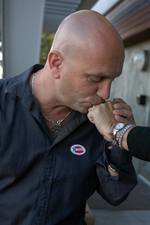
"That was really cool," he said as he and his British-born fiancée, Kara, walked away from their polling place, "I VOTED" stickers firmly affixed to their chests. "Everyone was so sweet," Kara said. She, too, voted for the first time, having become a U.S. citizen in a ceremony several months ago at the LA Convention Center. They stood at adjacent voting booths, their printouts by their sides as they inked their ballots. "I'm proud to have been asked what my opinion is," Lisker said, smiling broadly. "Proud to have a voice. It's one of highest honors, one of the best things about this country."
He doesn't think it's fair that prisoners cannot vote. He says that there are 170,000 people who pay California state tax when they purchase items in prison. "Not letting them vote is taxation without representation," he says.
Early on in the process of deciding for whom he would cast his vote in the governor's race, he thought there was no way he would vote for Jerry Brown. "His office tried to rekindle this nightmare that justice had at long last extinguished," he said, referring to a last ditch attempt by the Attorney General's office to send him back to prison on a technicality that was quashed by Federal Judge Virginia Philips a month ago. "But in the end, I'm convinced that he is the best candidate and the one that will be the best for California and that's why he got my vote. You've got to look at the big picture here."
Indeed, Lisker never disappoints when it comes to showing what he's made of, despite the cards he was dealt.
The past few months there have been other "firsts." He cashed his first paycheck, $87.00 for a day's work. He's been working for about six weeks. "I've started getting regular checks." he says. "I'm on the up and up now, working three days a week at Archival Film Restoration in Larchmont Village." He's doing a little of everything, getting trained in the film lab on a huge contact printer but also making film deliveries, cleaning up and decorating the office, hanging pictures ("Most people at work don't have a sense of how to hang pictures. You have to leave some white space"), clearing brush out in the front parking lot, bringing in design ideas for re-cladding the building and generally making himself useful. "I do a lot of different things there," he says. "Whatever they need."
The other two days a week, he's in his second semester at Santa Monica Community College. He takes a class in Argumentation and two courses online: Advanced Composition and Web Design using Dreamweaver. His first presentation to the Argumentation class was a very personal speech against the death penalty. He spoke from the heart: if he was only a few months older at his trial--18 and not 17--he could have been tried as an adult for his mother's murder and sent to death row when he was convicted.
The memory of his trial was fresh in his mind for several reasons this past month. He and Paul Ingels, the private investigator who was convinced of his innocence and worked tirelessly for years to get him freed, gathered recently with some friends and CBS staff to watch Bruce's story told on "48 Hours."
Sitting and watching the tale unfold, "a million things went through my mind," Lisker said. "The catharsis of having passed through it. The sadness that comes from seeing the toll it's taken. As you watch it on TV you can almost separate yourself and see it as someone else's story. I had tears in my eyes for most of it. It was very emotional. Paul and I were both teary-eyed...I got 450 facebook messages of support that started as soon as it aired on the East Coast. People were outraged at what happened to me."
A few days later, Lisker sat across from Detective Andrew Monsue in the office of his lawyer, Bill Genego. Monsue was being deposed in the civil suit Lisker filed against the LAPD and the city of Los Angeles for what Lisker claims was a case based on lies and bungling that put him in prison for a crime he did not commit. He hadn't seen the detective in years. "He claimed to still be utterly convinced I was guilty," Lisker said. "But it was good to sit across from him and take it in stride. I'm not the one who did anything wrong."
While things are falling into place for Lisker, "I'm still waiting for the other shoe to drop in an outstanding legal battle," he said, referring to the March court date of his civil suit. "I'm not sure why it should be a battle. I should be compensated for what happened to me."
But Lisker is trying hard to leave the past behind and savor the future. He and Kara have decided to get married, and she now wears a beautiful ring on her left hand--"It's Dorka's," she said proudly, mentioning the name of Bruce's mom. "We decided a long time ago," Lisker said. "I had to ask Kara's son for permission. I got down on one knee and he gave me his blessing. For a long time we didn't tell anyone, only strangers--waitresses and stewardesses. There's no date set yet. Sometime this coming year."
As they walked, hand in hand, to the car after voting, Lisker gave Kara his ballot stub. "Let's put this in our memory box," he said. "It's very special."
Photographer Iris Schneider is following Bruce Lisker as he returns to society. He was released from prison in August 2009 after 26 years.
When comparing Dodger games to Angel games, local sportswriters love to cite an annual study by Team Marketing Report (TMR). This past year it showed a typical family of four would expect to spend $131.80 at Angel Stadium and a much higher $221.64 at Dodger Stadium, per the Fan Cost Index.
Most recently, Bill Dwyre brought up the study, apparently with nothing better to write about in the middle of the baseball playoffs. Bill Plaschke cited it back in July.
I don't necessarily want to be accused of being a Dodgers apologist, and I can't defend much of what went on the courtroom last September. But I have defended the Dodgers from unfair criticism in the past, and when someone like Steve Soboroff accuses the local media of "piling on" this is just one small example of what he's talking about.
While citing TMR's data, few journalists have stopped to ask if their study makes sense nor discussed whether the Fan Cost Index is the best way to measure fan spending. Having worked in professional sports, and being very familiar with the Fan Cost Index (FCI), I can tell you that it produces a number which can be easily manipulated and is highly misleading.
Arte Moreno and the Angels have done an excellent job of improving the fan experience at their ballpark, but there's a few arbitrary factors that make the Angels' FCI the fourth-lowest in baseball. On the other hand, the Dodgers could literally not change a thing and find their FCI reduced significantly.
So what is FCI and how is it calculated? Team Marketing Report's formula combines the average cost of 2 adult tickets, 2 child tickets, 2 small draft beers, 4 small soft drinks, 4 hot dogs, parking, 2 programs, and 2 caps. In reality, most fans don't purchase quite the same way, but TMR believes that families still attend baseball games the same way they did in the 1960s.
To add another quirk to the formula, TMR counts the average season ticket price, not the actual average gameday ticket price. I don't know of too many "regular" people who buy individual game tickets at the season ticket holder price, so TMR's decision to use that figure is bewildering.
The reality is that most fans purchase tickets either at a team's box office, on a team's web site, or on a third party site like StubHub.com. In the latter case, the price can vary dramatically and it can allow fans to find a great deal. In all three of the previously mentioned cases, fans have to pay annoying handling fees and/or services charges which are not factored into the TMR formula.
I'm going to go into more detail on ticket prices later on in this, but I do want to discuss some of the other components used by TMR.
According to TMR, the Angels charge just $6.99 for their "least-expensive adult-size adjustable cap." They're one of just three MLB teams with a hat under $10. On the other hand, the Dodgers cap price is listed at $16, much more in line with other MLB teams. Since TMR assumes you're going to buy two adult-sized caps (when you probably should buy kids caps, since you TMR presumes you have 2 kids), the Dodgers get docked $32 for hats while the Angels come in at under $14. That accounts for $18 of the $90 difference between the two teams.
I asked Angels VP of Marketing and Ticket Sales Robert Alvarado what type of cap the team sold for just $6.99. I found that number interesting, considering the team sells no cap under $17 on its own web site. Alvarado noted that Angels have worked with their merchandising partner AEG on a "family values" plan, which offers lower-priced and lower-quality options. All of the team's other caps cost the same amount as they do at other ballparks. I wondered if the $6.99 was actually a kids cap, but Alvarado described it as "an adjustable cap that can fit a child or an adult."
When I asked the Dodgers about their caps, VP of Communications Josh Rawitch informed that the team's merchandising partner Facility Merchandising Inc often offers caps on sale for as low as $5. However, because the standard price is $16, that's the price that gets counted in the formula.
I think it's great that the Angels have worked with AEG to provide low-cost options. But in this particular area, the formula works against the Dodgers, even when the reality has fans of both teams spending roughly the same amount of money. Both teams, it should be noted, have at least one game a year when they give away free caps.
Another area of difference comes in programs. TMR assumes the family of four will buy two of them, and the Dodgers are listed at $5 while the Angels charge $3. Yet the Dodgers actually give away a free program when you drive into the parking lot. They do sell a more expensive magazine for $5, but TMR should probably count them as having a free program like they do with six other teams. That would knock $10 off the Dodgers' FCI.
As for parking, Dwyre lauds the Angels for dropping the price of parking $10 to $8 for season ticket holders. But he fails to note in the article that the Angels raised it from $8 to $10 for individual game buyers. It is well-known that the Dodgers charge $15 for parking. However it's not as known that season ticket holders pay $10 for parking. Yet while TMR counts the season ticket holder price for tickets, they don't count it for parking.
One of the reasons why Angel Stadium parking is lower is because of Arte Moreno's commitment to fan experience. But another reason is competition. There are several competing lots within walking distance of Angel Stadium, some that only charge $5 for parking, so it behooves the team to keep parking prices low. On the other hand, there aren't too many other lots near Dodger Stadium, so the team naturally charges more. And one would expect to pay more to park just north of Downtown LA than they would in the middle of Orange County.
Now, I hate paying $15 for parking, as does everyone else. However, I've come to accept that's the going rate for parking for LA sporting events, and I don't believe the Dodgers are out of line. I've never read an LA Times article complaining about the price of parking at STAPLES Center and LA Live, nor do they talk about what a pain it is to park at the Coliseum or the Rose Bowl. Heck, it even costs $15 to park at Home Depot Center for a Galaxy game, but that's never been covered. I'd like to see some of the local sports writers try going out anywhere cool in LA on a Saturday night and not have to pay too much for parking. The local media has simply chosen to hold the Dodgers to a higher standard.
When Arte Moreno became the Angels owner, he memorably announced that he'd lower beer prices. Today, the Angels offer a 14-oz beer for $4.50, the second-cheapest figure on the TMR study. The Dodgers charge $6 for a 16-oz beer, which is their smallest. Again, TMR assumes a fan will buy two beers, so the Angels get counted for $9 while the Dodgers get counted for $12. Yet the Dodger fan is drinking two more ounces per beer. Should the Dodgers offer a cheaper 14-oz beer option? That could be debated, but it should be noted that TMR is comparing prices on products that it counts as equal, yet are actually different.
The same could be noted for hot dogs. Both the Dodgers and Angels offer an array of scrumptious grilled hot dogs, bratwursts, and sausages that all cost roughly the same amount of money. Yet the Angels also offer a cheap $3 hot dog made by Wienershnitzel that is small and steamed. Conversely, the Dodgers concessionaire chooses not to go that route, and its cheapest hot dog is a bigger $5 grilled Dodger Dog from Farmer John. Should the Dodgers offer a smaller and lower-quality hot dog in addition to the Dodger Dog? Perhaps. But again, TMR is giving the Angels credit for $12 for hot dogs and the Dodgers credit for $20 (since they assume you'll buy four), when the products are actually different.
The same issues also exist in soda where the Dodgers charge $3.50 for a 16-oz drink, whereas the Angels charge $3 for a 14-oz drink. That's $14 vs. $12 in the formula, but 12-oz difference is not factored in, even though the cost per ounce is almost the same.
It also should be noted that teams don't actually control their own concession prices and food items. The Angels have to negotiate their concession prices with Aramark while the Dodgers work with Levy Restaurants. Sometimes teams can't drop concession prices even when they want to, because the concessionaire is ultimately in control. Neither the Dodgers nor the Angels would tell me the revenue breakdown of their concession deals. However, I've heard of teams making as little as 25% and as much as 50% off their concessions. If I had to guess, I'd say both the Dodgers and Angels are in the 40-50% range, meaning that for every $5 hot dog you buy at either stadium, the team is probably receiving between $2 and $2.50 of your money.
All of this brings us back to ticket prices, which again, is skewed in the formula. The Angels average ticket price is listed at $18.93, but if you look at their web site, you won't find too many tickets under $18 on there. (http://mlb.mlb.com/ana/ballpark/seating.jsp) The Angels partially benefit from some "Buy 2, Get 2 Free" season ticket packages that effectively cut some prices in half in the formula. But again, that's only available for season ticket holders, not the average individual game buyer.
The Dodgers also have some "Buy 2, Get 2 Free" packages, but their average ticket price is listed at $29.66. Why are the Dodgers so much higher? Well, there's two factors that count against the Dodgers in the formula.
The first is minor, but worth noting. The Dodgers have an All-You-Can-Eat section in the Right Field Pavilion. They charge $27 for a season ticket for most of the seats in that area, but it includes an unlimited number of free hot dogs, soft drinks, and nachos. The Left Field Pavilion costs only $10 for a seat, and doesn't come with free food, but the view is effectively identical. So in the TMR formula, the Dodgers are noted as having several thousand $27 seats, when in reality they're actually $10 seats.
The second reason for the Dodgers' higher average ticket price has to do with clientele and demand. Quite simply, there are more corporations, law firms, and other big spenders willing to buy expensive seats in Los Angeles than in Orange County. I don't think that's a bad thing. Every team needs rich companies to buy pricey seats in order to be a sustainable organization. If the Dodgers can get a law firm to buy four field level season tickets at $85 a seat, then good for them. It's not an affront on the average fan and the Angels do the same thing. There's just more money to be spent in LA than in Anaheim. (Keep in mind, that premium seating is not counted in the TMR formula, but there's still pleny of expensive seats that are counted. TMR doesn't break down corporate-owned seats vs. individual seats, which they probably should if they're trying to look at the cost for the "average fan.")
For many sections in the ballpark, both Dodger and Angel Stadium have similar ticket pricing. If you want to sit in the last row behind home plate, then it will cost $12 in the Top Deck at Dodger Stadium and $20 at the View MVP section at Angel Stadium. If you want to sit in the Left Field Pavilion (for a regular game, not season ticket), then it will cost you $18 at Dodger Stadium and $16 at Angel Stadium. We could go down the line, but when you compare similar seats at both stadiums, the prices are not overwhelmingly different.
Personally, if it were up to me, I would recommend both teams move more toward a dynamic pricing method, similar to what the Giants use. The reality is that every game has a different demand, depending on the day of the week, the opponent, and the home team's record that season. Dynamic pricing more accurately assesses the true value of a seat given all those extenuating circumstances. I think most MLB teams are moving slowly in that direction, but for now, many teams treat most games equally.
In Dwyre's column, he lauds the Angels for having 80% of their 2011 season ticket prices be either "frozen or reduced." However, the Dodgers have also frozen or reduced 80% of their 2011 season ticket prices, yet they were criticized for raising the prices on Top Deck season tickets from $4 to $6 a game. The main reason for this though came because ticket brokers were hoarding cheap Top Deck seats, making the section "sold out" when the average fan wanted to buy walkup tickets and increasing the no-show rate up there. Ironically, raising the season price, makes Dodger individual game tickets more affordable for most "average fans," but no one ever likes to miss an opportunity to criticize a team for raising ticket prices.
There's been a popular narrative recently that the McCourts are overcharging Dodgers fans so that they can continue a lavish lifestyle. Again, I can't defend much of anything that happened in the divorce trial. But I can honestly say that the Dodgers are not doing anything outrageous with their ticket, concession, and parking prices. They are more or less in line with other teams, and are honestly what you'd expect from a major market team.
If someone wants to use Team Marketing Report to "prove" that the Dodgers are overcharging fans, then I would hope this article has shown you that the formula is heavily flawed and doesn't tell the whole story. The Angels should be commended for providing a host of low-cost options, and having met Arte Moreno, I believe he's one of the two or three best owners in baseball. But Dodgers management is not the evil devil that some would have you believe.
* * *
On a completely separate note, I do want to bring up a quick point about payroll. For all the hand-wringing about the Dodgers not spending enough money on players, it's easy to forget that the World Series is being played between two teams with lower payrolls than the Dodgers, according to Cot's Contract. In fact, six of baseball's eight playoff teams spent less on players than the Dodgers this season.
I've said it before, and I'll say it again. The Dodgers had a payroll that was high enough to compete for the World Series. The problem wasn't that the Dodgers didn't spend enough, it was that they weren't efficient enough with their spending. If they had a stronger minor league system and better organizational depth, then they would have been able to trade for bigger names or replace some of their injured and struggling players more effectively. By the way, the Angels had virtually the same problem this season.
A recent Bill Shaikin column was headlined "Dodgers could learn from Phillies' open wallet." Learn what exactly? How to lose in the National League Championship Series? The Dodgers have already learned how to do that. Despite the Phillies giving up a ton of prospects and cash to have an all-world pitching staff with Roy Halladay and Roy Oswalt, they actually were worse in the postseason than when they won the World Series with a rotation of Cole Hamels, Brett Myers, Jamie Moyer, and Joe Blanton.
Shaikin's article was written a day after an unknown named Colby Lewis shut down the Yankees to get the Texas Rangers into the World Series, a year after he pitched in Japan. And I'm writing this article the day after an unknown named Madison Bumgarner pitched eight scoreless innings to put the Giants within a game of winning a championship.
If my job were to cover Major League Baseball for a living, then I would probably be thinking more deeply about how teams put together championship pitching staffs.
|
Media
|
Politics
|
|
|
LA Biz
|
Arts, Books & Food
|
LA Living
|
Sports
|