A few weeks ago, I was listening to the Kamenetzky Brothers on 710 ESPN Radio discuss the most disappointing athletes in LA sports history. The brothers (who have a really underrated weekend show) started the discussion in reference to David Beckham.
I started to think about my own list of most disappointing LA athletes, and it seemed like Dodgers made up more than half the guys on it. With Dodgers fans constantly calling for the team to make a high-profile acquisition, I thought it prudent to look at the best and most disappointing Dodger acquisitions of the past 25 years. Looking at the lists, it's possible the Dodgers have the worst history of any team in recent years when it comes to acquiring players.
By "acquisition," I mean a player who was acquired either through a trade or signed as a free agent from another MLB organization. When a trade had taken place, I tried to place more weight on individual player performance, rather than examining a trade on the whole.
It should be noted that Manny Ramirez is not ranked because frankly, he could qualify for either list.
Below is my list of the 10 best and 10 most disappointing:
BEST
10) Tim Leary
Before the 1987 season, the Dodgers traded first baseman Greg Brock for Leary and reliever Tim Crews. Leary wasn't great in 1987, but in 1988 he was an important part of the Dodgers World Series team. He went 17-11 with a 2.91 ERA and also won a silver slugger award as the NL's best hitting pitcher. In the World Series, Leary threw 6.2 relief innings with a 1.35 ERA. In the middle of 1989, he was traded to Cincinnati and never came close to repeating his 1988 success.
9) Gary Sheffield
Most Dodger fans have poor memories of Sheffield because he was traded for Mike Piazza. But Sheffield wasn't necessarily the reason why the Piazza deal didn't work out. Sheffield performed exactly to expectations, while Bobby Bonilla, Charles Johnson, and Jim Eisenreich all struggled. In nearly four seasons with the Dodgers, Sheffield hit over .300 every year, had an OBP over .400 every year, had a slugging percentage over .520 every season, and hit over 34 homers or more and 100 RBIs or more in each of his three full seasons. His 1999-2001 offensive seasons are as good as any Dodger in team history. But Sheffield isn't higher because of his attitude. He regularly criticized the organization, publicly whined about his contract, and openly demanded a trade several times. At first, he refused to move to left field, which weakened the team defensively. Despite his strong performance, fans never felt comfortable cheering for him. The Dodgers then had difficulty trading Sheffield because his no-trade clause limited the number of suitors. He was finally dealt to Atlanta for Odalis Perez and Brian Jordan in 2002.
8) Tim Belcher
In 1987 Belcher was the player-to-be-named-later in a trade with the Oakland A's for Rick Honeycutt. While Honeycutt was an excellent setup man for the A's, Belcher was a pretty good pitcher himself. He finished third in the Rookie of the Year voting in 1988 and started Game 1 of the World Series that season. He won two games in the 1988 NLCS, and won Game 4 of the World Series. Belcher continued to be a solid starting pitcher for the Dodgers until he was traded with John Wetteland for Eric Davis and Kip Gross in one of the worst deals in team history. Belcher remained a MLB pitcher for nine seasons (although his numbers were always best in Dodger blue).
7) Derek Lowe
In 2005, Paul DePodesta signed Lowe to a 4-year $36 million contract and was crucified by the media for overpaying. It turned out to be the best free agent pitcher signing of that offseason. Lowe started 32 or more games in those four seasons, never posted an ERA over 3.88, and had double-digit win totals each year. He was the team's Opening Day starter in three-straight seasons and won a postseason game over the Cubs. This was one of the most solid free agent pitcher signings of the past decade for any team.
6) Shawn Green
Before the 2000 season, the Dodgers traded Raul Mondesi and Pedro Borbon for Green and Jorge Nunez, and subsequently signed Green to a multi-year deal. Green had some good years and mediocre ones, but he set an LA Dodger record with 49 home runs in 2001. He followed that up with 42 homers in 2002, displaying rare power for a Dodger hitter. After below expectation seasons in 2003 and 2004 (because he played hurt), Green was traded to Arizona for Dioner Navarro in a move that was motivated by salary just as much as performance.
5) Kevin Brown
Say what? Wasn't Kevin Brown a huge disappointment? Well, the numbers tell a different story. Most people remember Kevin Brown as baseball's first $100 million man after he signed a then-record 7-year $105 million contract which included free trips on a private jet to Macon, GA. They also remember a surly Southern pitcher who never won a Cy Young Award and wound up in the Mitchell Report. But Brown actually pitched really well for the Dodgers in his five years in LA. In four of Brown's seasons, his ERA was never above 3.00, despite pitching at a time when offensive records were being set. He led the NL in both ERA and WHIP in 2000. He missed nearly all of one season due to injury and about one-third of another, but when he pitched, Brown was one of the best in the game at the time. Traded at age 39 to the Yankees, Brown's career fell apart the moment he left LA, as New York fans will remember him getting shelled in Game 7 of the 2004 ALCS against the Red Sox.
4) Brett Butler (twice)
Butler signed as a free agent before the 1991 season at age 34 and continued to be an excellent lead-off man. Butler posted high on-base percentage numbers every season and stole plenty of bases (although he was also caught stealing a bunch). The Dodgers let him go to the Mets after the 1994 Strike, but then traded back for him in August 1995. Butler was part of two Dodger playoff teams. He is also remembered for being diagnosed with throat cancer in May 1996 and then defied expectations by coming back in September of that season. He played one more year for the Dodgers before retiring in 1997 at age 40.
3) Hideo Nomo (twice)
I probably shouldn't count Nomo because he didn't come from another Major League club, but Nomo was a high-profile acquisition from Japan in 1995 who cost the Dodgers millions. "Nomomania" swept LA in 1995 as Nomo started the All-Star Game, was named NL Rookie of the Year, and confounded hitters by leading the NL in strikeouts. He continued to be an excellent pitcher for the Dodgers for several seasons, as he threw the first no-hitter in Coors Field history (pre-humidor), and pitched on two playoff teams. But Nomo struggled in 1998 was traded midseason to the Mets with Brad Clontz for Dave Mlicki and Greg McMichael. After bouncing around the majors, the Dodgers signed Nomo in 2002 and he had two more excellent seasons for the team again, before flaming out in 2004.
2) Andre Ethier
The best trade Ned Colletti ever made was Milton Bradley and Antonio Perez for Ethier before the 2006 season. At the time, Ethier was a little-known prospect in the A's organization. Since then he has put himself in position to be one of the best hitters in team history, having already won a Silver Slugger Award and started in an All-Star Game. If he continues at his current rate, then Ethier will be remembered well in Dodger lore.
1) Kirk Gibson
It's easy to forget that two of Gibson's three seasons in LA were horrible. But oh, how great was 1988! Gibson won the NL MVP Award, was the team leader in the clubhouse, and his memorable World Series home run was voted the greatest moment in LA sports history. His No. 1 ranking is based entirely on one magical season, as injuries subsequently wrecked his career and he never was the same player again.
MOST DISAPPOINTING
10) Carlos Perez
At the 1998 trade deadline, then-GM Tommy Lasorda traded a group of prospects that included Ted Lily for Perez, Mark Grudzielanek, and Hiram Bocachica. Perez had been a promising young pitcher in Montreal, and wound up going 4-4 in 11 starts down the stretch for the Dodgers in 1998. Kevin Malone then saw fit to give Perez (the brother of former MLBers Melido and Pasqual) a 3-year $15.5 million deal. Perez then imploded, going 2-10 with a 7.43 ERA in 1999 and 5-8 with a 5.56 ERA in 2000. He was well-known for his excessive strikeout celebrations which used to piss off opposing hitters. His short-temper led to a famous incident where he smashed a water cooler repeatedly on camera with a baseball bat in the dugout. Perez was arrested for DUI in Vero Beach in 1999 and then a Delta flight attendant sued the Dodgers after she accused Perez of choking her and threatening to shoot her. He never even pitched in the third year of his deal.
9) Andruw Jones
When the Dodgers signed Andruw Jones to a 2-year $36 million contract before 2008, they were acquiring a 5-time All-Star with 10 gold gloves. Still, Jones hit just .222 in 2007, which led to him only receiving a 2-year deal at age 31. Fans hoping he'd revert to his old form were beyond disappointed as Jones showed up to spring training overweight and out of shape. He hit .158 and whined the whole time. He was put on the DL, partially to keep him away from the team and the Dodgers released him while still owing him $18 million. They are going to pay him $6 million this season and then he'll finally be off the books.
8) Jason Schmidt
While fans knew there was a chance that Jones might not perform, there were slightly higher hopes for Jason Schmidt. After several excellent seasons in San Francisco, the Dodgers signed Schmidt to a 3-year $47 million contract before the 2007 season. There was some concern that Schmidt had suffered some minor injuries with the Giants, but since Ned Colletti and trainer Stan Conte both came from San Francisco, the belief was that they knew his arm well enough. Instead, Schmidt spent the vast majority of his Dodger time on the DL, winning just three games in 10 starts. He retired in 2009, and the Dodgers collected some insurance money on his contract.
7) Juan Pierre
It's hard to classify Pierre as a "disappointment" since many people predicted he would play poorly. But any time you sign someone to a 5-year $45 million contract, there are some implicit expectations. In three seasons (2007-09), Pierre failed to do many of the things that lead-off men are supposed to. His on-base percentage was below-average as he rarely drew a walk. He had poor flyball recognition which negated his speed on defense. And he displayed an exceptionally weak arm in the field. Pierre's acquisition was even more frustrating as it took at-bats away from both Andre Ethier and Matt Kemp, before the Dodgers finally figured out that Pierre was best left on the bench. He got on a bit of a hot streak during Manny Ramirez's 50-game steroid suspension, but not enough to prevent the Dodgers from trading him to the White Sox and picking up more than half of his salary.
6) Kal Daniels
In 1989, the Dodgers were supposedly trading for a budding superstar when they sent Tim Leary and Mariano Duncan to Cincinnati for the 25-year old Daniels and Lenny Harris. Just the season before, Daniels had led the NL in OBP and he was seen as a guy with 30-30 potential, having hit 26 homers and stolen 27 bases in previous seasons. But Daniels never stole more than six bases for the Dodgers in a season again. After hitting .296 with 27 home runs in 1990, Daniels regressed quickly due to knee surgery and was never the same player. He could barely hit his weight and was shipped to the Cubs for a minor leaguer. He was out of the game by 1993.
5) Todd Hundley (twice)
Just two years removed from setting the MLB record for home runs in a season for a catcher, the Dodgers traded Charles Johnson and Roger Cedeno to acquire Hundley from the Mets. Hundley went on to introduce steroids to the Dodger clubhouse connecting players with Mets trainer Kurt Radomski, if the Mitchell Report is to be believed. Eric Gagne, Kevin Brown, and Paul Lo Duca were among the players who received HGH shipments from Radomski. Hundley himself put up freakish steroidesque numbers. He hit .207 with 24 home runs in 1999 and then just played half a season in 2000 due to injury. His defense was atrocious the entire time as baserunners stole against him with ease. Part of what puts Hundley so high on this list is that the Dodgers then reacquired him before the 2003 season in a trade that sent Eric Karros and Mark Grudzielanek to the Cubs. The Dodgers went on to pay Hundley $7 million a season for two years. He only wound up playing 21 games in 2003 and hit just .182 as a backup, while keeping his steroid connections active.
4) Charles Johnson
Remember that this article recognizes most disappointing players, and so that also means the player had reasonably high expectations. Johnson's expectations were exceptionally high when he was acquired in 1998. Most people remember the Mike Piazza trade for brining over Gary Sheffield and Bobby Bonilla. Sheffield actually produced pretty well for the Dodgers (despite having a bad attitude), and the expectations for Bonilla were never high (at least, they shouldn't have been). But the key to the entire Piazza deal was supposed to be Charles Johnson, regarded as one of the best young catchers in the game and considered a whiz behind the plate. Just one season removed from being a World Series hero with the Marlins, Johnson hit .217 after the trade and seemed mentally anguished to be outside his hometown of Miami. He struggled defensively too. The Dodgers then shipped Johnson to Baltimore in what was effectively the three-team deal that brought them Hundley. He performed reasonably well after that. Had Johnson lived up to his potential in LA, then the Piazza trade would be looked at completely differently today.
3) Delino DeShields
After the 1993 season, the Dodgers failed to re-sign second baseman Jody Reed. Needing someone to play the position, the Dodgers traded Pedro Martinez to the Expos for DeShields. At the time, DeShields was considered a rising star and he was thought to have Hall-of-Fame potential after posting high OBPs and stealing plenty of bases in Montreal. But when DeShields came to LA, his career was never the same. He never hit higher than .256, he struck out regularly, and he seemed disinterested on defense. In 1996, DeShields hit just .224 with a .288 OBP and virtually no power. The Dodgers let him go to St. Louis via free agency while Pedro Martinez became a Hall of Fame pitcher.
2) Eric Davis
In 1991 the Dodgers traded John Wetteland and Tim Belcher for Davis and Kip Gross. For years, Davis had been known as "The Next Willie Mays" and he was considered one of the game's best players, having led the Cincinnati Reds to a surprise World Series win over the Oakland A's in 1990. Entering 1992, the Dodgers were thought to have a dream outfield with Davis, his childhood friend Darryl Strawberry, and Brett Butler. But Davis suffered every injury imaginable, and he toiled through two miserable seasons in LA, hitting .228 and .234 before practically being given away to Detroit. He had some decent seasons later in the career, but never became anything close to Willie Mays.
1) Darryl Strawberry
Strawberry was a legitimate MLB superstar in the prime of his career when he signed a 5-year $22.25 million contract with the Dodgers before the 1991 season. To this day, he is probably the biggest name free agent signing in team history as he was as big as any MLB star at the time. But Strawberry has became a poster child for free agent bust. His 1991 season started poorly, but Strawberry rallied to hit 28 home runs that year as the Dodgers lost the division to the Braves. After that, injuries and cocaine caused Strawberry to hit just 5 home runs in each of the next two seasons as he hit just .237 and then .140. While on the DL in September 1993, Strawberry was arrested for beating his girlfriend Charisse Simons. In 1994, he disappeared before the team's final exhibition game against the Angels, before finally being discovered in the wee hours of the night having abused cocaine. Strawberry was sent to rehab and then had his contract bought out in May of that season. Since then, his life has been filled with ups and downs (mostly downs), as he has struggled to stay sober.
Honorable Mentions:
Best - Jay Howell, Takashi Saito, Paul Quantrill, Todd Worrell, Jesse Orosco, Tom Candiotti, Jose Lima, Eddie Murray, Odalis Perez
Most Disappointing - John Tudor, Tom Goodwin, Devon White, Brian Jordan, Daryle Ward, Hee Seop Choi, Fred McGriff, Bobby Bonilla
L.A. Times Publisher Eddy Hartenstein offered a year-end report in Sunday's edition extolling the paper's journalistic successes and previewing all the good things coming our way in 2011.
I've read the paper pretty much every day since joining the adult club, and as someone who also claims membership in another L.A. Times club (laid-off journalists), I join him in saluting the year's good work--the city of Bell investigation, the enduring commitment to foreign coverage, the spectacular writing chops of some incisive columnists.
But loyalists like me miss our old L.A. Times friend. If this newspaper were a person, it would be the valedictorian of my high school class. A straight-A student, she was the good-looking head cheerleader who always wore a wide smile. From her perch at the top of the high school food chain, she went on to graduate from college and then enjoy a long, successful career as a United Airlines flight attendant.
The L.A. Times is a very, very good newspaper that used to be great. In many comparative contexts, it still is. Every time I go home to Denver, where they no longer have a grownup paper, only a clipping service augmented with the local movie listings and so much Bronco coverage you'll know when the long snapper farts, I fall back in love with the L.A. Times.
But despite love letters from its publisher, my affection sometimes is unrequited, as an ex-employee, as a reader, as a subscriber.
We former employees got a letter earlier this month from Eddy's corporate overseer summarizing the annual reports "for each benefit plan in which you participate." Because people who aren't employees generally don't participate in company benefits, I figured this letter was in error, like the one in 2008, when employees were sent packets containing their individual retirement financial statements. Although the statements corresponded to the name on the envelope, the addresses to which they were sent did not. So everyone got someone else's private and sensitive information. I received the statement for somebody who, I learned after looking up the unfamiliar name in the company directory, worked in the printing plant. My 401(k) statement, luckily, had been sent to a features reporter I knew who returned it to me unopened, a practice I'm sure plenty of others did not respect.
Turns out this year's letter concerned information for Tribune's 2009 401(k) plan. I don't really care about year-old news, but today, precisely one year after being lopped from the Tribune employment rolls, I would like to know when I can have the funds in my cash balance plan. It's my money. I earned it. I want it. But that account is being held hostage to the enduring drama that is Tribune bankruptcy, even though the $40 millionish in 2010 executive bonuses are not. Who do you think needs the money more, Eddy or me?
So, the publisher's "Dear Reader" seduction isn't working too well for me on a couple of fronts. For every claim that "our newsroom has given you, our readers, some of the best journalism anywhere in the world...." I say, yeah, sometimes, but not last week's splashy story about the wild popularity of fantasy football leagues driving up the NFL TV ratings. The reporting on that piece was so slender it was able to maneuver all the way around the huge elephant in the room, right onto Page 1. That elephant is gambling, which is the primary reason professional football is attracting new eyes from fantasy league players, and whose heft was wholly missing from the fluffy Times story pretending to be analysis.
I still like and respect the underachieving valedictorian cheerleader--she's a genuinely nice person who sees the best in everyone. And a good, formerly great newspaper deserves respect just by trying so hard in difficult times. But, like a cheerleader who's nice only to the popular people, a good newspaper devalues its currency with hypocrisy. The lofty L.A. Times sets and expects to reach high standards. It refuses to accept adult advertising, but it's OK with the sports section jumping into bed with a website partner that publishes "The 50 Best Butts in Sports" and "The 20 Most Boobtastic Athletes of All Time." It's OK with having a (former) editor sit on the Pulitzer Prize Board in a year in which it was in contention for several of those prizes, but the paper prohibits its highly qualified and usually objective sports reporters from voting on Hall of Fame nominees, college football rankings or athlete awards. There's nothing wrong with being a flight attendant, Eddy, but please don't ask me to join the frequent flyer program, then serve me cold coffee and powered milk.
The Times loves me because I still subscribe to the print edition, and because other laid-off people like me help Tribune achieve a $600 million cash flow. But sometimes love can look a whole lot like stalking. This month I had seven phone calls within a two-week period from different people all identifying themselves as "with the Los Angeles Times," each wanting to know why I hadn't paid my subscription. I told each that it's paid like clockwork via automatic credit card payment, and that they had my phone number incorrectly listed for a person completely unknown to me, and would they please cease and desist. After calls on successive days I located a person of authority in The Times' Retention and Customer Service Department, who apologized and said the calls were intended for someone in Torrance (where I do not live) who opened an account in August, but has declined to pay. She said she would close the account and remove my name from the file immediately. The next day a guy identifying himself as "with the Los Angeles Times" called and asked, again, for the same guy in Torrance.
I probed and learned that this elephant wasn't in the Retention/Customer Service room, but in Grand Junction, Colo., where the folks at Press-One Customer Care were making calls, they told me, as part of "outbound promotions for the Los Angeles Times." They don't work for the newspaper, they only pretend to.
I want to believe Eddy, I want to stop being annoyed by my daily paper and appreciate that I don't live in newspaper-liberated Denver. "It upsets me so much I had to stop reading the paper," said a friend of mine who still works at The Times and shares my frustration. "Why don't you just stop reading the paper?" I can't. I have to know what's going on, and I like to know what's going on in print. Print is a journey; online, although hassle-free (if you don't expect the search function to work) is a destination. I need the journey as much as the destination. "You have a problem," my friend said. "You need to go to rehab."
A couple of weeks ago I heard that the valedictorian cheerleader had retired from United. Wonder what she's doing now.
Murder rates continue to fall in LA County, and this report in the LA Times attributes the decline to factors such as early gang intervention, more people in jail, and the apparently vanishing drug epidemic.
But I've wondered for a long time if there is any correlation between crime rates at home and wars abroad? Are there fewer murders at home when many of the country's young men are gone? Conversely, does the rate increase during peace time?
Would be an interesting investigation, and I hope someone takes it on...And no, this is not a slam on the military, or young men...
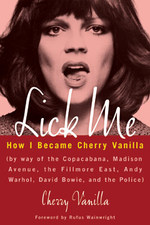
If you are still looking for the perfect gift for a jaded pal who's done everything and been everywhere, give her a copy of Cherry Vanilla's rock and roll groupie bio, Lick Me- How I Became Cherry Vanilla (by way of the Copacabana, Madison Avenue, the Filmore East, Andy Warhol, David Bowie, and the Police)
Cherry Vanilla's tales of rock and roll hedonism offer the reader an opportunity to re-experience the madcap adventures of a young woman who enjoyed the decadent and glam lifestyle of New York in 70s as David Bowie's first US PR rep. She lived and loved hard on the rock and roll groupie circuit, acquiring an enviable list of lovers that included Bowie and Kris Kristofferson. Eventually, Cherry became an entertainer herself and launched a punk act that toured the UK backed by Sting and Stewart Copeland of the then-nascent band, the Police.
Cherry Vanilla gradually retired from the limelight and moved to Los Angeles. She runs the U.S. office for the composer Vangelis and resides in Hollywood. Just off a quick tour of New York to promote her book before the holidays, Cherry participated in the following email interview:
I really appreciated the candor of your book. Unlike most rock bios, you were not coy about the drugs and sex you enjoyed during your youth. Was there any part of your story during those years that you didn't feel comfortable sharing?
Oh sure, I mean I talked about such highly personal things, like my OCD and my earliest methods of sexual stimulation and masturbation. And I talked about being a murderess by having abortions, and about humiliation and rejection, and the fact that I really wasn't such a great singer. Those things are all so hard to just blurt out publicly in print the way I did. But my goal was to be one hundred percent honest, and to not hold anything back. That's what I always want from a biography, the absolute truth, cringe-making moments and all. So, that's what I strove to give. And I am happy I did, despite how difficult it was. You know, I'm a person who moves on quickly from devastating things. But bringing all of these past situations to mind in the writing, that brought back a lot of the pain that I had long ago buried in the little corners of my mind. It wasn't only uncomfortable, it was a kind of torture. But then it was also a kind of a catharsis as well. I feel much lighter now.
How long did it take you to write the book and what inspired you to do it?
It took about two years. Pamela Des Barres asked me to be in her book, Let's Spend the Night Together, and based upon my chapter in it, her agent negotiated a deal for me with the same publisher, Chicago Review Press, to write my own book. My whole life inspired me to write LICK ME. All the while I was living it, I felt like I was living in a movie. I realized that the things that were occurring in my life by sheer good luck and destiny and the things I was doing to further magnify and glorify those situations were the stuff of a fantasy life. I remember thinking to myself many a time, wow, this is something quite special, rare, exciting and high. So, I always knew I would write the book one day. It was just a question of having someone put the fire under me at just the right time in my life. I'm so glad it didn't happen earlier, because the years have given me perspective.
I liked your poems and songs. Do you know of any songs written about you? Were you someone's explicit muse?
There are two Shawn Phillips songs I write about in the book, though I can't even remember the names of them now. I didn't write the titles in my diary, even though they seemed to be so monumentally important to me back then ... well, you see what I mean by perspective. There are so many songs with the name Cherry in them, and a couple of 'em might be about me. But I've never bothered to find out for sure. I can hear little influences here and there in Bowie songs, certain expressions I might have used or glimpses of things I might have called his attention to. Stewart Copeland once told me that the Police's song, "Roxanne" was about me. But I got highly insulted (not really), because I had already heard it was about a French prostitute. In truth, I think it actually is about a prostitute. But with the way I used to slither around on the piano and act like such a whore on stage with them, I think there probably is some element of truth in what Stewart said. Off-stage I was such a wholesome young woman in a monogamous relationship with Louie Lepore, my guitarist, that it was sort of like I did have to "turn on the red light" each night and sell my songs. Explicit muse? The only one I could guarantee that about would be Louie. I pretty much dragged the songs out of him when we were together.
What piece of clothing from 1974 do you miss the most?
Forget about the clothing; I just miss the body I had then! The body I could squeeze into all of those great vintage pieces I used to find at a New York shop called Early Halloween. And to think I used to think I was fat then. You see what I mean about perspective. I guess I don't really miss clothes. I mean, clothes are made to pass through our lives and not necessarily be held onto. I do wish I had been photographed in more of them though. It would be nice to have captured some of those looks for posterity.
When and why did you settle down in Los Angeles? What's your favorite neighborhood?
I moved to LA fifteen years ago. I had always wanted to move to California. When the San Francisco flower child thing was happening in the 1960's, I wanted to be a part of that. But New York was so fabulous and so familiar to me at the time, I just couldn't tear myself away. I'd visited and worked in LA a few times over the years and I always kind of envied the people who got to live in such a sunny, beautiful place. But I tended to go in the other direction, to Europe and the UK. I found myself in Massachusetts at the age of fifty-two, with almost nothing to my name and therefore almost nothing to lose. So, I figured, OK, if I'm gonna be homeless, it might as well be in some place where at least I won't freeze to death. Thanks to some friends out here, I was able to get myself back on my feet and make the lovely life I've enjoyed for all of these years. I love the big city things all combined with the mountains, the flowers, the palm trees and the sea. I get a thrill every time I drive along the Pacific Coast Highway, with the top down on my car and my sunglasses on. That's all I have to do any time I wanna feel like a star. And with all of the lies we're feed by the governments of the world, including ours, I love the fact that the truths that reach the most people on the planet do so through the movies and TV shows that are made right here. In a way, it makes LA the center of the universe. And the city is broke! What a joke. My favorite neighborhood is my own neighborhood, Hollywood.
Patti Smith seems to have embraced the idea of being a Rock & Roll Crone. How do you feel about growing older and what do you enjoy about aging?
Mostly I enjoy feeling free to express myself fully. You know, you get to a certain age and you think, well, I won't be around too much longer anyway, so I might as well say whatever the hell I want to say. And I like that people start showing you more caring and respect, that they think about your comfort and your safety, offer to pick you up and take you to the party, instead of letting you drive yourself there. I like that I have wisdom and information to impart about things the younger generation seems to have a keen interest in, things like be-ins, peace marches, Theatre of the Ridiculous, easy backstage access, pre-AIDS sex and pre-911 air travel. I like the fact that the worst possible photos of me are already out there, along with the best ones. So, I don't have to keep up the glamour-girl pretense anymore. I love the way that I've come to accept my body, old and imperfect as it is. I was never as comfortable in it as I am right now. I love that I can entertain all of the sexual fantasies I want, without feeling the slightest compulsion to act upon them. I love that I can look back and be so content with the life I have made, while still having the burning desire to keep on creating something new. Let's face it, with all of the drugs and the chances I took, I just love that I'm still alive and kicking!
Angels owner Arte Moreno has come under a shocking amount of criticism lately after the team failed to sign high-profile free agent Carl Crawford. As Moreno noted in an LA Times interview, he's received e-mails accusing him of being "cheap" and saying he should sell the team to someone willing to spend more money. If you listen to "Petros and Money" on AM 570, then you might hear producer and "baseball analyst" David Vassegh furiously lambaste the Angels owner. Sunday's LA Times also had an article from Bill Shaikin which offered plenty of veiled criticisms and strongly implied that Moreno should raise ticket prices 50% in order to bring in a free agent like Crawford.
All of these criticisms are absolutely nuts.
As some of you might know, I used to work for the Tampa Bay Rays. In my first season, we had the worst record in baseball, and within three years we were in the World Series. Carl Crawford was a big reason for our success. I got the chance to get to know Crawford a little, and he's one of the best guys I've ever met. He's got a great personality and he works as hard as any player in the game. Crawford does valuable things that don't show up in statsheet, as he wreaks havoc on the basepaths and might be the best defensive leftfielder in the game. I believe Crawford will retire with more than 3,000 hits because of both his athleticism and his outstanding work ethic.
But Carl Crawford is not LeBron James. He won't single-handedly take a team deep into the playoffs (really, hardly any baseball player can), and paying him $142 million over 7 years is excessive. Yes, Crawford would make the Angels a better team, but it's not hard to see why Moreno felt it would be a bad business decision.
The fact of the matter is that baseball is a team game. In order to succeed you need significant contributions from 25 players over the course of a 162-game season. Actually, you really need contributions from almost 40 players because of the strong likelihood that some guys will get injured. The most successful teams in recent years have had deep rosters and strong performances from multiple starting pitchers, multiple relievers, and consistent play in the field and up and down the lineup.
Spending $20 million a year on one player is extremely risky and very inefficient. In the NBA, it makes sense to give a player like Kobe Bryant or LeBron James a maximum contract, because they'll be one of five guys on the floor, give you 40 minutes a game, and the team's offense will effectively go through them. You could make the same case for an NFL quarterback. But for a MLB hitter who gets four plate appearances a game and makes a few defensive plays? Personally, I can't think of too many players not named Albert Pujols who have that kind of overwhelming impact on a team for 162 games in a season.
Shaikin notes that "of the 26 contracts in major league history worth at least $100 million, the Angels have accounted for none of them." That's true, but how about an actual study evaluating those $100 million contracts. Does simply making a large a splashy free agent signing guarantee a $100 million performance?
Of those 26 contracts, eight of them took place in the last two years, and it's too soon to evaluate them. That includes Crawford, Jayson Werth, and Cliff Lee, who were just signed, as well as recent deals like Troy Tulowitzki and Joe Mauer.
Of the 18 remaining deals, I would argue that eight of them turned out to be mistakes, eight of them more or less have worked out, and two of them could be argued either way. The regrettable deals include Vernon Wells, Alfonso Soriano, Mike Hampton, and Barry Zito - a mixture of players who have either underperformed or been injured. The good deals include Derek Jeter, Alex Rodriguez (twice, although you'll get debate on this), and Manny Ramirez (won two titles and always produced, despite annoying the Red Sox enough to trade him). I counted Miguel Cabrera and Johan Santana as good deals, even though those contracts are just three years in and the Mets and Tigers have yet to reach the playoffs in that time. And the two debatable deals were Todd Helton (whose performance has declined through the years) and Jason Giambi (who was great at first, but wasn't the same player after the BALCO allegations).
So what does that tell us? It means that $100 million deals work out about 50% of the time. That's an astonishingly poor percentage, and it should be enough to make any MLB owner seriously hesitate before offering a mega deal. The Yankees and Red Sox might be the only teams in baseball that bring in enough revenues to provide enough for margin for error in the event that a $100 million deal becomes a mistake.
But what about the Angels revenues? We have some idea of them, based on financial documents that were leaked to Deadspin. In 2009, the documents show the Angels had $10 million in net income. That season they had a reported $113 million payroll. We don't have information on net income for 2010, but we know the reported payroll jumped to $121 million. It's hard to see where revenues might have gone up though, considering the team's average ticket price went down in 2010. I'm not sure exactly how much they made in sponsorship and television in 2010.
According to Shaikin, the Angels are projected to have a payroll of $133 million in 2011, so it's hard to see how they could take on an additional $20 million a year in the form of Carl Crawford. Moreno told the Times that he'd have to raise ticket prices to do it. Shaikin writes that the Angels average ticket price is so low that it seems like "the market could support a 50% price hike."
Honestly, I think that's crazy talk. First off, Shaikin is citing Team Marketing Report for its data. Last month, I wrote about the flaws of the TMR formula and how it makes little sense to use it in any reasonable analysis. But second, I think the Angels would have to raise ticket prices an unreasonable amount to add $20 million. We're still in a recession, and asking a family of five to go from spending $20 a ticket to $30 a ticket doesn't seem right. It might also lead to a reduction in attendance.
I had a chance to sit in on an interview with Moreno in my role as a project lead for David Carter's recently released book - "Money Games: Profiting from the Convergence of Sports and Entertainment." We spent several hours with him on the day of our interview, and much what was said is printed in the book. I honestly believe that he's one of the two or three best owners in the game. His teams have made the playoffs five times since he bought the club in 2003 and his payrolls have consistently been among the highest in the game. Through it all, the Angels have maintained a steadfast belief that the game should be affordable and family-friendly, and the team averages over 40,000 fans a night as a result. The atmosphere at Angel Stadium has become one of the most enjoyable in baseball, and Moreno has taken the Angels from a club that once received revenue sharing payments to one that now gives them out.
Any fan who complains about Moreno being cheap, simply doesn't know what they're talking about.
So what can improve the Angels? Well, it's worth noting that they have a very good team already. Our what-have-you-done-for-me-lately society seems to have forgotten that the Halos made a huge deal for Dan Haren in the middle of last season. He's an elite pitcher who has Cy Young potential this year. They should also get back a healthy Kendry Morales, who is a top power hitting first baseman entering the prime of his career.
But the Angels do need to improve their scouting and player development, something they acknowledged by hiring a new scouting director this offseason. The Angels used to have a top-5 farm system, but it's fallen outside the top-20 on some lists. A stronger farm system would mean they would need to take fewer financial risks, as the team currently is paying large sums of money to Torii Hunter, Scott Kazmir, Bob Abreu, Joel Pineiro, Ervin Santana, and Fernando Rodney, among others.
But in the shorter term, the Angels can use the money they may have earmarked for Crawford on filling holes at third base, in the bullpen, and they could use another outfielder. Regardless of what happens, we know the Angels won't be cheap, we know their ticket prices will be affordable, and I can assure you that they will field a strong team - all because of the excellent leadership from their owner Arte Moreno.
I came across Bob Timmerman's post on this site recently, and I can't help but to respectfully disagree.
In this post and in another, Timmerman strongly implies that the LA Times is biased in favor of an AEG-built Downtown football stadium, and presents some recent columns by TJ Simers and Bill Dwyer as evidence. Presumably an NFL team here would give the Times more to write about and it would help the sagging sports section.
In my opinion, if the Times wants LA to get an NFL team, then they've been doing a terrible job for 15 years. Yes, Simers has written two pro-AEG columns recently, but he's also bashed just about every other NFL owner and/or team that could wind up in LA. Over the years, Simers has referred to the Spanos family (which owns the Chargers) as the "Spanos Goofs." Last year, responding to reports that the Rams were considering moving to LA, he wrote an article headlined: "The Rams back in Southland? Be very afraid".
Simers has covered the NFL to LA story since the moment the Rams and Raiders left. He's never been shy to criticize Ed Roski, Eli Broad, Michael Ovitz, Ron Burkle, Marvin Davis, Ken Behring, John Moag, Mark Ridley-Thomas, and dozens of other people over the years. He's even been known to call AEG's Tim Leiweke by the name "Tim LIE-weke." Here's a sampling of Simers quips:
Every time there is an NFL report involving Los Angeles, I'm reminded of one of my all-time favorite movies, "A Thousand Clowns."
It's usually the first question when traveling if L.A. is mentioned: "When are you folks going to get an NFL team?"It seems to be a big concern to people living elsewhere, but the answer around here is usually the same: "Who cares?"
Given all the wasted rhetoric to date, it's like waiting for Beckham to make an impact. The interest is long gone.
We love the NFL. On TV, all right.Some people, who live elsewhere, will insist we are missing something because we don't have a team of our own to get excited about.
But then we don't pay for parking, tickets, concessions or experience a rise in the crime rate with so many more professional athletes living among us. And our dogs don't have to sleep with one eye open.
...
But whatever happens, we're probably going to be stuck with the return of the NFL, and you know what that's going to do to our Sunday TV fare.
Now we have Charger owner Alex Spanos knocking at the door, which makes me long for those Russian Sputnik days when we had underground bunkers to hide in....
When Seattle Seahawk owner Ken Behring tried to move his team to Anaheim, he expressed great dismay when the L.A. media failed to greet him with puff pieces.
And I guess I can understand why Staples Center-price gouger Philip Anschutz would want to keep the location of his new stadium secret until he ties up all the land at a cheap price because he's a billionaire and he doesn't want to become just a millionaire.In fact I gave this some thought before guessing the stadium will be built in South Park because I'm not sure I could sleep knowing I might have contributed somehow to making Anschutz just a millionaire.
But then I remembered what I paid for that last Diet Pepsi at Staples Center, and I'd like to see this guy take care of his monthly bills after a night out in his arena.
...
If Leiweke is going to try to steer people away from South Park, I suggest he start spelling his name LIE-weke, and tell the truth.
I see the day when City Councilman Joel Wachs is dressed in black and gold from head to toe, standing before his brethren in City Hall, proclaiming it "Los Angeles Saints Day."He's telling reporters, "There's nothing like pro sports to bring a city together," the people in New Orleans be damned. And one more thing, Wachs will say, "Anyone got any extra Super Bowl tickets?"
Mayor Xavier Becerra will then hand the keys of the city to an Art Modell-like carpetbagger, while proclaiming the Monday after the Super Bowl a free day for all L.A. schoolkids.
I'm predicting it right now: The time is coming when every one of you who has said that L.A. does not need the NFL, that L.A. does not miss the NFL, that L.A. never will spend a dime of public money on the NFL, will collapse under the pressure of championship fever and act like a football goof again.
Now, I actually like T.J. Simers. I find him humorous and I know not to take him too seriously. But when someone with his experience and history actually praises a football stadium plan, then you know there has to be something to it.
Times columnist Bill Plaschke has also been unenthusiastic about the idea of the NFL coming here, penning columns headlined: "Forget the NFL, LA Leads Field in Football" and "Life Without the NFL? There's Nothing to It".
Other Times writers have been similarly cynical, skeptical, and apathetic about LA football stories. The recent Dwyer and Simers columns are rare exceptions and not indicative of the Times' staff feeling as a whole.
In the meantime, I'm going to say something that few media members are willing to say in the open: I want the NFL to return to Los Angeles. I've been longing for a team to come here since Raiders left in 1995 and have openly supported every reasonable plan to do so.
Why on earth do I care? There's plenty of lip service that politicians and businessmen give to the idea of job creation, economic development, and civic pride. Many of those arguments have merit. But for me, the reason is simple: I really enjoy watching professional football and I would like a local team to call my own. I would like to attend a few NFL games a year in my own city and cheer on a team with other fans who live here.
I know it's shocking to hear someone in the LA media say that, but I'm not going to apologize for my position. And I think there are plenty of Southern Californians who agree with me. The percentage may not be as high as in Cleveland or in Baltimore, and they may not be as fanatical as fans Pittsburgh or Green Bay, but there's enough people here to fill a stadium every Sunday and avidly support a professional team.
Some people say that we don't need football in LA to survive. That's true. But we also don't need the Lakers to survive either. Or the Dodgers. Or USC and UCLA athletics. You could get rid of all of them and the sun will still find a way to rise every morning. But people enjoy watching those teams, and they would enjoy watching a competently run NFL team too.
This doesn't mean I think the people of Southern California should be swindled into a bad deal. But neither AEG nor Ed Roski are looking to swindle people with their current stadium proposals Downtown or in the City of Industry.
AEG has spearheaded a dramatic transformation of Downtown LA, despite being opposed by cynics and nimbys at every opportunity. STAPLES Center was the catalyst for economic development that has happened there this past decade, and the construction of LA Live and its adjacent hotels have given this city the opportunity to host numerous events and conventions that would not have otherwise come here. That has led to new tax revenues coming into this city, and yes, created jobs. A Downtown stadium (doubling as a convention center) would only help LA attract more high quality events and continue to help this city. No company has more credibility than AEG when it comes to stadium and event center construction. They haven't just done it in LA. They've done it all over the world. And nearly every facility they've built has become a success. If anyone can make a football stadium in LA happen in a way that is fair to taxpayers and drives economic development, then it's AEG.
Similarly, Ed Roski is another well-respected businessman in Southern California, who worked closely with AEG on projects in the past. The design for his City of Industry stadium is excellent. It might be further away for most Angelinos, but it's closer to LA than Foxboro is to Boston, and it's more convenient than living in New York and having to take a bus to East Rutherford, NJ. And people within LA city limits often forget that there is an enormous population in the San Gabriel Valley and Inland Empire, and this proposed stadium would be closer to them. If LA's only NFL team played in the City of Industry, then the stadium would absolutely be a success.
There have been some lousy LA stadium proposals, but neither of these are it. I'm in favor of whichever can be done and can finally bring the NFL back to Los Angeles. And if the LA Times is on board too, then that would be a pleasant surprise.
Thursday, December 9, 2010
Saturday, December 11, 2010
L.A. Times sports columnist T.J. Simers, who already devoted an entire column on November 8 in order to drum up support for a football stadium/convention center Downtown to be built by AEG, wrote another column about it on Monday.
Simers wrote that the San Diego Chargers could be on the move to Los Angeles. The Chargers have been asking for a new stadium to replace Qualcomm Stadium, but seem unlikely to gain voter approval for it.
This is nothing new as the Chargers have long been one of the teams rumored to be on the move to Los Angeles. Other candidates have included, at times, Minnesota, Buffalo, New Orleans, St. Louis, and Jacksonville. For Simers, the column was really another excuse for him to turn into an AEG mouthpiece.
For a writer who prides himself on always wanting to get to the truth and not being afraid to get people angry, Simers certainly seems to be in the thrall of AEG President Tim Leiweke. Every financial figure presented by AEG is presented as the unvarnished truth. And there is no room for debate.
An example:
All are in agreement, though, an events center would only maximize L.A. Live's effectiveness and lead to further development."The Microsoft convention this July will be the largest to date -- 45,000 hotel-room nights total, and that would not have happened without building this hotel in L.A. Live," said an AEG spokesman. "An event center would provide for more convention space and more hotels built downtown."
Any time anyone mentions a new stadium around here, the uneducated become alarmed, figuring public money would be spent on such a playpen.
No public money was used in the building of Staples Center. It's true more than $70 million was committed to the area surrounding the arena, where L.A. Live now sits -- $58 million in bonds currently being repaid. Another $12 million in redevelopment money was committed to the project.
When the bonds are paid in full, it's expected the interest paid will match or exceed the $70-million contribution, allowing AEG to say the city essentially paid nothing for the downtown facelift.
Leiweke has told folks in public gab fests no public money will be used on the events center. He's counting on Anschutz and a contribution from the NFL.
Who are the "all" in "all are in agreement"? The City Council? The Mayor? Downtown residents? City of Los Angeles taxpayers?
So, let's see how this works. The present Convention Center is torn down. A new multipurpose facility with a retractable roof is built in, let's say two years. The NFL manages to avoid a lockout and continues to rake in money. Some other city refuses to submit to blackmail and won't build a new stadium for its team, so it moves. Then, that team moves to L.A., plays in the brand new stadium. Downtown L.A. becomes an urban center that is studied in graduate schools for the next 100 years! The City of Los Angeles finds its general fund so flush that every citizen gets a $50 bill in the mail!
Sports stadiums are always sold to the public as the solution to just about every problem. They supposedly are an economic stimulus that is fun to visit! (Unless you're a UCLA football fan visiting the Rose Bowl. Then you're just going through hell, but I digress.) If Los Angeles wants to create more jobs for people to sell hot dogs and collect money at parking lots, then a football stadium is the way to go. But, can't the region come up with a better idea to provide better jobs for its residents?
Even if AEG pays around a billion dollars to build a football stadium, who is going to pay for the roads to take people to it. Or the improvements to the public transportation system? (Do you want to wait with a football stadium sized crowd at the Pico stop on the Blue Line?) Or what about stuff like water and other utilities?
Simers column just assumes that everything AEG tells him is correct. And everything will work out perfectly. And that just seems hard to believe. No matter what your level of education is. In Simers' view none of us are nearly as smart as an unnamed spokesperson for AEG.
Thursday, December 2, 2010
Saturday, December 4, 2010
Save the Date: Thursday, November 9, 2010
Zocalo at the Hammer: Christopher Isherwood's Los Angeles. Hammer Museum. 7 PM
*ETA
|
Media
|
Politics
|
|
|
LA Biz
|
Arts, Books & Food
|
LA Living
|
Sports
|