
 Follow LA Observed on Twitter here

An island of toxic plastic - three million tons of it - floats about a thousand miles off the California coast. More than 1,500 miles wide, it far outweighs the plankton in the sea, and forms an amorphous mass made up of tiny chips too small to clean up.
SFGate.com, one of the web's best newspaper sites (which fronts an often mediocre newspaper, go figure) has been on the story for a few days. It focuses on Charles Moore, the marine researcher from Long Beach, who has studied the trash heap for the last 10 years. The news is not good.
"For every 6 pounds of plastic that we got, there was only one pound of zooplankton," Moore says on the Algalita Marine Research Foundation's web site.
And here he is, quoted in Justin Berton's story in the San Francisco Chronicle.
"Any attempt to remove that much plastic from the oceans - it boggles the mind," Moore said from Hawaii, where his crew is docked. "There's just too much, and the ocean is just too big."The trash collects in one area, known as the North Pacific Gyre, due to a clockwise trade wind that circulates along the Pacific Rim. It accumulates the same way bubbles gather at the center of hot tub, Moore said.
A two-liter plastic bottle that begins its voyage from a storm drain in San Francisco will get pulled into the gyre and take weeks to reach its place among the other debris in the Garbage Patch.
While the bottle floats along, instead of biodegrading, it will "photodegrade," Moore said - the sun's UV rays will turn the bottle brittle, much like they would crack the vinyl on a car roof. They will break down the bottle into small pieces and, in some cases, into particles as fine as dust.
The Garbage Patch is not a solid island, as some people believe, Moore said. Instead, it resembles a soupy mass, interspersed with large pieces of junk such as derelict fishing nets and waterlogged tires - "an alphabet soup," he called it.
Reliably readable Mark Morford takes on the travesty with characteristic bite:
Is there anything more impressive than the idea that you can, say, toss away your little Calistoga bottle or your plastic Safeway bag or your meth syringe or old iPod case or cigarette lighter or DVD wrapper here, and it will somehow, through a miraculous combination of time and wind and wastefulness and the flow of nature's beautiful eternal pulsing rhythms, wend its way 1,000 miles out to sea and then, well, just swirl around, slowly breaking apart and poisoning all life surrounding it...
So - paper or plastic?
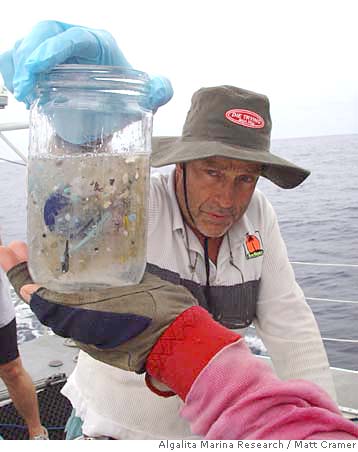
Algalita Marina Research Foundation photo by Matt Cramer


