
The weekend weather forecast promises clear skies so there's no excuse not to go for a walk. If you desire company and/or motivation, check out the following two upcoming walking events. Of course, if you prefer to march there will be plenty of opportunity at Saturday's May Day rally for immigration rights downtown and other May Day marches scheduled around town.
SATURDAY, MAY 1: PARK CITY - a special themed walk: six miles of stairways, and six miles of city park. Meet: Angel's Flight Stairway, 341 S. Hill St., downtown Los Angeles, 9AM.
TUESDAY, MAY 4, 2010, 7:15PM: INTRO WALK . Meeting spot: in front of Baller Hardware, 2505 Hyperion Avenue Los Angeles, CA 90027. This walk covers just two miles, but includes 14 stairways. It is a perfect way to get accustomed to stair climbing and figure out how the Parade will feel. First-timers are welcome.
The social calendar for early May is stuffed with activity. Many of these events celebrate a cultural or ethnic heritage: BritWeek has just arrived, sharing the talents of all the UK residents in the area;the Los Angeles Asian Film Festival starts on Friday; local Hawaiians will be celebrating Lei Day on Saturday with luaus, flower exchanges and cultural performances; the annual Armenian Festival in Glendale rolls around again on May 1; meanwhile, on Sunday, the Dutch can get their Koninginnedag on; and authors Roxana Saberi and Nahid Rachlin share aspects of Persian culture with their readers. Later in the week, Mireille Guiliano returns to town to teach Angelenos why French women don't get fat. Best of all, the area's smart alecks can let it all hang out in Old Pasadena at the Doo Dah Parade, which is also scheduled to unfurl on Saturday.
Wednesday, April 28, 2010
Thursday, April 29, 2010
Friday, April 30, 2010
Saturday, May 1, 2010
Sunday, May 2, 2010
Monday, May 3, 2010
Maybe it's because we're not used to the idea of a series--up to seven games between the same two teams, games that may take nearly two weeks to play--that the first round of the NHL playoffs felt so long for LA hockey fans. It's over now, the team having lost on Sunday night, but before the whole thing is forgotten, those of you not interested in the game might give one moment's pause to consider the plight of the Angelino afflicted with the love of hockey.
Same thing out here in LA. The wait was forever to get back in the playoffs (eight years, for those of you not keeping a precise count), and even this year, near the end when the Kings seemed like they would make it but were flirting with giving it all back in a post-Olympic slump, it felt like time slowed down. Once the team got in, the clock moved even more slowly.
In one way, that's because the playoffs bring so much hope. Every day fans wake up thinking about their team. Sure, it was only the opening round, what was called not too many years ago the "elimination round," which only existed to dispatch the lesser teams, those which didn't have any business being in the thing to begin with. But Kings fans knew that if things went right, their team could move on, eventually to play for the Stanley Cup. They hadn't gotten that far since 1993.
It was absurd to hope that they could get that far again this year, but still, while the team was in it, LA-based hockey nuts could greet each other across the breakfast table by saying, "Is this the year?"
They say you have to lose before you win, and many NHL teams have proven this to be so over the years. Carolina lost a Finals to Detroit before later winning it all, in 2006. The Ducks did the same, New Jersey beating them before Anaheim conquered Ottawa in 2007. Even Detroit lost, back in the 1990s, before they became champions and then repeat champs over and over again.
That doesn't make the losing any easier, of course. Look at Ottawa, Colorado, and New Jersey this year. The dream lasted just nine or ten days for them, and the fact that it's over seems harsh, but think of their fans, how much anticipation they've had over this nearly two-week period. For that time, nothing else has mattered.
When I was a kid, one year, Montreal lost in the semi-finals. I think it was to Boston. The series went 4-2, and I can remember thinking how horrible it was that they didn't get anything more done than that. It seemed like a disgrace. Why hadn't they at least pushed it to seven games? I wondered. I, only years later, realized that 4-2 isn't so bad. In fact, it's just a win from 3-3, and that crucial seventh game.
Now when I look at playoff history and see that a team was dispatched in six, I don't think of it as such a horror. And that's precisely why I'm not feeling too bad about the Kings losing to Vancouver Sunday night.
This last ten days that the Kings have been in it have seemed like an eternity to me. I've waited each game day for the puck to drop at night. The first game, in Vancouver, things were close. But for Luongo snatching a puck off the goal line, the underdog Kings would have been ahead by a game. In game two, they won, overtime this time going in their favor.
At home, they won again, and last Wednesday night in LA, they should have. Had they done so, they would have gone up 3-1, and Vancouver would have been in trouble.
In every series, there is a moment, a flash that tells you what will happen. That what is to come is inevitable. For the Kings, that happened Wednesday night. As the third period started, there was the feeling in the arena that no matter what they did, they could not be beaten. They were ahead in the game, 3-2. But then came the cruel reverse of losing the game.
Two goals put the Canucks ahead, 4-3. The Kings tied it on a poke-in goal from the crease by gritty Wayne Simmonds. Yet that feeling of invincibility still lingered. It seemed like the teams would go to overtime. Then came the goal that represented Vancouver's resurgent strength. Their best guys, the Sedin twins, played tick-tack-toe with the puck, freezing the Kings and stifling their hopes and those of their fans. It was 5-4, and another went in before the end.
It might as well have been 8-4, because in that moment when the puck went in to give the visitors the lead, it was obvious to anyone with any real eye for the game that the Kings were dead, though the series was even at two apiece.
Still, this is the playoffs, and there's hope. Maybe it was hope against hope at this point, but one could still have gotten up Friday morning with the thought that things could change. The Kings could avenge the loss, and be up 3-2. A 4-2 series win for them was still in the realm of possibility.
Then gametime came on Friday, and the LA team used both its goalies and still couldn't stop anything the Canucks threw at them. Their defense made mistakes. Their offense didn't generate anything. The Canucks were by far the better team. They won, 7-2.
Because it's a series, that wasn't the end, Vancouver not yet having won the requisite four games. The win in game five was just their third. They would have to return to LA to wrap it up. On the other hand, the Kings could still win it. They just had to put two good games together.
They failed, though once again, a win was within their grasp. They led, again, going into period three. Game seven would have been in Vancouver, and perhaps impossible to win, but this game, game six, was going to be theirs. Then it wasn't.
Why? More than anything, because the Kings had reached their level, and they willed themselves to go no further. One guess as to why says that in their heads, making it this far was to have had a good season. They weren't expected to make the playoffs. They almost didn't, having a weak string of games in March. Getting this far was success.
Coming in, Vancouver was seeded third in the West. Most people didn't give the Kings much of a chance. This year, it was said, wasn't about winning the Stanley Cup for LA. It was about continuing to build something. Losing to later win, in other words, and that's exactly what the Kings settled for, so it's over.
So those of you casual sports fans, or non-hockey people, have a little heart this morning for your colleagues who seem down. They're Kings fans, and their problem isn't so much that their team lost as that, for them, it's back to real life. The playoffs will go on, but the games won't be local. Instead, they will represent the hopes of other fans in other cities. In LA, the passing of time will return to normal speed, Monday being followed by Friday, then the weekend, then Monday all over again.
The nomadic Architecture + Design Museum, Los Angeles, finds a permanent new home on Wilshire Blvd and holds a Grand Opening Celebration + Fundraiser on Tuesday, April 27, 2010 from 7:30 PM to 9:30 PM. Los Angeles City Council President Eric Garcetti will be the keynote speaker while KCRW's Frances Anderton will undertake Mistress of Ceremonies duties. Tickets are $75.
Architecture + Design Museum, Los Angeles
6032 Wilshire Blvd, Los Angeles, CA 90036
I received a disturbing ten-page letter this week. It was from a prisoner who last year confessed to a triple homicide. An attorney who represents a woman I am writing about also represented the prisoner, who I will call John. The attorney asked whether I was I interested in interviewing John, because John wanted to talk.
John's crime - murdering and dismembering three meth buddies in eastern Oregon - did not in itself interest me. Now in his late 30s, John had been in trouble with the law since age 12; his confession, to the television cameras, seemed to leave little room for interpretation. Still, the rock had been placed at my feet, and I felt, as someone increasingly working within what I've come to think of as the murder machine (the killers, the victims, the cops, the press), I thought it best to turn it over.
I drove across the state. The night before John's sentencing, I sat with his mother in her tarpapered kitchen. She showed me a hundred letters and drawings John had sent her for the past twenty-five years, from various boys' homes and jails. She confessed she felt she'd failed John, what with the savage beatings from his father; her own alcoholism, and the family's chronic impoverishment, which caused them to live in the woods for several years. She lived now in a town of twelve hundred; it was impossible to not run into the mothers of those her son killed. She expressed to me, then and in the months to come by telephone, how grateful she was that I was interested in her son; how he'd told her he was going to commit the rest of his life to speaking out against methamphetamines. She took this as a good sign, yet another signal he was a good person, which she also knew because he had told people that when he walked his female victim through the woods, first making her take off her shoes so she could not run away, and the woman had complained her feet hurt, John had said, "Here, get on my back, I'll carry you." This, before he strangled her, cut off her head, hands, feet and tattoos, threw them in a gym bag and tossed it in a lake.
John's mother could not bring herself to go the following day to the sentencing. I went. It took place in a mean cold courtroom. Forty relatives of the victims were there. John sat at the defense table, shackled. He appeared relaxed. The judge went over John's crimes, asking whether it was true he killed over a $5 debt. John confirmed this.
The relatives spoke: John had robbed them of a mother, a grandmother of a two-week old infant, the father to two little girls, and the only child of an 86-year-old woman. Those who spoke could not show John enough contempt; could not wish him a long enough rot in hell.
"And I do not believe you are sorry," said the sister of one of the dead. "You are someone who brags to anyone who will listen about what you've done."
I thought, after listening to John swear how he'd give his life to bring back his victims but seeing him swan for the judge and give the assembled puppy-dog eyes of contrition, that the sister had a point.
I did not say as much to John's mother when she called to find out how the sentencing went. What could I say? The world hates your son?
In the months to come, I did not pay much attention to John. I spoke with his mother when she called. I did not bring up having been told by the DA that she'd had an incestuous relationship with John. Meanwhile, I discussed the story with my editor at the Oregonian: how would we tell this story, and why? We thought it might be along the lines of, "A Year of Reconciliation," John would have undergone changes; we would look at the event as it impacted the community, his family, and whether he was following through on his claim to preach against drugs. It didn't matter to me what road John chose, but one must have a reason to tell a story; something must be illuminated, or why else are we here?
These are the questions I asked myself when I received John's ten-page letter. In it, he requested I send him clippings of his crimes, and asked if I could put him in touch with an author who wanted to write a book about him (or maybe I was interested?). He told me he lied in court; he wouldn't give his life for his victims. "I have zero remorse... I honestly have not had a single lost night's sleep over them," he wrote, and then detailed for me how he killed the woman. This took four pages. I read the letter at a coffee shop. I went outside and called someone familiar with the case: did he think John was unburdening himself to me, or was this his m.o.? The person said, the latter; that it seems John is turned on by his crimes. I drove home and was sick.
I could say it was then I had to decide whether to continue with the story, but that is not the case. I knew I would not. Not because John wanted attention (or, as my husband put it, "Fuck him, he doesn't get your time"), or because there is nothing there to write about. The circumstances and decisions that got John where he is today might well intrigue another writer, who will want to spend time excavating the story. But it is not for me. For me, John is a shallow stream. Or, as I later wrote, of the letter, to John's attorney, "It was like having an ugly woman lie naked on the bed and say, 'Take me.' And you think, uh, no thanks."
I wrote to my editor, explaining the situation, saying I was open to continuing but did not see the reasons why. She didn't either. I did not feel I owed John any more return letters. I did write a note to his mother, saying I would not be continuing to write about John. I did not elaborate as to why. One assumes she knows her son better than I do.
My choosing to not write about John (or, not today, more than I am here) is not a consequence of his actions. I might have the tools to write this story; I don't feel like using them here. This has little to do with being repulsed by murderers. The first feature I wrote was about John Wayne Gacy, who I drove across the country to meet. More recently, when I learned Amanda Stott-Smith forced her two young children off a bridge, one of who died, my Geiger counter went nuts. I had to know how this happened. I had to dig and dig and look and put the pieces together until they made sense.
If the comments on websites are an indication, most people do not want to read about how people come to murder. They want retribution. I get this. John will likely have as terrible a life in prison as he did out of it. This does not trouble me. I have fantasized about dropping Lily Burk's murderer from a plane. But I don't feel this way about Amanda Stott-Smith at all; I think hers in an important story to tell, and I respectfully disagree with the judge who last week sentenced her (to life with the possibility of parole after 35 years) and characterized her actions as "truly incomprehensible." We don't have to like what Amanda did, or forgive her (if you think that is up to you), but the duty to try to understand, in this case and for me, is immutable.
For every person who reads what I write about Amanda and asks me to continue because it helps, there is another who tells me to go to hell. All, I think, have the same motivation: they sense a type of redemption if they take the journey, and some are not, as I was not with John, ready for that.
This week's party circuit is all about the exchange of information. The Los Angeles Times Festival of Books rolls into town on April 24 and 25th at UCLA (Carolyn Kellogg of the paper's books blog, Jacket Copy, has posted some great pre-festival interviews with authors attending this year's event). There will be lots of high profile authors and journalists in town, popping into the offices of film agents, book readings and cocktail parties. The Los Angeles Times Book Prizes ceremony will be on Friday, April 23rd at 8 PM in the Los Angeles Times building, Downtown.
After the book festival, attendees can continue to enjoy the literary festival lifestyle by seeing the film, "The Eclipse," which is now in limited release and available on VOD. An elegantly elegiac ghost story directed by Irish playwright, Conor McPherson, the film involves participants attending a book festival in Ireland that slyly winks at the literary set in the same way David Lodge teased academia in his book, Small World: An Academic Romance.
Last night, April 21, 2010
Friday, April 23, 2010
Saturday, April 24, 2010
Monday, April 26, 2010
Tuesday, April 27, 2010
Managing fear. It's a huge part of being a success in sports. In my first book, "Growing Up Hockey," I talk about this, showing what it was like for me as a thirteen year-old realizing for the first time that hockey wasn't simply beautiful, but terrible as well.
The latter aspect came from the fact that a team my All Saints Pee Wee squad was playing, Immaculate Conception, were ruffians who were terrorizing even our first-line players. As a third-line right winger, I knew I didn't stand a chance.
And that's why, thirty years later, I'm watching hockey and writing about it from the press box, and not enjoying the fruits of a career on the ice. I couldn't master the fear that came when I thought about getting what we called back in the day, "hammered."
For the L.A. Kings Monday night against Vancouver, the thoughts might have been the same. On every early shift, the Canucks slammed and smashed, sending guys hard into the boards and at one point seeming to knock Richard Clune almost into Tuesday. But rather than display fear, the L.A. team displayed resolve. It's the very reason these guys are doing what they're doing, playing in the league, in the first place.
The crowd, revved up as might be imagined by a combination of an eight-year playoff drought and the extra efforts of the people who do such things to make the arena playoff-ready, had already screamed their heads off during the game's introduction. An early Vancouver goal might have shusshed them a little bit, but their ire was raised again by the sight of the favorite players being tossed around.
Were fans surprised at the ferocity of the Vancouver checking game? That's the funny thing about the Canucks. When one thinks of them, the picture of two delicate, goateed Swedes obviously comes to mind. "Effete," "skill players," you think. That translates into "don't hit me, and I won't hit you." But this squad is made up of a lot more rough customers than that. Alexandre Burrows, Tanner Glass, Alexander Edler, Andrew Alberts--this is a big team, with some tough hombres ready to knock you down when you've got the puck, and sometimes, even when you don't.
The first ten minutes were all about the knocking around, although L.A. evened the score at minute eleven with Christian Erhoff in the box for slashing. The goal was a wake-up moment for both squads, and the Canucks went back on offense at that point. Over the course of the game, L.A. ended up outhitting them, 49-38.
There's also the fear of failure, and an opposing goalie on a tear can strike that into the heart of any shooter. Roberto Luongo has the reputation of being a big-game goalie. Nevermind that he hasn't earned it, never taking his team much of anywhere in the playoffs and winning his gold medal at this year's Olympics despite his own inept third-period play.
But because he seems to have a sense of his own invincibility, it gets into the heads of those he plays. In game one, he snatched a puck off the goal line to preserve a tie, and then watched his team go on to win. It might have been an "uh-oh" moment for the Kings, as they wondered to themselves whether maybe this guy had the hockey gods on his side. Everyone knows what a hot goalie can do in the post-season.
But Saturday, he lost. And Monday, he got yanked after letting in four goals. When his coach was asked afterwards about the move, he said simply, "it was time." And there may have been a slight concession to injury, as Luongo had taken a skate blade to the back of the catching hand when Ryan Smyth stepped on him on his way through the crease just before Luongo went out.
No matter. The L.A. bench had to be happy to have chased him, though to his credit, Luongo didn't pout on the Vancouver bench with his mask on as many goalies in that situation do. He simply donned his baseball cap and sat there watching the play as if he'd been slated for backup duties all along. In the end, shots were 28-23 in Vancouver's favor, with Luongo letting in four goals, his backup Andrew Raycroft one. Jonathan Quick saw three get by him in the 5-3 win.
If there's one thing that the Kings, now up 2-1 in the series and with much of the momentum on their side, need to watch out for, it's the quiet confidence which Luongo, his coach, and many teammates bring to their current situation. They aren't panicked, yet. After the game, Coach Alain Vigneault smiled at the press, answered questions as if it were an October game, and vowed to move on to a new day. "Vowed," actually, is too movie-melodramatic a word. He simply said the team would come up with a new plan to deal with L.A.'s power play before they meet again. Should they lose Wednesday in L.A., that sense that there's no need for desperation might change, of course.
But expect for them to come out Wednesday night with a renewed effort to stop L.A. on the PP, and more discipline to begin with so that they don't give the Kings the extra man. Add to that continued strong breakouts and odd-man chances, and they'll likely make things interesting, no matter what counter-moves L.A. throws at them.
Notes
As of Tuesday morning, I could still buy a single-game ticket online (not through an agency). So L.A. fans, get on it--www.lakings.com/playoffs--and be a part of this thing.
Who's using the ticket? The lovely Gabriela. She'll be sitting alone with 18,200 friends while I'm in the press box. So whoever's around her--be nice.
Wednesday, April 14, 2010
Thursday, April 15, 2010
Saturday, April 17, 2010
Sunday, April 18, 2010
Monday, April 19, 2010
Tuesday, April 20, 2010
On Saturday, April 17th, the Los Angeles County High School of the Arts (known as "Arts High") is holding a gala celebration to commemorate its 25th anniversary as one of the country's leading training ground in the performing and visual arts. LA notables like Natalie Cole, Arts High alumnus Josh Groban, Barry Manilow, Marilyn Horne, Bob Newhart, composer John Williams, architect/designer Frank Gehry will gather at the Ahmanson Theatre to pay tribute to the school's accomplishments and raise funds to continue the delivery of excellent arts education in Los Angeles, despite the looming threat of budget cutbacks at both the state and local level.
Founded in 1985, the tuition-free public school is run by the Los Angeles County Office of Education in partnership with and on the campus of California State University, Los Angeles (CSULA). The program offers a specialized program combining college-preparatory academic instruction and conservatory-style training in the visual and performing arts. Alumni include such future stars as Josh Groban, actors Jenna Elfman and Anthony ("Law and Order") Anderson, Fergie of The Black-Eyed Peas, playwright Josefina Lopez, Corbin ("High School Musical") Bleu, Alvin Ailey dancer Matthew Rushing, and visual artist Kehinde Wiley.
Tickets are still available for the anniversary gala, which will honor Dr. Edward Kantor, Ginny Mancini, Barry Manilow and Flora Thornton.
The school's current Principal, George Simpson, an arts educator with bachelor and Masters degrees in music, gave LAObserved a quick Q&A in time for the upcoming fundraiser.
Why is LACHSA honoring Barry Manilow at the anniversary celebration?
Barry Manilow has been a friend of LACHSA since the early days of LACHSA. He made repeated visits to the school, he donated instruments. We thought it only fitting that, at our 25th anniversary, we recognize and honor him for all that he has done over the years.
How has arts education impacted at least one student and why?
Here is an excerpt of something that addresses your prompt. I recently sent this to LACHSA families:
After a few moments in our hallways one immediately notices that LACHSA is very different than other schools. The tensions that divide students at other schools do not exist to the same degree at LACHSA. At LACHSA we see acceptance, not mere tolerance, but acceptance; our students feel like they have a home, a place, a community.
Many students have remarked that before coming to LACHSA, their school experience was often marked by isolation. Students have told me they felt somewhat like misfits for their passionate love of the arts, or felt ostracized by their peers for holding such a unique view of the world. When they arrive at LACHSA, students have a very different experience. They feel a connection to one another. They recognize a similar enthusiasm in their peers; they feel understood. I believe it is the arts and the way our students use art as a lens through which to view the world that creates this connection.
How have the budget cuts on a national and city-wide level impacted your school programs?
Although we will continue to offer a robust academic and arts program we have had to prioritize our use of resources. At least in the short term, we are not in a position to offer the same breadth of elective classes as in years past. Our focus will continue to be our arts programs and our academic program.
If you would like to learn more about the program and its students, check out the videos below, highlighting student contributions over the years.
Trailer for LACHSA: Beyond the Usual, a documentary about Arts High
2008 Performance of "Why Did I Choose You" by LACHSA jazz vocal group at Monterey Next Gen Jazz Festival
Today (April 12) marks what would be the 106th birthday of my maternal grandmother, Ella Kimberling. She passed away in 2001, a few weeks shy of her 97th birthday.
I tend to start looking at old photos of her around this time. One photo, which I had ignored for years, seems to represent her importance to my family.
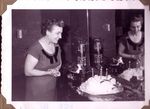
This photo was taken, judging from the children present and the background, around Christmastime 1962. It features my grandmother in the center with her two daughters standing on either side (my late mother is on the right, my aunt Mary is on the left) and six of my grandmother's seven grandchildren. (I would not make an appearance until Christmastime of 1965.)
I view this photo as a kind of planetary system. I see my grandmother as the person everyone revolves around. Her daughters seem to be hovering about her. And, in turn, their children are revolving around them. The orbits, as you can best call them, are rather eccentric since none of the children are over the age of four and toddlers are well known for not wanting to pose in a stance that their cousin could interpret in some scientific way forty-eight years into the future. Grandma apparently captured my brother Tom into her own orbit.
My grandmother was not someone you would have expected to be so important. She came from a rather poor background, growing up in St. Louis, the oldest daughter in a large Croatian family. (The photo below doesn't even include all of her siblings. She had one sister who was born 20 years after her. Grandma is the girl on the upper left. There would be nine children overall.)
Grandma, born as Jelena Zuzenak, and then later Anglicized in part to Ella, dropped out of school after the fifth grade (or possibly eighth, she wasn't too clear on this) to go to work to help out the family. She started off doing piecework, making dresses. She would later get a job in the Fleischmann's yeast factory, wrapping cakes of yeast for resale. The 1920 Census listed her profession as "wrapper."
While at the yeast factory, she met a man named Walter Hitchcock, a salesman for the company. Walter and Ella quickly hit it off and married. Grandma was able to flee the unpleasant home that her own mother, an often critical and always bitter woman, had created.
But, life with Walter would not be pleasant for her. Although she had two children with my grandfather, it was not a happy life. Walter was a drinking man, a very hard drinking man especially after injuries curtailed his semipro soccer career in the St. Louis area. Many of the jobs Walter held were for company teams looking for him to fill out their rosters.
In 1932, Walter Hitchcock fell down a flight of stairs (for mysterious reasons) in a speakeasy in St. Louis. He died of a skull fracture from the injury. This left my grandmother as a single mother with two young children in the throes of the Great Depression.
She was forced to move back in with her mother, who would help look after the children, while Grandma had to go find work. ("Grandma" was about the only name we ever called her. My family is not creative in the nickname department. "Bob" represented a radical leap in creativity in my family.) Eventually, she got a job working for the Veterans Administration as a clerk, which would pay her a decent wage.
In 1960, my parents decided to move out to Los Angeles from Breese, Illinois, where my father was running a dairy farm. My aunt had already moved out to Los Angeles. So, my grandmother packed up and moved out West as well.
Like many people who have moved to Los Angeles, my grandmother reinvented herself. She was no longer the poverty-sticken single mother, living paycheck to paycheck. She was now Grandma. She was part of two families that were much happier than anything she had experienced before in her life. She had grandchildren to look after and dote on.
Grandma became the center of two families' universes. She lived with my family for most of her life in Los Angeles, although her other daughter lived just a block away. At holiday dinners, when all the families came together, she was the center of attention. She was a benevolent dictator in the kitchen, cooking up anything on demand. However, most of my demands did not extend pass wanting a grilled cheese sandwich. Or sandwiches, to be precise, because if you asked for just one, she assumed you wanted two. Potato chips would be added without any question either.
In her honor, I'm going to make myself some grilled cheese sandwiches for dinner tonight. I've got the processed American cheese food slices ready for the occasion. (I always like my food to have the word food inserted into its name so I know it's really food.)
What I miss the most about Grandma is the connection to the past. I've always been in love with history. The only thing better than reading about history is experiencing it. And through Grandma, I could learn about what it was like to live through the Great Depression and two World Wars. I learned that the Croatian kids in St. Louis were picked on by the Czech kids. I marveled at how she got excited each month to get her World War I widow's pension check (she had remarried after my grandfather died) even thought it was a trifling amount. I always know what day Franklin Roosevelt died: her 41st birthday.
In 2001, Grandma more or less just faded away a couple weeks before her 97th birthday. A series of small strokes combined with a failing pacemaker took away much of her strength and mental sharpness in her final months. Fortunately, for most of her life, Grandma was a treasure trove of information about life and family lore.
I don't know if Grandma ever expected that she would still be remembered this way after so many years. Yet, I've written about her before. The story of her life always draws me back in. It is very much a story of America as well as a story of Los Angeles, her adopted home.
Happy Birthday!
The shortest lane stretched seven carts back from the register, all the way to the makeshift tables constructed of plywood and four-by-fours, the kind of tables that warehouse stores routinely load with discount-priced, name-brand fashions from foreign countries; well-known labels that advertise in major magazines, on billboards, and on TV. The woman in line just ahead of me turned her head, looked back and around, beholding the busyness that surrounded us. She held several items in her arms -- a bulk-sized cylinder of disposable cups, some paper plates, napkins ... But no cart. No cart? Anyone without a cart in a warehouse store is immediately suspect. No one just stops by a warehouse store to pick up a few paper products.
I scanned the nearby lanes and, as I surmised, she had an accomplice.
A man with a cart full of items stood in the line to our left, his eyes making contact with the woman every few seconds. She kept her elbows tucked to her sides and made small, subtle motions with her hands, pointing first to her cashier, then to his, clearly seeking direction. Did he want her here? There? The man responded by opening his hand, his wrist still resting on the cart handle, his fingers up and tight together, as if to say stop ... stay ... wait.
How devious! This man and woman were playing two lanes at once. Call it what you want, but I call it taking cuts.
I spoke on impulse, said something like "that's not cool," to the woman, who shot me with a bewildered look and a terse reply.
"What?"
"Playing two lanes at once," I said. "The store's busy. Everybody waits their turn, but we all have to pick one line. Just pick one."
There are lots of ways to say something like that, and I'm not sure whether my tone was civil, or curt. But the words that came out of the man with the cart in the next lane suggested that I had been curt.
"Shut up, we're not breaking any laws, she's fine," the man said.
He appeared, to me, like a husband. I can't really explain what a husband looks or sounds like, except to say that I'm married and he looked and sounded the way I would look and sound if someone dressed my wife down in a checkout lane.
I laughed, not intentionally, but out of incredulity, the same way I did 20-some years ago as a restaurant waiter after I'd accidentally spilled an entire glass of Cabernet Sauvignon on a customer in a cream-colored suit. I wasn't laughing at the guy, I was laughing at the tragic irony of the situation. He wore a cream-colored suit. He ordered red wine. A law governing checkout lane etiquette? Of course! A law! Why not a law? Laws are the 21st Century solution to everything, and this churlish situation was in desperate need of something like that. By all means, summon the state Legislature, place the US Congress under call ... Phone the President on the red line! The golden rule needs teeth. All of America seems to have forgotten that most basic childhood mantra: No cuts. No cuts. No cuts.
Somebody had to speak up.
I knew what I wanted to say. I had the word right at the edge of my brain. It was a grown-up word, a positive word, the only word I needed to utter and everyone within earshot would surely nod in agreement, but then ... the word was gone. It slipped away and out of my head. So, I said something less ideal.
"Unethical."
I said it was "unethical" to take cuts, which, in a warehouse store checkout lane is like ... well, uh ... like ... like ranting about ethics in a warehouse store checkout lane.
"Ethical?" the husband said. "What's ethical? What are you talking about? There's no rule. No rule. No law. No ..."
My brain went offline and became locked in a word-search stutter "it's ... it's ... it's ..."
Everyone was staring at me with their ears.
This was my Ira Glass moment, my "This American Life" story. This was the point at which the music crescendos and wanes to clear the way for the voice of that public-radio icon, Ira Glass, so that he can offer a poignant moment of reflection, explaining that this is where I realized I'd passed the point of no return, that I could either continue to argue and risk looking like a hothead, or capitulate. I could apologize. I could walk away. Pick one. Same result. I lose.
This was what Ira Glass describes as "the cringe," that moment in which we realize that "the world sees us differently than we really are ... and not in a good way."
There I was, standing behind my cart, this word "unethical" hanging in the air between checkout lanes, when some guy in line behind me speaks up, my one-man cavalry.
"It's discourteous," the guy behind me said.
I didn't know who he was. Still don't. But the moment I heard his voice I wished he hadn't tried to help. By this point, even I had begun to doubt whether I'd done the right thing. As bad as it felt to be branded a fool, I preferred it to being seen as an agitator. So, I didn't turn around to thank the guy behind me, nor did I explain that, yes, "discourteous" was a much better word than "unethical," but still a negative word, and not the positive one I'd lost.
I was ready to let it all drop when the guy behind me picked it up again.
"That's the problem with you people," the guy behind me said. "You people come to this country and you don't have any respect for it."
I didn't just cringe, I immediately said what I thought: "THAT is not at all what I'm saying," I said.
Up until that moment I had completely overlooked a detail that obviously made a difference to the guy behind me. To him it was not only obvious, but a far more serious issue than simply taking cuts in a checkout lane. You see, the woman in front of me, and her husband, appeared to be Asian Americans, though, of course, it was impossible to determine exactly how many generations their family had been in the USA.
I'm fifth generation Irish American, which I rarely profess, but when I do it often elicits some crack involving alcoholism.
The husband, justifiably I think, told the racist guy behind me to stuff it. The wife let the guy have it too.
I finally turned to have a look, couldn't help myself, and, sure enough, the racist guy behind me wasn't just white, he could have reasonably been mistaken for a relative, my brother maybe, or a cousin. Irish. Got to be some Irish in there.
I cringed again.
"I'm not saying that at all," I repeated, quietly this time, as though lowering my voice would further dissociate me from the white racist guy behind me.
"Why don't you people go back where you came from," the white racist guy behind me continued, and all I could think about was every white racist I'd ever encountered, most of whom I met while in the course of performing my duties as a journalist during the past 20 years. I used to puzzle about what it was that made some racists confide in me their utterly ignorant points of view, especially when it never had anything to do with the stories I happened to be reporting at the time. Did they think I agreed with them? Was it because I'm white too? Of course. That was exactly it. Racists believe skin color determines character, or lack thereof. So, they also assume everyone who looks like them shares their hatred. Ignorance has no off switch.
I hesitated to respond.
Few in the news media report these kind of stories, except the radio program "This American Life." It tells tales like this all the time, and I can only imagine how difficult it is for them to persuade people to particpate. This is a discussion from which many shy away, not just for the fear of being misunderstood, but the fear of what might be revealed.
During the last presidential campaign, for example, an episode of "This American Life" titled "Ground Game," which first aired on October 24, 2008, focused on union members who'd been challenged to confront the racism of colleagues who refused to vote for presidential candidate Barack Obama simply because of his race.
One of the union members interviewed for that show remarked that he regretted the experience. However noble the quest may have been, it opened his eyes to the hate that he never realized existed in the hearts of his friends and coworkers. This was hate he could not quell, and it changed his perception of the people he saw every day.
I'm sure I'm not the only one who used to know folks like that, at least until I realized it. Thanks to the ease of e-mail and the reconnections afforded by social-networking sites like Facebook, such revelations have become even more common. It happens every so often. Someone I've known for years will include me in an e-mail forward of some racist joke they thought was funny. My response is always the same. I express my disappointment. I describe the joke as "ignorant." I tell them to forget my e-mail address.
As the fracas between the couple and the racist man behind me continued, I noticed another checkout lane open up. I moved fast, physically distancing myself from all three participants without so much as a word.
The verbal confrontation went on, and, though I couldn't see, it sounded as though it nearly came to blows. The woman's voice boomed as she warned the racist guy behind her that she would sue if he hit her ankles with his cart.
I felt ashamed, as though I should at least walk over and apologize to the woman and her husband, but I couldn't. Not only was I unsure of how to express what I felt, I was afraid of being misunderstood. I never for a second suggested anything hateful, I simply objected to blatant line cutting, which, granted, now seems ridiculously insignificant considering how things had escalated. As for the racist guy, nothing I had to say could save him from drowning in shame. My only motivation for diving in would have been to comfort the couple and to save face. I wanted to show the couple, and all those strangers around us, that I was not with this loser, that I knew ignorance when I heard it, that this isn't the way our American life is supposed to be.
And if I went that far, I'd have to go further. I'd have to give a history lesson, to explain that this was not why we go to war, not what our soldiers die defending. This is what we've been struggling for centuries to change. Even my ancestors were victims of it for generations. The term "you people" may sound nicer than a racial epithet in 2010, but it's really just a cowardly way of saying what "dirty Irish" meant in the 19th Century. Merchants may no longer post the 21st Century equivalent of "NINA" signs in their windows -- signs so named because they said "No Irish Need Apply" -- but the message is imparted in other ways -- in attitudes, in tones of voice, in body language. My great, great grandfather changed his name from O'Sullivan to Sullivan in the hope that, without an "O," it would be more difficult for ignorant people to determine his ethnicity. The Irish were ridiculed publicly, and popularly, as inferior. They weren't the first, and, I'm sorry to say, they weren't the last.
Had I started in on the racist guy, I'd have told him that every time I hear someone denigrate or demonize minorities, I translate the words into "dirty Irish mick," but I didn't say anything. No one else did either.
No one spoke up. No one. Not necessarily because they were on the side of the racist guy, but probably because lecturing someone on race relations in a warehouse store checkout lane is like ... well ... it's like ranting about race relations in a warehouse store checkout lane. Where does it stop? After pulling items from the guy's cart to highlight the many countries that manufactured the goods he's purchasing? While checking the labels of his garments to list the nations that put the clothes on his back? Before following him out to his car to reveal that, though it may be the product of an American company, it was either assembled abroad and/or comprised of parts from several different continents?
As I loaded my purchases into my car I watched for the couple in the parking lot, figured I could at least offer a handshake. I didn't see them, but I thought about them all the way home. I've thought about them most every day since.
I've encountered several more instances of line cutting in the past couple weeks, but I care a lot less about it now.
Queues. Lines. Americans are obsessed with lines. So many people boast about the short cuts they succeed in taking -- short cuts on their commute, short cuts in business, short cuts to buying, or selling, a home -- then they decry the unfairness of those who cut in line ahead of them. Many proudly declare the accomplishments of their ancestors, the ones who came to America with nothing in their pockets, yet they fail to see the hypocrisy of demonizing today's penniless immigrants. American politicians on both sides of the issue talk about all of this in terms of lines. Who should stand in what line? Who should be allowed to stand in the line? Should we close the line to this group, or that group, or all groups?
Basic human decency rarely warrants a mention.
I once asked a conservative Congressman how he could reconcile his radical stand on immigration with his Christian morals, particularly the biblical ideal imparted in the phrase "love thy neighbor." He didn't respond, but an aid said later that I had submitted my question too late, other questions were in line ahead of mine, there wasn't time to address my concern.
Decency.
That's the grown-up word I forgot while standing in line.
It appears I'm not alone.
TJ Sullivan is the author of the novel "Boon."
Is it April already? Everything seems to be happening all at once. April is simultaneously national poetry month and earthquake preparedness month so it makes sense that an earthquake hits Baja California the first weekend of the month. We haven't had many poetry outbreaks yet but the month is still young.
While the planet seems unsettled, the stars are still on display around town. Tomorrow, the City of Los Angeles will dedicate the corner of Fifth and Grand as John Fante Square, in recognition of author John Fante's influence on literary Los Angeles. Russell Crowe receives a Hollywood Walk of Fame star on April 12th and Neil Patrick Harris sharpens his emcee skills by hosting the Academy of Magical Arts annual awards ceremony on Sunday, April 11th. On Friday, April 9th, Seymour Hersch will speak at the 2010 Selden Ring Award for Investigative Reporting luncheon, honoring T. Christian Miller and Douglas Ring.
Here is a look at events happening all around town.
Wednesday, April 7, 2010
Thursday, April 8, 2010
Friday, April 9, 2010
Saturday, April 10, 2010
Sunday, April 11, 2010
Monday, April 12, 2010
Wednesday, April 14, 2010
The Dodgers left their spring training home in Glendale, Arizona on Wednesday to play a game in Las Vegas. On Thursday night, they came back home to Los Angeles to play an exhibition game against Cleveland. And both the Dodgers and this fan still do not seem ready for the regular season to start on Monday.
Only 25,313 people showed up at Dodger Stadium on a chilly April 1 evening for the game. It was not televised nor was it even available to watch online. And that may have been for the best. It was not an artistic success.
The Dodgers had a 3-1 lead in the seventh inning when reliever George Sherrill gave up two runs, one of which scored on a passed ball by backup catcher Brad Ausmus that allowed a Cleveland runner to scored from second base.
In the eighth inning, Cleveland score three runs on an inning that started with a strikeout, but then third baseman Ronnie Belliard made a throwing error, first baseman James Loney misplayed a grounder (which was scored a hit), second baseman Blake DeWitt threw away a relay on a potential double play, then a walk, and two more singles and Cleveland had a 6-3 lead.
Sitting at the game, I was having trouble getting myself back in the swing of things for watching a game. I bring a scorebook to just about every game I attend. (Don't ask why. You either are one of those people who keep score or you aren't. It's just something people do and other people wonder why you care.) In two innings, I wrote the Cleveland batters actions on the wrong page. I kept making mistakes on figuring out if the runs the Dodgers pitchers gave up were earned or unearned. I did not feel like I was in midseason fan shape.
Dodger Stadium is not quite ready for the regular season. The usual large size posters of the players were not on display on the outside of the stadium. The outfield wall did not have all of its advertising signs displayed. The faint outline of "MANNYWOOD" remained on the short fence in left field.
When you enter Dodger Stadium, you hear recordings by Vin Scully and Jaime Jarrin reminding fans of the rules about behavior in the stadium. These may not have been updated for this season as Scully still welcomes fans on behalf of "the McCourt family."
I did not see any McCourt in the stands on Thursday night. Jamie McCourt's Dodgers WIN (Women's Initiative Network) is no more. The Dodgers debuted its replacement "Women in Blue." (You have to register to find out what it is. It is most likely promotional material targeted for female fans.)
Overall, there did not seem to be any radical changes to Dodger Stadium this past offseason. A few food vendors changed, but the basics are still there. It still costs $15 to park, although shuttle service from Union Station resumed. (I drove to the game, so I can't say how that went.) The Dodgers still make you listen to "God Bless America" in the seventh inning stretch. And the egregiously awful Journey song "Don't Stop Believing'" made a return in the eighth inning, although in a more subdued form.
The Dodgers go to Anaheim Friday night to play the Angels and then the two teams come back to L.A. on Saturday to end the exhibition season. The Dodgers open the regular season on Monday in Pittsburgh (good weather and a high of 68 in the forecast on Monday in Western PA.) The Angels open at home on Monday against Minnesota.
I bought tickets for my first regular season game. That will be on May 1. By then, I hope to be up to speed. And I hope that the follies of Wednesday night will just be something to chalk up to the players not being completely ready. But by Monday, there will be no excuses. Everything will count. And this fan better be ready to count everything correctly.
As LA Biz Observed's Mark Lacter noted on March 31st, a USC demographer has released a report indicating that homegrown Californians have become the majority population for the first time since before Gold Rush days.
Perhaps now more natives will recognize the importance of preserving remnants of a region that they can remember from their childhood or young adulthood. Certainly Los Angeles's baby boomers are going to be mighty upset when they realize that the building that once housed (the now defunct) Tower Records at 8801 Sunset Blvd. may no longer exist.
The Sunset Tower Records, which is now a clothing store, was the "Kings Road" of the West Coast (hell, it's not too far from the actual street called King's Road in West Hollywood). It was a place where millions of teens from all over the world flocked to in order to find new imports, see favorite bands perform live, and meet like-minded individuals in the days before the Internet. Before Tower Records, the location supported two earlier notable eras. In the 1960's, inventor Earl "Mad Man" Muntz created his 4-track stereo cartridge music system for cars, which led to 8-track tapes. It was "Jack's On The Strip," a diner where stars socialized, during the 1940's through the 1950's.
Domenic Priore, author of Riot on the Sunset Strip:Rock 'n' Roll's Last Stand in Hollywood, remembers Tower Record's historical importance and is leading the fight against Chicago developer Sol Barket's plans to raze the world famous "Tower Records store" and build a five-story office and retail space. Demolition is slated for January 2011. Priore has his own plans for the old building; he wants to build a Sunset Strip Museum.
The City of West Hollywood is accepting comments on the draft Environmental Impact Report for 8801 Sunset Blvd until Tuesday, April 5th. Preservationists are encouraging community members to advocate against the development by sending emails to Adrian Gallo, agallo@weho.org and John Keho, jkeho@weho.org or mailed to: Planning Dept., Adrian Gallo/John Keho, 8300 Santa Monica Blvd., West Hollywood CA 90069.
Further south in South Los Angeles, radical Angelenos of a certain age can relive the antics of the L.A. chapter of the Black Panther Party. The Pan African Film Festival has extended the run of Gregory Everett's documentary, "41st & Central: The Untold Story of the L.A. Black Panthers." You can catch screenings of the film at the Culver Plaza Theater until April 8th. Even if you are not familiar with names like Bunchy Carter or Ron Karenga, it's still a trip to see the LA. landscape in the late sixties.
Finally, Angelenos with really long memories will get a kick out of the Google Map, entitled " A Tour of German Los Angeles in the Twentieth Century," created by the LA Conservancy in celebration of the upcoming Ring Festival LA.
I bet the residents of 1347 North Citrus Avenue in Hollywood have no idea that noted German author Alfred Döblin lived there from 1941 to 1945.
|
Media
|
Politics
|
|
|
LA Biz
|
Arts, Books & Food
|
LA Living
|
Sports
|
