Native Intelligence
 
Archive by Month

« March 2011 | Home | May 2011 »

April 27, 2011

Obama spoils the children

Except for Donald Trump, who parlayed the event into yet another all-about-me moment, the response to President Obama's provision today of his long-form birth certificate seems to be a collective sigh of relief. Obama conceded to what he deemed "silliness" and to what the less charitable (me) deem moronic petulance.

According to a USA Today/Gallup poll earlier this month, only 38% of Americans believe Obama was "definitely" born in the United States. Nearly one-quarter believe he was probably or definitely born in another country.

We love conspiracies and shallow science and telegenic people who enthuse about them on TV and Twitter. Some people don't know whether to indict our educational system or celebrate our childlike wonder given that:
--48% of Americans believe in ghosts (2005 CBS poll);
--34% believe in unidentified flying objects (2007, AP), and 80% believe the government is concealing knowledge of extraterrestrial life forms (1997, CNN);
--36% believe it is "very likely" or "somewhat likely" that federal officials either participated in the 9/11 attacks on the World Trade Center and the Pentagon or took no action to stop them (2006, Scripps Howard/Ohio University);
--more than 20% say it's possible the Holocaust never happened (1993, Roper).

Apparently, I'm alone in wishing Obama hadn't gratified the interests that dominate a parallel universe to common sense. Democratic consultant Phil Singer applauded the fact that time, energy and dollars were expended to fly the president's lawyer to Hawaii to procure the document the White House released. "This is a nonissue that for whatever reason takes up space that would otherwise be dedicated to the good things that the president is doing, so it makes every piece of sense in the world to try to take the issue off the table," he said. "...better late than never."

Another Obama supporter, Linda R. Monk, writing on the Huffington Post, claimed never to have "doubted that the president was born in Hawaii." Still, she castigates him for "stonewalling on controversial issues by blaming questioners, leaving the country bitter and embroiled and wasting precious energy to do the nation's business. It is the president who squandered the nation's time, not so-called 'birthers.' ... Any questions about the details of the president's birth should have been answered, regardless of motive."

Bitter? Embroiled? Naw. How about "indulged" and "spoiled"? I'm no parenting expert, but even the people who made Lindsay Lohan probably understand that to wilt in the face of infantile demands and tantrums is to encourage that behavior in perpetuity. Monk makes that point herself: "That some so-called 'birthers' would never accept President Obama's election was irrelevant. Any American voter is entitled to know the facts about the president's birth, period."

Reasonable people within the GOP concurred that it was ludicrous for any thinking person to have entertained the idea of an alien in the White House, but also agree that, in the hope of moving on, the certificate should have been made public. "This has long been a settled issue," said Brendan Buck, spokesman for House Speaker John Boehner. "The speaker's focus is on cutting spending, lowering gas prices and creating American jobs."

In resisting for so long the whining appeals for fluff over substance, Obama maintained his role as the adult in the room. The country is not going to be able to solve its problems, he said, "if we get distracted by sideshows and carnival barkers. ... We do not have time for this kind of silliness."

Is he naive in thinking his disclosure puts to rest a silly nonissue, or am I naive in thinking that it only invites endless permutations?

Consider Al Cardenas, chairman of the American Conservative Union, who called Obama's initial resistance to providing his birth certificate arrogant. "You scratch your head wondering why it took the president so long to put this to rest -- if indeed that long form puts it rest."

Consider the bloviating, heft-challenged Trump who lives to feed America's hungry maw for political junk food, who lives to throw a hissy fit. "I'm very proud of myself because I accomplished something that nobody else was able to accomplish." A couple of days ago, he impugned the scholastic credentials of Obama, who graduated from Harvard Law School magna cum laude. "I heard he was a terrible student, terrible," Trump said in an interview with the Associated Press. "How does a bad student go to Columbia and then to Harvard? I'm thinking about it, I'm certainly looking into it. Let him show his records. I don't know why he doesn't release his records (from his school days)."

It will never end. Let children eat chocolate cake for breakfast Monday, and guess what they demand for breakfast Tuesday?

Public figures, especially those who run for office, deserve a higher level of scrutiny than the rest of us. If they don't expect less privacy than other citizens, they're in the wrong line of work. But there is a limit, and a grownup society understands and respects it. Grownups do not allow the children to run the household. Grownups do not elect leaders who announce their political intentions on "Celebrity Apprentice."

If The Donald truly plans to leverage his silly passion into a presidential run, the only greater gift to the Democrats would be to choose Snooki as his running mate.

April 26, 2011

A journalist of the old school

I remember Terry McGarry twirling his fingers over the keyboard at the sprawling new L.A. Times Chatsworth Bureau back when it overlooked strawberry fields.

"Did I tell any lies?" he asked, a wicked gleam in his eyes.

I was studying journalism at Cal State Northridge, and the Times had picked up a story I'd written for the CSUN Sundial and assigned Terry to re-write it. For some reason, they'd asked me to visit the newsroom.

"What?" I stuttered, mortified.

"Here, pull up a chair, read it. Did I get all the facts right?"

So I sat next to this jovial middle-aged man in the tie and sports jacket and read the story on his screen. Suddenly it flowed. Terry had punched up the prose, pepped up the verbs, made the transitions seamless, set up the quotes like solitaire diamonds.

"It reads great," I whispered.

"Nice job," he told me, and shook my hand.

Like we were equals or something.

I'll never forget his great kindness to me.

Later, I became an intern and got to know Terry better. He was a raconteur of the old school, a wire reporter who learned his trade in the trenches. He'd been Mexico City Bureau Chief for UPI, and the glamorous, romantic, heartbreaking stories he told left me agog. I still remember one about a poor Mexican peasant who traveled two days to bring his sick daughter to a hospital, which made me cry.

Working with Terry was like being in the movie "The Front Page." He was a link to the swashbuckling school of early journalism. I even forgave him when he asked me to fetch him coffee. I was going to the cafeteria anyway, it was no big deal. And I'm sure that impressionistic bits of him made it into my novels over the years, especially when I wrote about gruff but well-intentioned male bosses.

During those years, Terry and Marlane his wife always held a blowout St. Patrick's Day bash at their Tarzana hillside home, complete with men in kilts playing bagpipes. The invitations came on creamy embossed paper and read something like: "Tiaras and Military Dress Suggested."

The last time I saw Terry was several years ago. A Cold War buff, he took me on a tour of Valley sites where spy planes and bombers were once assembled and a secret government communications building prepared for the apocalypse along Ventura Boulevard.

Thoughtfully, he'd brought along a picnic lunch and brought a split of champagne and we picnicked up on a curve of Mullholland with the best view of the Valley, while Terry held forth about KGB defectors and the nuclear war that never came.

When we said goodbye, he pressed a KGB history in my hands and encouraged me to contact him if I ever wrote a mystery novel set in LA during the Cold War.

I drove home, thinking I should take him up on that, but then time passed, as it does. I'm sorry about that. He was full of yarns, was Terry, and a character out of a novel himself. I won't soon forget him.

McGarry died April 26 at age 73.

April 24, 2011

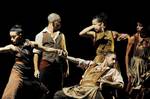
Dance review: 'Monger' at UCLA Live *

monger-uclalive.jpg

There's the world, says choreographer Barak Marshall, with all its social inequities, hard-scrabble struggles and heartless contradictions. And then there's a person's heritage - a dual one in the case of this native Angeleno whose mother is the former Yemeni star of Inbal Dance Theater and whose father hails from the Bronx.

In "Monger," the piece danced by Marshall's Israeli troupe at UCLA's Royce Hall, we find them both - societal vagaries and his own cultural heritage - framed in the dark downstairs quarters of humbled, obedient servants answering their mistress's bell.

We hear her clicking footsteps through the floor boards and a leak dripping from the interior plumbing - all of it fearsome and ominous. We hear those solemn, ting-a-ling attention calls, followed by the employer's amplified voice delivering orders. We see the listeners below gather like frightened prisoners as one of them replies to those orders and apologizes for any infraction previously committed.

But all hell breaks loose after the duties are fulfilled. No longer supplicants, these workers show their raging side; through hyperkinetic, in-your-face movement, they spill aggression in forcefully rhythmic low squats and pungently pithy gestures plotted as a convulsive step-per-beat -- all set to a raucous sound score pieced together from Middle Eastern rock and Klezmer bacchanales. At intervals it stops to embrace American pop ballads and '50s swing, and, yes, even Handel and Verdi.

Because, after all, there is a lyrical component to life, even in the worst of circumstances. For that, Marshall turns to an aptly balletic "Traviata" excerpt, in this case, the terminally tubercular Violetta sadly reciting Alfredo's love letter to her. (Remember, she is of the underclass as well, a courtesan who would bring dishonor to a "good" family, so the episode is thematically akin).

And then there's the curious sleight-of-hand image he constructs of three women clutching their babies, born in the backstairs, away from public view. Also, there's the outright comic cross-dressing vignette that brilliantly makes two seated men into three figures, one of them a woman. Interspersed are choice tidbits like commercials for Manischewitz as delivered on NPR's Yiddish Radio Project and spoken with laughably perfect English diction.

No doubt, the choreographer boasts endless sources of material that inspire him, though, possibly, he might want to limit his palette somewhat.

And while the work may not boast the nuanced stratification seen in Bob Altman's "Gosford Park" or the grim sado-masochism of Jean Genet's "The Maids" (both cited in the program notes as its basis) there's a huge inventory here of vulnerability, helplessness, and finally revolt.

Still, it's subterranean anger that has a field day in "Monger," which in the spirit of fish-sellers and war-makers, is no subtle business. Brutish, it curiously resembles an aspect of Israeli culture: argumentative, unafraid of loud debate. The national reputation is built on this stuff, as with the Israeli Philharmonic, for example, that marvelously irascible band of players.

"Monger" shows a tender nostalgia, though, as it ends. The ballad "Close Your Eyes," led us out the door, with a golden-oldie male voice poised in the air, gently floating above all that had preceded it.

[* Update: Also posted at LA Opus.]

Donna Perlmutter is an award-winning critic, journalist and author. Formerly the chief music/dance critic for the Los Angeles Herald Examiner, she contributes to the Los Angeles Times and other publications.

Photo: Gadi Dagon

Samson, Icarus and the L.A. Kings

How much does one loss cost? For the LA Kings, what has become nicknamed the "Flop on Figueroa," Tuesday's 6-5 overtime loss, is more than one game not won. It's got qualities of the epic failures portrayed in ancient literature, and it's going to stay in the collective psyche of fans of the perpetual also-ran Kings for a long time to come.

If you're interested in the hockey side of things, the question for the Kings still, four weeks after Anze Kopitar went down for the year, is what should be expected of the team without him. Ancillary to that is what it will mean for them not to take their series with San Jose.

One opinion holds that whatever the Kings accomplish without Kopitar is gravy, because the season ended the moment his ankle snapped. The other says that the team needs to go on despite the loss, and that given how they've played in the series with the Sharks thus far, they have every reason to believe that they can win without him.

That is, until the debacle of Tuesday night. And there's the rub. The team came back to within a whisker in game one, losing in overtime after a chance bounced off of Kyle Clifford's stick. In game two, the Kings walked away from the Sharks, 4-0. The same thing was happening Tuesday night until the collapse that has been talked about on every sports TV show and hockey broadcast.

So close. So close to going up 2-1 against a team that's known for softness in the playoffs but who were playing a better all-around game, a team that surely, this year, was ready to go a step or two farther than they had before. So close to knocking them off their perch.

And then the hubris set in. There's no other explanation for it.

The Kings decided they'd won the game on Tuesday night though just a period plus 44 seconds had been played. They eventually dropped the game in OT, 6-5.

It took no time for the Flop on Figueroa to be figured into Kings' history. The Miracle on Manchester and the Stunner at Staples had both gone their way. Third time was not the charm. Two out of three ain't bad, but not when you lose the third one.

The question now is how much this game matters. If the team ends up winning the series, not at all. If they lose, then there's no other way to see it: game three was a disaster which sets the Kings fans' psyche back a decade or more. Maybe, the hurt is as great as losing the Stanley Cup in 1993. OK, this is a first-round series, and there's a long way to go before the hockey starts to matter.

Think about last year's first round. Nashville lost after blowing a game late in the going to Chicago, right? You remember, right? If you're a Nashville fan you do. If you're a Chicago fan, tambien. But if you're a follower of any of the other teams that made the playoffs last year, it's unlikely that that loss is more than a faint memory. Why?

Because the first round doesn't matter. If you've been watching this game long enough, you might remember that this round used to be called the "Elimination Round," and it was best of five. It only existed to give a little false hope to the bottom dwellers, and get them off to the golf course as fast as possible.

So, in proper perspective, this game doesn't mean much. But in Kings' fans' minds, if they lose, it will be extremely damaging.

This team was built to play defense first. Their style is what Murray calls "puck management" based. That means keeping the other team to the outside. Getting hard back into the zone. Not sending two guys in deep in the other team's end, but letting one retrieve the puck while the other follows up for support. The result is that the team gave up the sixth fewest goals in the league, tied with Pittsburgh.

So why couldn't/didn't they do that with a four-goal lead Tuesday night? After the game, Murray said he had no idea. He had told the players, he said, what to do during every TV timeout. They knew, he maintained, and he didn't really have any way to explain why they hadn't complied.

But isn't that the way with heroes sometimes? Why did Icarus fly too close to the sun? Because he could. He was told not to by his dad, but hey--once he felt that breeze, it just didn't seem like a good idea to turn away from the giant glowing disk that promised so much but cost him his wings.

Why did Samson allow his hair to be cut? Again, he was told not to, by God himself. But you know, that Delilah, she had her charms. He ended up chained to a couple of pillars, blind.

Why do heroes do stupid things that end up undoing them? Because sometimes, the temptation is just too much. The result, however, is what we're after here. In the case of the two aforementioned heroes, it was death, but with a kind of nobility. Samson, at least, had the last laugh as he collapsed the building around him, taking his enemies with him.

But other heroes haven't left such a legacy. What did Oedipus get? A complex, but that only came thanks to Freud, and only a couple of thousand years later.

That, you'll recall, is the urge on the part of the boy child to kill his rival, who is the father that he sees getting in the way of the good thing he's got going with mom, and marry, well, mom.

Freud's idea that the complex is repressed as the child grows into self-recognition but still lurks somewhere in the psyche to haunt him in his later relationships (you true Freudians are welcome to write in with corrections on this pop version of the theory) might take us back to the Kings. The question--will the fans be haunted over time by this terrible mistake on the part of their hockey heroes?

Sitting in the press box Thursday night, it certainly seemed to me, as the lasers shone and the music blared to begin the game, that the fans at Staples Center had forgiven and forgotten the debacle of the other evening. They cheered, perhaps louder than they had two nights before when the bright hope of the playoffs was just beginning, at least as far as the home games were concerned.

Their team did not disappoint early on. They were outshot in period one by 13-9, but that advantage was negated by the outstanding goaltending of Jonathan Quick who, by the way, got perhaps the loudest accolades at the start of the game. He let in six goals the other night, a bad number by anyone's standards, but none were, as is sometimes said, "bad goals." On none could it be said that he was out of position. His team was just that horrible defensively in front of him that he had "no chance" (another cliché) to stop the puck.

Thursday, the second period saw the Sharks jump to a three-goal lead and the Kings almost erase it. It ended 3-2. Hope brewed in the crowd. Maybe Tuesday could be forgotten.

The third period undid that hope, with the Sharks going to 6-2 before the Kings got a goal back. That last, to make it 6-3, was merely symbolic, even as they enjoyed a two-man advantage due to San Jose taking a couple of penalties. The Kings just didn't have anything for the Sharks, and whatever hopes this city had to erase forty-plus years of hockey frustration went away as the clock ticked down.

By the time there were eight minutes left, many fans had decided they'd seen enough, heading for the exits. For all they know, that's the last they'll watch hockey live this year, unless they're planning to drive north for San Jose's next series, or southeast to see whether the Ducks can continue their winning ways versus Nashville. The Kings go to San Jose down 3-1 in their series. It would be more than a miracle if they came back to win it. It might even be surprising to see them back at Staples for a sixth game, which would happen Monday if necessary.

So the question remains: how important is, or was, the Flop on Figueroa? If things turn out well from here on, it's forgotten. Perhaps, to stay true to Freud, though, a better word might be "repressed." If things go downhill, as they appear to be doing, then that game will be remembered in the line of those two great triumphs mentioned earlier, and of the second game of the 1993 Stanley Cup finals, the McSorley stick game. (You can look that up pretty easily on google, too, if you don't remember.)

McSorley, by the way, is still around. He walked through the press entrance just after I did, and was on the TV pregame show. It's like any old ghost--they might seem like they go away for a while, but they're never really gone. Just quiet for a time.

So once again, as they have done so many times before, Kings fans head to their summer vacations having endured a season of promise and ultimately, frustration. Only this time, it wasn't just a hockey loss. It was a loss with overtones of the great prideful falls of myth. And that's going to sting for a long time. Maybe forever, because this time, except for some poor decisions in game two, things might have been different.

Brian Kennedy is the "PhD in the Press Box," an honest-to-goodness academic who spends his off hours writing about hockey and car racing.

April 22, 2011

Obit Beat: Goodbye, Mr. Luxe

Bijan Pakzad, owner of the Bijan boutique, which described itself as the"most expensive store in the world" in Beverly Hills, died last Saturday, April 16, 2011. Bijan's extravagant advertising and merchandising became synonymous with the glitzy rise of Rodeo Drive in the 70's. Mr. Pakzad brought unapologetic opulence back into style, selling everything from diamond encrusted charm bracelets for infants to $1,000 suits. Stores like Bijan and Giorgio Beverly Hills challenged the then prevalent egalitarian attitude of Los Angeles in the early 80s. Westside matrons were scandalized to learn that visitors needed an appointment to shop at Mr. Pakzad's boutique. Judith Krantz captured those heady times in her first novel, Scruples. If Bijan Pakzad hadn't existed, Judith Krantz would have had to invent him.

April 21, 2011

Angeleno Datebook-April 21, 2011

Thursday, April 21, 2011

  • Ron Dietel reads his book, The Perfect Test , at the Flintridge Bookstore & Cafe
  • MOCA Art Talk hosts "A Conversation with Kate and Laura Mulleavy, designers of RODARTE clothing line" at MOCA PACIFIC DESIGN CENTER, Silverscreen Theater at 6:30 PM.
Friday, April 22, 2011
  • Stephen Jacobs sign his biography of Boris Karloff at Larry Edmunds Bookshop in Hollywood at 7:30 PM.
  • Opening Reception for "A Place in the Sun: Picturing California" photography exhibit at the Hi-Lite Studio and Project Space, 533 South Los Angeles Street, 6th Floor, Downtown. 7 PM.

Saturday, April 23, 2011

  • Peter Lunenfeld discusses and signs The Secret War Between Downloading and Uploading: Tales of the Computer as Culture Machine at Book Soup at 5 PM.
  • Cinespia and Cinefamily co-host the premiere of Werner Herzog's new documentary,"Cave of Forgotten Dreams," and party at Natural History Museum of Los Angeles 5:00 PM.
  • Lucie Foundation's first annual benefit to support the organization's photography workshop for at-risk youth in Los Angeles. The fundraiser starts at 7 PM in the Factory Place Arts Complex, 1330 Factory Place, Los Angeles, CA, 90013
Sunday, April 24, 2011

Monday, April 25, 2011
  • Professor Patrica Moy presents a lecture on "The Popular and the Political: Exploring the Effects of Infotainment on Citizenship" at USC Annenberg School for Communication & Journalism, Rm 207 at noon.
Tuesday, April 26, 2011
  • Jim Krusoe discusses and signs his novel, Toward You, at Vroman's Bookstore, Pasadena at 7 PM.
  • Diesel, Brentwood hosts the "Family Matters" panel discussion with Jennifer Lauck, Dinah Lenney & Hope Edelman at 7 PM.

  • BritWeek launches.
  • Beverly Hills Chamber of Commerce hosts its "A New Dawn or a New Bubble?" Economic Summit at the Beverly Hilton Hotel. Starts at 11 AM.

  • Wednesday, April 27, 2011
    • Beverly Hills Education Foundation hosts its Apple Ball at the Beverly Hilton Hotel.
    • British designer Zandra Rhodes makes an appearance at Nieman Marcus Beverly Hills from 11 AM to 4 PM in the store's Couture Salon on Level Two
    Thursday, April 28, 2011

April 20, 2011

A cultural critic attends the NHL playoffs

A hundred and forty years ago, Matthew Arnold was worried. Worried that his culture was falling apart. Worried that the newly literate working class wouldn't find anything solid to occupy their minds because the poets--he names Wordsworth as an example--weren't working in a rich enough vein. Worried that people in the the newly prosperous business class weren't using their money to buy the time to improve themselves, but frittering away their excess of leisure in unhealthy pursuits.

His answer? That the critic must work to provide a more rich cultural field in which art could thrive. England could then be filled with what he called "sweetness and light," and the panic which was edging its way into his mind could be stilled.

Maybe he was looking in the wrong place. Maybe he should have looked to the NHL playoffs instead. OK, so organized hockey wasn't around until late in the 19th century, just in the aftermath of the time Arnold was writing. But had it been, he might have understood that its passion and its history fill a void left each spring with the happy moment of the lifting of the Stanley Cup.

You see, it's not that it's hockey, that violent product of the Canadian imagination. The point is not that we're talking about a sport at all. It's not the substance of the thing analyzed which matters, if one stretches Arnold to his logical conclusion. Rather, it's the way one looks at that thing. A cupcake is just a cupcake until the foodies get to it. Then it becomes a sophisticated interpretation of a familiar icon of school events (which may, even, suggesting the meaninglessness of life in a post-modern world, or something like that). And, of course, in LA, it suddenly costs six bucks.

So it is that in LA this week, fulfillment comes again for hockey fans and hangers-on who will fill Staples Center on Tuesday and Thursday evenings hoping that their Kings can upend the strong, faster, and deeper San Jose Sharks. It's been done before. Anaheim upset the Red Wings in 2003 from the eighth and last seeding spot in the West, and they eventually went to the Stanley Cup finals. Calgary was sixth seed and went to the Stanley Cup finals the next year.

The Kings entered this year's playoffs in seventh spot in the West, but they might have been as high as fourth, and it wasn't determined until the last couple of days of the season, and two losses against the Anaheim Ducks. In many ways, that doesn't matter now. Once the playoffs start, all bets are off, and it's just one team against another, with regular-season records left behind.

That's probably why there's so much excitement in the air in Hockeywood this week. Were you to drive by the arena and the public space across the street, you'd see that there's a festival going on. Maybe even a carnival, for those of you who know the Bakhtinian theory of such. People celebrate, they listen to music, they dance. Likely, some of them began imbibing way earlier in the day than they might have otherwise. It's all part of it.

Inside the arena, things are not business as usual. Rather, the place is blanketed in white as a towel sits on every seat. The purpose--so that fans may wave them in the frenzy which will take place when their team takes to the ice to play.

For some, it will be a repeat of last year, when the team played the Vancouver Canucks to six games, and lost. For others, the playoffs this year will remind them of years past, like 1993, the only time the team made it all the way to the last round. For the kids in the crowd, and maybe some adults too, the experience will be altogether new, and the purgation they feel as they wave those towels and scream their lungs out will be the release they need from the stress of spelling tests, or math quizzes, or a layoff.

But for the Arnoldians in the crowd, these games are much more. They are a tangible connection to all of the great hockey played in the past. Each time the puck drops, the team will get closer to or further away from the magic of Rocket Richard and John Beliveau lifting the Cup back in the original six era, pre-1967.

Sure, it's the West coast, and hockey's a bit of an afterthought here for most of the year. But for this week, these moments, it's all that matters to those who love it, and as they watch in person or follow on TV, their lives will take on a feeling of fulfillment that they don't normally have. Things will matter in a way that's tangible and hyper-real.

If the Kings manage to unseat the Sharks, that feeling will continue. If they don't--no, it's not cool to go there. Not now. Now in this moment of magic. Let the playoffs, at least, the part played here, begin.

Brian Kennedy wrote "Growing Up Hockey" (Folklore 2007) and "Living the Hockey Dream" (Folklore 2009), as well as a number of academic essays on topics from Henry James to Virginia Woolf. His last post for Native Intelligence was on managing fear in hockey.

April 18, 2011

"The Bad Mother" vs a Bad Mother

Most writers have someone to whom they show their works in progress. Mine is Victoria, the lady that works the cash register at the donut shop. Victoria is maybe 5-foot-nothing in the 6-inch mules I have never not seen her tottering on behind the counter. She is also always, by seven in the morning, in full make-up, her processed blond hair rippling like a mermaid's to her waist. Victoria and her husband, who makes the donuts, moved to Portland from Mexico; they have seven children and own three businesses and work seemingly all the time. Despite this, Victoria is perennially cheery and a big reader, something I learned when I used to pick up the donuts every morning for my husband's coffee business.

As wives will do, we discussed our lives. When Victoria learned I was a writer, she asked to see some things I had written. I brought her two features I wrote for the LA Weekly. When I stopped in a few days later, she took my hands and said, "I need more." I brought her more. And more. She wanted to see everything, she professed to love the way I wrote and the topics I chose. How can this not be the best things a writer can hear?

Two years ago next month, I began to write about Amanda Stott-Smith, after she dropped her two young children from a Portland bridge at 1:43 AM, killing her four-year son. Her seven-year-old daughter survived for an hour in the 45-degree water and essentially saved her own life by screaming so long and so loud that two residents along the river motored their boat into the darkness and found her. I knew almost immediately the writing would become a book, if not how long it would take to get members of the family to trust and speak with me.

Victoria, who I would see every two weeks when I paid the donut bill, and I talked about Amanda, about the children. She asked when the book would be out; I told her, not for years. She said, she could not wait that long. And so last December I gave her the book in progress, about sixty pages. When I next saw her, she said, "I need more." I promised her that more would be forthcoming.

It was not, not for lack of material, but because The Bad Mother, a novel I finished writing in March 2009 -- two months before Amanda dropped the children from the bridge -- was slated to be published. I found this out in late December; there was editing to do, and once it was published, in March, pushing the novel into the world, what a writer friend refers to as, "rolling that log." There was and is travel, and appearances, things one does not anticipate, or that I did not anticipate, that make you portage from one writing stream to another.

When the novel was released last month, I brought a copy to Victoria.

"My god," she said. "You wrote it so fast!"

I explained, as I would wind up doing with many people, that the novel was not the book about Amanda, and that while I understood why people would, from the title, imagine it to be about a mother who drops her children from a bridge in the middle of the night, it was actually about homeless kids in Hollywood. That the confusing coincidence of the titles was just that, coincidence, and that the book about Amanda is called, "To the Bridge."

Last Thursday, I stopped into the donut shop. I had not seen Victoria for a month, as I had been out of town on readings. She was interested in these, saying, "I bet when people hear you read it, it changes their opinion about what happened."

I told her, that was true. That some people read the book and are scared of what happens to these kids and the dangers they are in. But when they hear me read it, they understand I feel only tenderness for these kids. Victoria nodded.

"You are also showing that the mother is a human being," she said. "That they didn't get the whole story in the newspapers."

Victoria had another customer, and so I had about two seconds to tell her, it was the novel I was doing readings for, not "To the Bridge." She looked puzzled, as though the overlaps in the stories were causing vexation, and it put me in mind of something my mother often asks: why are you always writing about dead children?

I left the donut shop thinking about this, as well a question I receive at each reading of The Bad Mother: was the novel inspired by your experiences as a journalist in Hollywood? I answer that, while it makes sense this is the case, it is not. That the characters are made up; that I have never interviewed a homeless or dying teen; that it must be the osmosis of driving through Hollywood every day for eighteen years that created the book.

I was pressing the clicker that opens my car door when I realized the genesis of the work is quite the other way: that I began writing nonfiction books and articles about murdered children after I began addressing them as fiction. That "To the Bridge," in fact, grew from The Bad Mother.

Nancy Rommelmann reads from The Bad Mother at Book Soup on June 30.

April 16, 2011

Who can beat the Lakers?

Last year I said that there were three teams that could beat the Lakers in a seven game series - Cleveland, Orlando, and Dallas. Fortunately, the Lakers faced none of those teams and wound up winning a second-straight title.

Basketball is a game of matchups. The best team doesn't necessarily win the NBA title. Instead it's the team with the most favorable matchups in four consecutive series. So with that in mind, it's worth asking who can beat the Lakers in the playoffs this year.

The Lakers match up first with New Orleans, the Western Conference team they probably match up with best. The Lakers swept the Hornets in the regular season, and it wasn't really close. Additionally, without injured forward David West, I'm not sure if New Orleans can even win a game.

If the Lakers move on to the second round, then they would face either Dallas or Portland. While Dallas is the higher seed of the two, they really don't scare me. The Lakers beat them convincingly twice towards the end of the season when there were real stakes on the line. Without Caron Butler, the Mavericks are missing an important cog on offense and arguably their best defensive player. The Mavs lack youth and speed and they really struggled down the stretch. The Lakers should beat them in five or six games.

Many are picking Portland to upset Dallas and they do pose problems for the Lakers. For one, the Lakers never play well in Portland. But the Trail Blazers are also deep and play great team basketball, and are a tricky team to stop. Still, the Lakers have more talent, and they should win a series over the Blazers, even if it goes seven games.

If the Lakers advance to the Western Conference Finals, then they would face either San Antonio, Oklahoma City, or Denver. First off, Denver is the biggest wild card in the playoffs. After trading Carmelo Anthony for half the Knicks, the Nuggets are basically two-deep at every position. They were one of the best teams in the NBA after the trade and actually beat the Lakers at STAPLES Center when both teams were basically at full strength. Still, the playoffs usually come down to the play of superstars, and I think Denver's lack of a go-to person will hurt them. I don't even see them getting by Oklahoma City.

San Antonio doesn't particularly scare me either. Despite having the NBA's best record, the Spurs struggled down the stretch. They're still old and they're not as strong as the Lakers inside. I think teams are figuring out how to play against the Spurs' new system, and the Lakers beat them convincingly at full strength in San Antonio after the All-Star break.

That leaves Oklahoma City as the Lakers' greatest threat in the West. If the Thunder get by the Spurs (no sure thing), then they match up very well with the Lakers. They have an elite scorer in Kevin Durant, speed and athleticism at the point in Russell Westbrook, and they finally have toughness inside with Kendrick Perkins. They also have some quality role players in James Harden, Thabo Sefolosha, and Serge Ibaka. Last year, the Lakers needed a Pau Gasol tip-in to avoid a Game 7. I'd expect a Lakers-Thunder series to go seven games this year. Ultimately, I see the Lakers prevailing on their home floor, but this series could really go either way.

If the Lakers move on to the NBA Finals, then I could only see them facing one of four teams from the Eastern Conference. The least likely of them is Orlando, which is still figuring out how to play with an entirely new group around Dwight Howard. But they really don't have enough to beat the Lakers, and I'm convinced a series with the Magic wouldn't last more than five games.

I really like how the Lakers match up with the Celtics without Kendrick Perkins. Last year, the Celtics probably would have won Game 7 of the NBA Finals with a healthy Perkins (but only because Andrew Bynum was out too). Without Perkins, the Celtics lose toughness inside that an aging Shaquille O'Neal can no longer supply. And the Lakers would probably win a series in six games. Having home court advantage would be important too.

Against Chicago or Miami, the Lakers would not have home court advantage. The Heat do pose problems for the Lakers, having swept them in the regular season. I'm really not sure if the Heat can get out of the East considering the circus that has surrounded that franchise since they got "the big three." They don't look ready for prime time, and I'm not convinced that Erik Spoelstra can coach. Still, the Heat do play great defense, and the Lakers have no answer for LeBron James on either end of the floor. On the other hand, the Heat have no answer for the combination of Bynum and Gasol down low, even if Chris Bosh plays the best basketball of his life. A Lakers-Heat series would be extremely competitive, and it may come down to home court advantage. If the Heat don't beat themselves, then yes, I think they could beat the Lakers.

I'm not someone who likes to play up experience too much, but I do think it would make a difference in a Lakers-Bulls series. Also, the Lakers front court with Bynum and Gasol would outplay Chicago's duo of Carlos Boozer and Joakim Noah. Ron Artest or Lamar Odom could contain Luol Deng. And the Bulls have no way of defending Kobe Bryant. The Lakers don't really have an answer for Derrick Rose, but he may not have anyone open to pass to. I actually think the Lakers could beat the Bulls in as little as five games.

I should note, all of this is predicated on the health of Andrew Bynum. Without a healthy Bynum, the Lakers might not make it out of the second round. Also, I'm mildly concerned about Kobe Bryant expending too much energy on the defensive end, as he'll likely be asked to guard quick players at the point like Chris Paul, Russell Westbrook, or Derrick Rose. He'll need to hold up. And I think the Lakers' biggest concern may actually be their occasional lack of focus, which has become a problem even in playoff games in the past. Ultimately, the team with the best chance of beating the Lakers, may be the Lakers.

April 15, 2011

Noticing National Library Week

Have you hugged and thanked your neighborhood library employee for his or her dedication and service yet?

I've just received an email from the Library Foundation of Los Angeles informing me that National Library Week comes to an end on Saturday, April 16th.

Since library hours have been reduced following budget cuts, the libraries of the city of Los Angeles need your warm presence and support more than ever. As the late, great Miv Schaaf, a Los Angeles Times Sunday Edition columnist and public library booster, once wrote, "When life seems not worth living, ten minutes in the library proves otherwise."

Since voters approved Measure L last March, perhaps there's hope that lost services will be reinstated in July. Martín Gómez, the city librarian, told Library Journal, "Starting in July, we will add back a sixth day of service, probably a Monday, and in the second year we will add back two more evenings, and in the third year we will provide seven days of service at nine locations."

Time will tell if these predictions come to pass. In the meantime, consistently support your neighborhood library NOW with donations, bequests and the commitment to keep advocating for the financial health of our public libraries. Just because Measure L was successful does not mean that the struggle to safeguard our library system from erosion has ended. Complacency is no longer an option.

April 14, 2011

Angeleno Datebook- April 14, 2011

Thursday, April 14, 2011

  • InVenture Reception at William Turner Gallery in Santa Monica. 7 PM
  • City of Hope hosts its "Una Notte di Speranza " fashion show with Renato Balestra at Millennium Biltmore Hotel Los Angeles at 6 PM.
  • Dominque Stevenson signs his book Marshall Law: Life & Times of a Baltimore Black Panther at Eso Won Books at 7 PM.
Friday, April 15, 2011
  • Grand Prix Association of Long Beach hosts 37th Annual Toyota Grand Prix of Long Beach Opening Day at Long Beach Convention Center.
  • Mayor Antonio Villaraigosa and City Controller Wendy Greuel are slated to speak at Special Needs Network's Tool's for Transformation Conference and Legislative Breakfast at FAME Renaissance Center, 1968 West Adams Blvd., Los Angeles, CA 90018. 8 AM check-in, breakfast starts at 9 AM with a prayer, I bet.
  • LACMA hosts its 26th annual Collector's Committee Dinner and Auction.
  • Claude Lelouch will present his latest film in person at COLCOA French Film Festival at the DGA at 8:30 PM in the Renoir Theatre.

Saturday, April 16, 2011

  • The Los Angeles City Historical Society presents a lecture by Thomas S. Hines on "Architecture of the Sun: Mid-Century Los Angeles Modernism" at the Central Public Library. 2 PM
  • Barbara Eden, star of "I Dream of Jeannie", signs copies of Jeannie Out Of the Bottle at Barnes & Noble - Grove Drive. Los Angeles, CA. 2 PM
  • Japanese American National Museum hosts its 2011 Gala Dinner and Silent Auction JW Marriott at LA Live, starting at 5:30 PM.
  • Riordan Scholars hosts its Sixth Annual Riordan Wine Gala at the Beverly Hills Country Club. 5:30 PM
Sunday, April 17, 2011Monday, April 18, 2011
  • Book Soup and The Skirball Cultural Center presents Mary Steenburgen in conversation with Ted Danson regarding his new book Oceana: Our Endangered Oceans and What We Can Do to Save Them at The Skirball Cultural Center. 8:00 PM
  • Actor Tyrese Gibson signs copies of How To Get Out Of Your Own Way at Barnes & Noble - Grove Drive.7:00 PM
Tuesday, April 19, 2011
  • Admiral Thad W. Allen lectures on "Issues in Focus: Managing the Unexpected" at RAND Corporation,1776 Main Street,Santa Monica, CA at 6 PM.
  • Sam Wasson & The Granola Project share their stories at the EATING OUR WORDS event at Taylor De Cordoba gallery, 2660 S La Cienega Blvd., Los Angeles, California. 7:30 start time.
Wednesday, April 20, 2011
  • Noted artist Camille Billops will screen her films at the Hammer Museum at 7 PM in Westwood.
  • Dancer Jacques D'Amboise in conversation with Sasha Anawalt, Director, USC Annenberg Arts Journalism Program at ALOUD at Central Library in Mark Taper Auditorium at 7 PM.

If you have upcoming events, be sure to share them with Adrienne Crew at adrienne at laobserved dot com

April 13, 2011

Obit Beat: Saying goodbye to two L.A. tastemakers

This seems to be the week for saying goodbye to influencers with heavy ties to Southern California.

In addition to Sidney Harman, Newsweek's latest owner, two other Southern California legends have passed away.

Eater LA.com reports, via the Hollywood Reporter, that Giorgio Baldi, chef and owner of Il Ristorante di Giorgio Baldi in Santa Monica, passed away earlier this week, supposedly while on vacation in Mexico.

Meanwhile, teenagers and women of a certain age who used to be teen agers sighed in despair to learn that Teen Beat founder and publisher, Charles Laufer, passed away last week in Northridge.

So long, fellas.

April 11, 2011

Reclaim the metaphor

The beating of a San Francisco Giants fan last week after the Dodgers' season opener engendered much conversation about stadium security and whether Dodger fans are drunker and gangier than most, or whether it's just that so many were raised by wolves.

Bullying behavior from sports fandom's bully pulpit is nothing new. A native of Denver, I am a partisan of the Broncos, who play in the same division as the Raiders, whose fans' reputation for thuggery is unmatched in this solar system. Many years ago, when the Raiders played in Los Angeles, I was in a bar watching them on "Monday Night Football." I didn't make it to halftime, not because the game wasn't good or the beer ran out, but because I was physically threatened by people who understood neither the concept of game nor sportsmanship. Young, white, upwardly mobile, they were an out-of-control mob with which I was ashamed to share a genus.

As the Giants host the Dodgers tonight in the first of a three-game series, the brutality of last week's assault remains an open wound that invites all forms of prescriptive address.

Most opiners deplore not only the brutal behavior of a couple of parking-lot Neanderthals, but the general vulgarity of fans everywhere. Many suggest tighter controls on the sale and consumption of alcohol, and most offered suggestions for enhanced security. There were the standard-issue media-blamers, including the sticks-and-stones denier who suggested in the Daily News that sports commentators are too provocative; they should practice safe adjectives, he said, and refrain from referring to "the dreaded Giants." Uh huh, and don't forget to tip your concession server.

Then there were the singular voices, the soloists who rang out above the clamoring chorus for adult supervision, common decency and linguistic hygiene. They included the correspondent in Saturday's L.A. Times sports section who wrote that eradicating unsavory and unsafe behavior at Dodger games was a simple matter of raising ticket prices in order to "price out the losers who cause these problems. ... people who pay $100 for a ticket," he said, "don't act like common criminals."

So, you can take Eliza Doolittle to Ascot, but you can't make her elocute and--more important--you shouldn't let her. This guy thinks a sporting event is the proper domain only of the affluent, which, he implies, confers class, which, he implies, confers good manners.
Really? Consider Exhibit A: sports fan/NBA owner Mark Cuban, who, by some estimates, has been fined more than $1.6 million for criticizing referees and the league in language that will never be described as diplomatic. He has been known to boo players who once played for his team when they returned as members of the opposition roster. Cuban doesn't excuse his incivility, he just pays it forward: He told the Associated Press that he matches fine levies with charitable donations. Exhibit B: another owner-boor, L.A.'s own Donald Sterling who didn't even wait for his Clipper player to become an ex-Clipper before calling him out publicly from his courtside seat. Another affluent cretin who, instead of cleaning up his act, just pays interest on it. In March, he offered space-available Clippers tickets to underprivileged kids in honor of Black History Month. The gesture not only invited people to equate underprivileged with African American, it missed the event of record by 11 months.

Here are a couple rich guys with a whole lot of class, but all of it is low. So if you're looking to correct bad fan behavior by raising the cost of being a fan, there's something wrong with your business model. (And never mind that, in the case of the Dodgers, this approach would offer the loathsome McCourts an even greater reward for their clueless, classless, incompetent ownership of the team.)

These monied morons are offensive, but at least there's sport to be made of their sheer hubris, at least we penny-pinchers deserve our righteous sense of superiority in the character department. But for other shrill voices recently raised in unison on the topic of fan-on-fan violence, we the (average) people respond with fear and loathing. These are the exhortations of humanlike creatures who believe that what you wear is a declaration of war, the nonmetaphorical kind. Last week, a Giants fan wore his team's apparel to Dodger Stadium and paid the price of brain damage for his loyalty. L.A. Times columnist Sandy Banks reported that at the game the next day, three young adults in the stands abused a man wearing a Giants jersey with prolific profanity, including sexual slurs and references to the Holocaust. "This is why people get killed," Banks said one of them yelled. "I hope you get shot in the parking lot."

And thanks to the digital realm that turns cowards into anonymous cowards, the racist cowardly element checked in yesterday on Craigslist with suggestions for tonight's Giants-Dodgers game. One posting advocated the slaying of "a Dodger Fan, a Mexican Fan," as did another in promoting beating "to death a Mexican in Dodger gear."

A bat, a ball and mitt are the tools of people who participate in America's pastime. But a disturbing number of people who watch them come equipped with hateful hearts, criminal intent and an utter disrespect for humanity. Remember when arguments about the designated hitter concerned skilled performers on the field, not bad actors in the parking lot?

April 7, 2011

Angeleno Datebook- April 7 , 2011

Thursday, April 7, 2011

  • UCLA celebrates Czesław Miłosz's Centennial Anniversary with a screening of "Valley of the Issa" followed by a panel discussion in Room 147 Dodd Hall at UCLA. Starts with a 6 PM reception.
  • Center Dance Arts / Music Center of Los Angeles County hosts a fundraising gala, entitled "In Celebration of the Alvin Ailey American Dance Theater," 6:00 PM in Hancock Park
  • Tom Arnold emcees the Los Angeles Tree of Life Dinner for the Jewish National Fund at the Beverly Hills Hotel.6:00 PM
  • Book Soup and the Bootleg Theatre present T.C. Boyle reading and signing from his latest book, When the Killing's Done ,at the Bootleg Theatre, 2220 Beverly Blvd. Los Angeles.7 PM

Friday, April 8, 2011
  • Neutra Practice at 85 celebration starts with dinner and a movie at the Eagle Recreation Center today. April 8-10, 2011
  • Beverly Hills Fire Department hosts its annual Retirement Dinner at the Beverly Hills Hotel.

Saturday, April 9, 2011

  • Betalevel hosts the Paranoid Bike Ride: A Brief Passage Through a Few Obscure Loci around Downtown Los Angeles. 3:00 PM start.
  • Actors and Others for Animals honors Betty White at its 40th anniversary fundraiser at the Universal Hilton in Universal City at 11 AM.
  • REDCAT International Children's Film Festival airs a round-up of animation from China curated by acclaimed animator, teacher and artist Joe Chang. Noon.
  • Enjoy A Taste of Dance with members of the Alvin Ailey® American Dance Theater in the Music Center Plaza. 11 AM to 4:30 PM
  • LA Plaza de Cultura y Artes honors Supervisor Gloria Molina at its inaugural Gala. 501 North Main Street, Downtown Los Angeles.
  • GOOD L.A. hosts a pop up community center in Atwater Village.
  • American Red Cross honors Betty White and Josh Duhamel at its Red Tie Affair Gala at the Fairmont Miramar Hotel & Bungalows in Santa Monica.
  • John Wayne Cancer Institute honors Alana Stewart at its 26th Annual Odyssey Ball at the Beverly Hilton Hotel.
  • Junior League of Pasadena holds its third Annual Chocolate Chip Ball in Pasadena.
  • Theodore Payne Foundation for Wildflowers and Native Plants hosts its eighth Annual Native Plant Garden Tour at various stops around West Hollywood. 10:00 AM start.

Sunday, April 10, 2011
  • Don Stadtner signs his book, Sacred Sites of Burma, at the Pacific Asia Museum in Pasadena. 2 PM. Reservations suggested.
  • CicLAvia blossoms once again throughout the Los Angeles area.
  • Academy of Magical Arts / Magic Castle hosts the 43rd Annual Awards at Avalon Hollywood. 5:00 PM

Monday, April 11, 2011
  • Writers Bloc presents an evening with Girl Detectives:Jacqueline Winspear and Cara Black in conversation with David Kipen at the MGM Building, 10250 Constellation Blvd., Century City. 7:30 PM
  • ColCoa Film Festival Opening Day: A Week of French Film Premieres (continues through April 18).

Tuesday, April 12, 2011
  • Joseph Lelyveld explains "Who Was the Real Gandhi?" for Zocalo at the Hammer Museum. 7 PM
  • Over at Hollywood's Space 15TWENTY, MOPLA presents Pro'jekt LA Part Two: Pacific Resonance, a night of projected photography by seven Los Angeles photographers accompanied by an original cello composition. 7-10 PM RSVP to ProjektLA2@monthofphotography.com
  • TEDxUSC in Bovard Auditorium at USC.
  • Phoenix Houses of California honors founder Mitchell S. Rosenthal and filmmaker Chris Weitz at its eighth annual Triumph for Teens Awards Gala at the Four Seasons Hotel Los Angeles in Beverly Hills.
  • The Colleagues / Children's Institute honor Nancy Reagan at its 23rd Annual Spring Luncheon, featuring an Oscar de la Renta fashion show, at the Beverly Wilshire Hotel. 11:00 AM
  • Indian Film Festival of Los Angeles opens at the Arclight and continues through April 17th.

Wednesday, April 13, 2011
  • Anthony Blasko signs his photo book The Way Things Are Vol 1 at Leadapron, 8445 Melrose Place, Los Angeles. 7 PM.
  • Opening reception for Judith Supine's "Ladyboy" exhibition at New Image Art Gallery, 7908 Santa Monica Blvd. West Hollywood. 7-10 PM
  • Jewish Federation hosts its Women's Lion of Judah Luncheon at the Beverly Hilton Hotel.

If you have upcoming events, be sure to share them with Adrienne Crew at adrienne at laobserved dot com

April 4, 2011

Addressing Dodger Stadium violence

The recent violent incident at Dodger Stadium has been getting quite a bit of attention lately, as Kevin Roderick notes. In the past season or two, a handful of people have told me that they don't think it's safe to go to games, a concern that I had never heard before.

I believe that these concerns are somewhat overblown. Maybe I'm naïve, but I've never felt unsafe at Dodger Stadium. I attend roughly 10 games a year, many of them in the cheap seats, and I've always found the atmosphere to be warm, enjoyable, and friendly. Occasionally, there are some annoying knuckleheads around me, but never more than I've seen at other stadiums.

Dodger Stadium isn't the only LA-area sports venue that's had a violent incident in recent years. There were two extremely violent incidents that took place at Angel Stadium in 2009. Last December, there was a brawl in the Rose Bowl parking lot before the USC-UCLA game, which resulted in two stabbings.

So is this an LA problem? Or is this a larger problem in sports?

I believe it's the latter. With the amount of alcohol consumed at sporting events these days, I'm honestly surprised there aren't more incidents. NFL and college football games have parking lots that are littered with tailgaters and arrests are not uncommon on football gamedays.

Still, that doesn't mean we should merely accept that the occasional incident will happen at a sporting event. If I were the Dodgers, then I would make a few clear and tangible changes to promote a safer atmosphere on gamedays.

First off, Thursday night's incident was not the first to have taken place in the Dodger Stadium parking lots. The Dodgers have a large number of security personnel inside the stadium, but outside the stadium, there's often no one to be found. They should look to increase the number of security officers in the parking lots, and even consider moving some people from inside the stadium to the outside once a game ends. There should also be more security cameras so they could identify people like the individuals who were responsible for Thursday's beating. Also, some areas in the parking lots are not well-lit, and I think a few more lighting towers would help.

Additionally, the Dodger Stadium parking lots are enormous, and sometimes it's extremely difficult to find your car. This is particularly true in Lots 3 and 4 near the Golden State Gate, but it's also not easy in Lots 1 and 2 near the Sunset Gate (here's a map of the Dodger Stadium parking lots). Row markers in the parking lots would go a long way. Visitors would be able to write down the row in which they parked, and then proceed much more quickly to their vehicle when leaving the stadium. Having two giant baseballs in Lot 3 that says "3" doesn't help that much. There are a few times when I've spent as long as 15-20 minutes looking for my car near the Golden State Gate, and it feels like an eternity. It would make an enormous difference if I knew I was parked in say, "Row 32G" for instance.

As for issues inside the stadium, I'm surprised that the Dodgers don't have fans go through metal detectors. They do check bags, but they don't have the metal detectors that you see at STAPLES Center, Home Depot Center, and other venues. I don't like walking through them, but since fans are legitimately expressing concerns about safety, then it's a step that the Dodgers should probably take.

Finally, the Dodgers do have a hotline where fans can call or text ballpark security if there is an unruly fan seated in their general area. I haven't been to a Dodger game this season yet, but I've been told that a sign with that number is now permanent. If so, then that's an excellent step for the team to take. In the past, they've flashed the number of the videoboard a few times, but it's certainly easy to miss. I'd also consider putting a flyer or card of some sort with the number inside the game program that one gets when they drive into the ballpark.

I believe that the perception of a problem is much greater than the actual problem at Dodger Stadium. A large reason for that is the negative image of the McCourts. I don't believe Dodger Stadium is any less safe than any other baseball stadium. But the Dodgers cannot ignore that an incident took place in the parking lot on Opening Night this year and at the Home Opener in 2009. There are some things the Dodgers can do to improve the atmosphere, and making those improvements can only help change the perception and reduce the likelihood of another problem.

Recently posted at LA Observed
Media
 
Politics
LA Biz
 
Arts, Books & Food
LA Living
 
Sports
 
© 2003-2011   •  About LA Observed  •  Email the editor
Follow LAO
Kevin Roderick blog
12:13 PM Wed | In order to become the first woman mayor of Los Angeles, analysts believed that Controller Wendy Greuel needed to win a majority of female voters and pick up both her home turf in the Valley and, as the somewhat less liberal of the two candidates, win the niche of Republicans who vote in LA. Kevin James' endorsement was crucial in the end.
Mark Lacter, LA Biz Observed
10:08 AM Wed | Well, it's the budget, of course, which is still $100 million or so in the red because the city has to keep paying out those out-sized pension and health care benefits.

Enter your email address:

Delivered by FeedBurner


Get RSS Feeds
of LA Observed
LA Observed publishes several Real Simple Syndication feeds for easy scanning of headlines. If you wish to subscribe to a feed, most popular RSS readers will do it for you. You can also enter the web address from the XML button below or click on a specific feed. For more help with RSS, try here or here.


Add to Google